
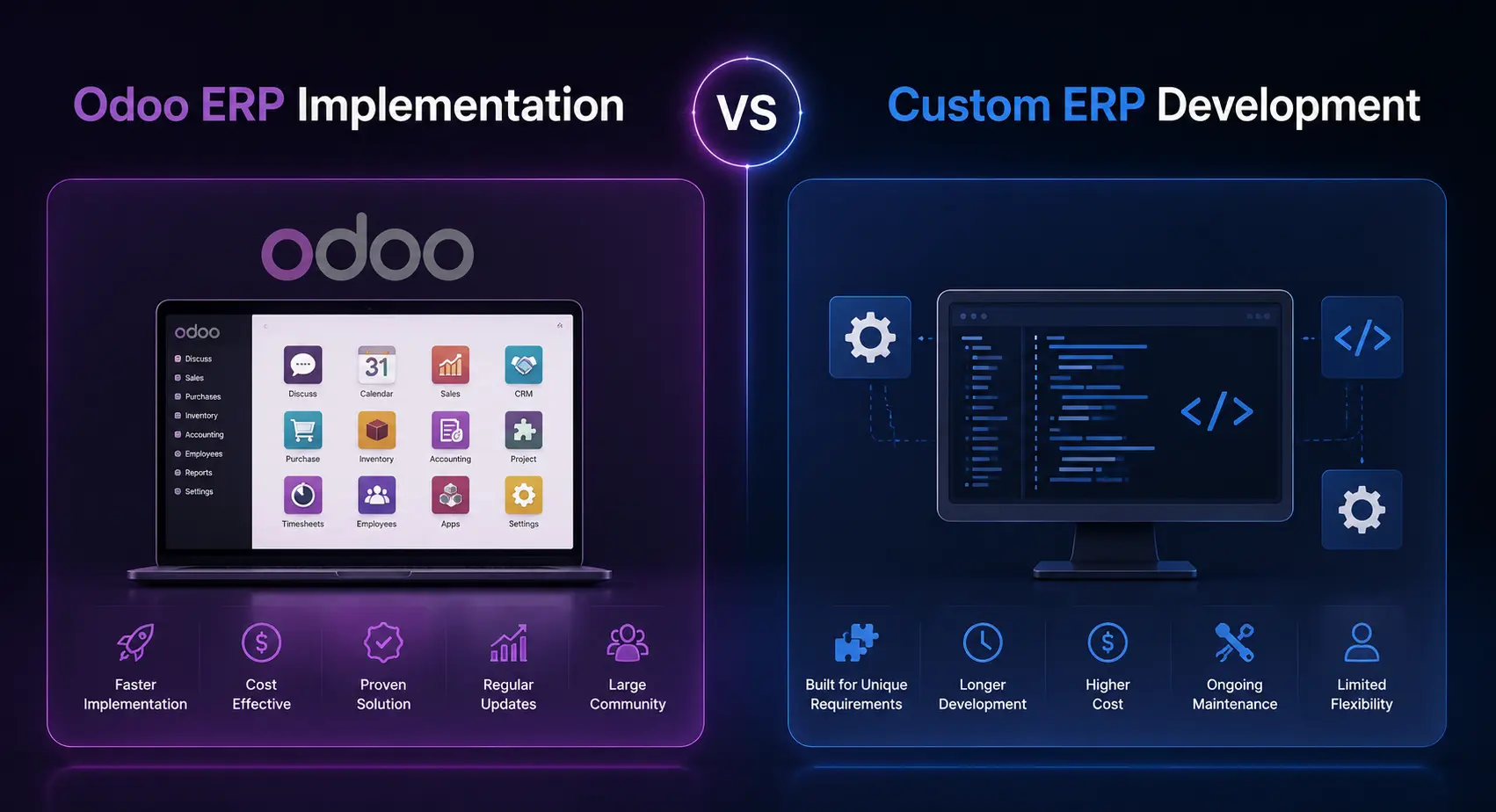
Odoo ERP Implementation vs Custom ERP Development
As businesses grow, managing operations with disconnected software, spreadsheets, and manual processes becomes increasingly challenging. Data is often scattered across multiple systems, departments struggle to collaborate efficiently, and decision-making slows due to inconsistent information. To overcome these challenges, many organizations invest in an Enterprise Resource Planning (ERP) solution that centralizes business operations, improves productivity, and supports long-term growth.
One of the most important decisions during this journey is choosing between Odoo ERP implementation and custom ERP development. While both approaches aim to streamline operations and improve business efficiency, they differ significantly in implementation time, investment, customization, scalability, maintenance, and long-term value.
Odoo ERP is a comprehensive business management platform that offers integrated applications for sales, CRM, accounting, inventory, manufacturing, purchasing, human resources, project management, and more. Instead of developing an ERP system from scratch, businesses can implement proven modules and customize them to match their operational requirements.
Custom ERP development, by comparison, involves designing and building a unique ERP system tailored to a company’s specific business processes. Although this provides complete flexibility, it generally requires a larger investment, a longer development timeline, and continuous maintenance throughout the software lifecycle.
Choosing the right ERP approach is not only about software functionality. It requires evaluating your organization’s operational complexity, available budget, implementation timeline, future growth plans, and long-term maintenance requirements.
We compare Odoo ERP implementation and custom ERP development to help you understand their key differences and determine which solution best supports your business objectives.
Understanding Odoo ERP Implementation
Partnering with an experienced Odoo ERP implementation company helps organizations reduce deployment risks, accelerate implementation, and ensure the ERP solution aligns with business goals.
Odoo ERP implementation is the process of planning, configuring, customizing, integrating, and deploying the Odoo platform according to an organization’s operational requirements. Instead of creating an ERP system from the ground up, businesses take advantage of Odoo’s modular architecture, allowing them to implement only the applications they need today while expanding the system as their business grows.
A successful implementation follows a structured methodology that minimizes operational disruption, improves user adoption, and increases the likelihood of long-term success.
Typical Odoo ERP Implementation Process
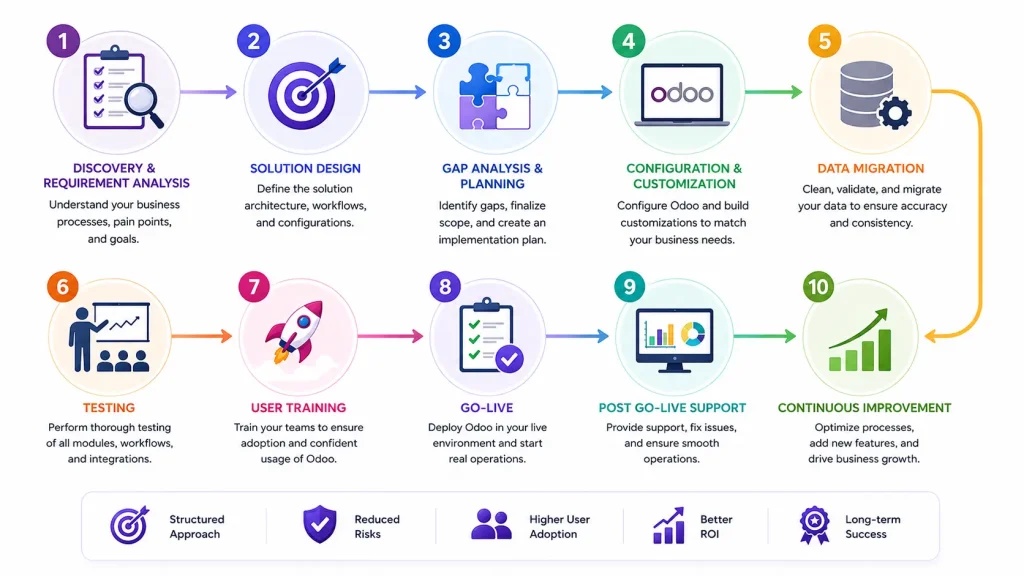
- Business Requirement Analysis
- Solution Planning
- Module Configuration
- Customization
- Third-Party Integration
- Data Migration
- Testing and User Acceptance
- Go-Live and Ongoing Support
Business Requirement Analysis
Every successful ERP implementation begins with understanding existing business processes. Implementation consultants analyze workflows, identify operational challenges, define business objectives, and recommend the most suitable Odoo applications for your organization.
Solution Planning
After gathering business requirements, an implementation roadmap is created. This includes module selection, implementation phases, customization requirements, integration planning, project milestones, resource allocation, and deployment timelines.
Module Configuration
Odoo provides a wide range of integrated business applications, including:
- CRM
- Sales
- Inventory
- Purchase
- Accounting
- Manufacturing
- Human Resources
- Project Management
- Helpdesk
- Website
- eCommerce
Each module is configured to match your organization’s workflows, approval processes, reporting requirements, and operational policies.
Customization
Although Odoo provides extensive functionality out of the box, many organizations require additional features tailored to their unique business processes. Professional customization ensures the ERP system aligns with operational requirements while maintaining scalability and upgrade compatibility.
Common customizations include:
- Approval workflows
- Custom dashboards
- Automated reports
- Industry-specific forms
- User roles and permissions
- Workflow automation
- Business-specific reports
Third-Party Integration
Most organizations rely on multiple software solutions. Odoo can integrate with payment gateways, accounting systems, shipping providers, marketplaces, CRM platforms, barcode systems, biometric devices, eCommerce websites, and various third-party applications, creating a connected business ecosystem.
Data Migration
Accurate data migration is one of the most critical phases of ERP implementation. Customer records, supplier information, financial data, inventory, employee records, and historical transactions must be transferred securely while maintaining data integrity.
Testing and User Acceptance
Before deployment, the implementation team performs functional testing, workflow validation, integration testing, and user acceptance testing to verify that every business process operates as expected.
Go-Live and Ongoing Support
After successful testing, the ERP system is deployed into the production environment. Ongoing support includes user training, performance monitoring, issue resolution, system optimization, security updates, and continuous improvements to ensure long-term business success.
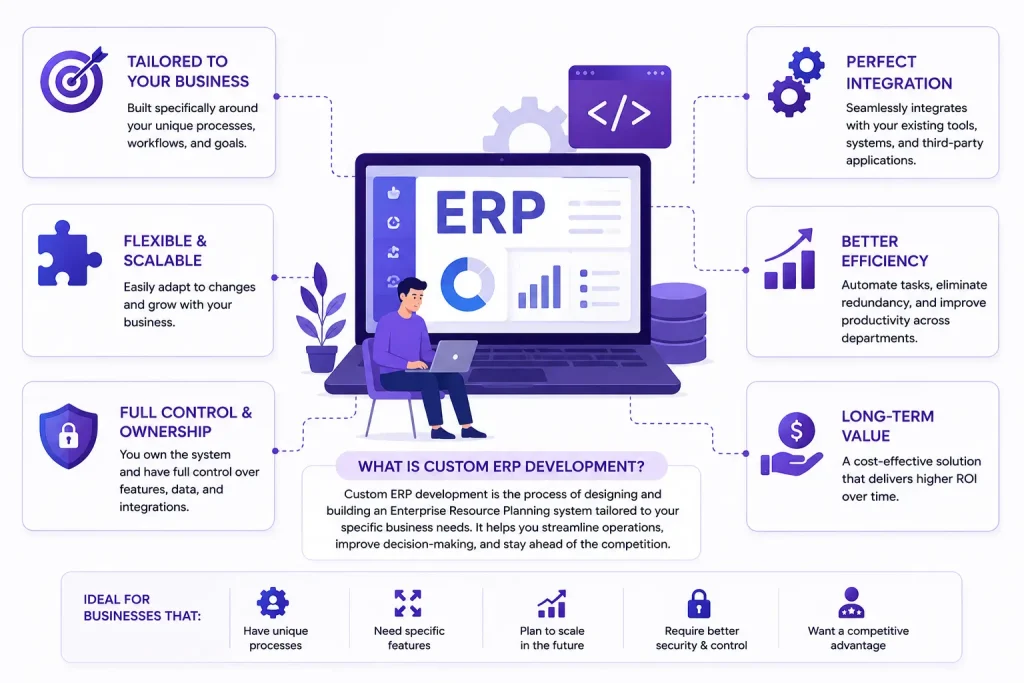
What Is Custom ERP Development?
Custom ERP development involves designing and building an ERP solution entirely from scratch to meet the unique operational requirements of an organization. Unlike implementing an established ERP platform, every module, workflow, database structure, business rule, and user interface is developed specifically for the business.
This approach offers complete flexibility because every feature is tailored to organizational requirements. However, it also demands significant investment in planning, software architecture, development, testing, deployment, infrastructure, security, and ongoing maintenance.
- Business process analysis
- System architecture design
- Database design
- UI/UX development
- Backend application development
- API development
- Security implementation
- Quality assurance testing
- Production deployment
- Continuous maintenance and future enhancements
Although custom ERP systems can provide highly specialized functionality, organizations must also manage software updates, security improvements, infrastructure costs, performance optimization, and future feature development.
For many businesses, these ongoing responsibilities increase the total cost of ownership compared to implementing an established ERP platform like Odoo.
Odoo ERP Implementation vs Custom ERP Development
| Feature | Odoo ERP Implementation | Custom ERP Development |
| Implementation Time | Typically, 2–6 months, depending on project scope | Usually 8–24 months based on complexity |
| Initial Investment | Lower implementation cost with predictable pricing | Higher development cost due to custom engineering |
| Customization | Extensive customization through modules and custom development | Unlimited customization built entirely from scratch |
| Scalability | Easily scales by adding new modules and users | Scalability depends on the system architecture and future development |
| Deployment Speed | Faster because core functionality is already available | Slower since every feature must be designed, developed, and tested |
| Business Applications | Includes CRM, Sales, Accounting, Inventory, HR, Manufacturing, Purchase, Website, and more | Every module must be developed individually |
| Third-Party Integrations | Supports integration with payment gateways, shipping providers, eCommerce platforms, APIs, and external software | Integrations require custom development and testing |
| Maintenance | Managed through regular updates and support | Ongoing maintenance depends on the development team |
| Security Updates | Regular updates from the Odoo ecosystem with implementation partner support | Security improvements must be developed and maintained internally |
| Future Upgrades | Version upgrades are available with proper migration planning | Upgrades require additional development effort and testing |
| Reporting & Analytics | Built-in dashboards and customizable reports | Reports must be designed and developed based on requirements |
| Mobile Accessibility | Supports web and mobile access with responsive interfaces | Mobile applications require separate development if needed |
| Training | Extensive documentation and user-friendly interface simplify onboarding | Training depends on the custom system design |
| Technical Support | Available through implementation partners and support providers | Relies on the in-house or outsourced development team |
| Best Suited For | Small, medium, and large businesses seeking a scalable ERP solution | Organizations with highly specialized workflows that cannot be addressed by existing ERP platforms |
Which Solution Is Right for Your Business?
Which Solution Is Right for Your Business?
The right ERP approach depends on your organization’s operational requirements, available budget, implementation timeline, and long-term growth strategy.
Choose Odoo ERP Implementation if your business needs:
- Faster implementation with lower deployment risks.
- A cost-effective ERP solution with predictable investment.
- Proven business applications that can be configured quickly.
- Flexibility to scale by adding modules as the business grows.
- Regular updates, ongoing support, and a mature ERP ecosystem.
Choose Custom ERP Development if your business requires:
- Highly specialized workflows that cannot be supported by existing ERP platforms.
- Complete control over application architecture and source code.
- Unique business processes that require entirely custom functionality.
- Dedicated development resources for long-term maintenance and enhancements.
Conclusion
Both Odoo ERP implementation and custom ERP development can improve operational efficiency and streamline business processes. The right choice ultimately depends on your organization’s business objectives, operational complexity, available budget, and long-term technology strategy.
For most growing businesses, Odoo ERP implementation offers a faster, more cost-effective, and scalable solution. Its modular architecture, extensive business applications, customization capabilities, and strong ecosystem enable organizations to modernize operations without the time and expense of building an ERP system from scratch.
Working with an experienced Odoo ERP implementation company ensures your ERP solution is properly planned, customized, integrated, and optimized to support long-term business growth while reducing implementation risks and maximizing return on investment.

