
Odoo ERP Secure? Hosting Security Risks Every Business Should Know
For many organizations, Odoo ERP has become the central platform for managing business operations. Sales, accounting, inventory, procurement, manufacturing, customer relationships, and employee information are all stored within a single system. As businesses become increasingly dependent on Odoo, protecting the ERP environment is no longer optional it is a business necessity.
For many organizations, Odoo ERP has become the central platform for managing business operations. The reliability, performance, and security of this environment depend heavily on the underlying Odoo hosting infrastructure. As businesses become increasingly dependent on Odoo, protecting the ERP environment is no longer optional—it is a business necessity.
While companies often invest significant time and resources into implementing Odoo modules and customizing workflows, the security of the hosting infrastructure is frequently overlooked. Unfortunately, even the most advanced ERP implementation can be compromised if the underlying hosting environment lacks proper security controls.
Cyber threats, unauthorized access, ransomware attacks, data loss, and service interruptions continue to affect businesses across industries. In many cases, these incidents are not caused by the ERP application itself but by weaknesses in server management, infrastructure security, backup strategies, and monitoring processes.
This is where choosing the right Odoo Hosting Provider becomes critical. A professionally managed hosting environment helps protect business data, improve operational reliability, and reduce the risk of costly security incidents.
Why ERP Security Depends on More Than Just Software
Many business owners assume that installing Odoo and creating user accounts is enough to secure their ERP system. However, ERP security extends far beyond application settings.
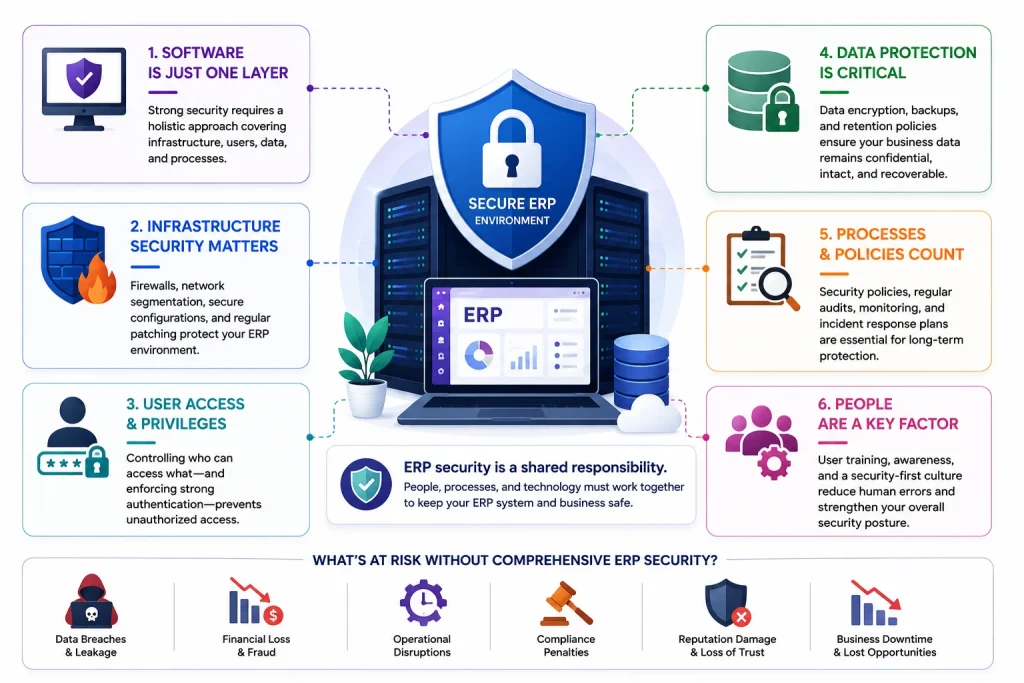
A secure Odoo environment consists of multiple layers:
- Server infrastructure security
- Network protection
- User authentication controls
- Data encryption
- Backup management
- System monitoring
- Vulnerability management
- Disaster recovery planning
If any one of these layers is neglected, the entire ERP environment can become vulnerable.
For example, a company may implement strong user permissions within Odoo, but if the server itself is poorly secured, attackers may still gain access through infrastructure vulnerabilities.
This is why experienced organizations prioritize both application security and hosting security when managing ERP systems.
Security Risk #1: Poorly Secured Server Infrastructure
The server hosting your Odoo ERP system serves as the foundation of your business operations. If the infrastructure is not properly configured, it can expose critical business data to unauthorized access.
Common infrastructure risks include:
- Open and unnecessary network ports
- Weak firewall configurations
- Insecure SSH access
- Outdated operating systems
- Improper server permissions
- Lack of intrusion prevention mechanisms
Cybercriminals often scan the internet for vulnerable servers. Once identified, these weaknesses can be exploited to gain unauthorized access or disrupt business operations.
A reliable Odoo Hosting Provider typically implements server hardening practices, firewall policies, secure access controls, and continuous security maintenance to minimize infrastructure-related risks.
Security Risk #2: Lack of Data Encryption
Every day, sensitive information flows through an ERP system. Customer records, quotations, invoices, supplier contracts, payroll information, and financial transactions are constantly exchanged between users and servers.
Without proper encryption, this data may become vulnerable during transmission.
Potential consequences include:
- Credential theft
- Data interception
- Unauthorized access
- Information disclosure
Secure Odoo environments should use HTTPS encryption across all user interactions. SSL certificates help protect data while it travels between users and the ERP platform.
Encryption not only improves security but also strengthens customer trust and supports compliance requirements in many industries.
Security Risk #3: Inadequate Backup and Recovery Planning
Many businesses underestimate the importance of backup management until data loss occurs.
A variety of situations can result in data loss:
- Hardware failure
- Database corruption
- Human error
- Software issues
- Malware attacks
- Ransomware incidents
Without reliable backups, organizations may lose critical operational information and face extended downtime.
A professional Odoo Hosting Provider should offer:
- Automated backup scheduling
- Secure backup storage
- Multiple recovery points
- Backup verification
- Disaster recovery procedures
Regular backup testing is equally important because a backup that cannot be restored provides little value during an emergency.
Security Risk #4: Weak Access Control Policies
User access management plays a significant role in ERP security.
Many organizations continue to use weak password policies, shared accounts, and excessive user permissions. These practices increase the likelihood of both internal and external security incidents.
Effective access management should include:
- Role-based permissions
- Strong password requirements
- Multi-factor authentication
- User activity tracking
- Regular access reviews
Businesses should follow the principle of least privilege, ensuring employees have access only to the information required for their specific responsibilities.
Security Risk #5: Unmonitored System Activity
Security incidents rarely happen without warning signs.
Failed login attempts, unusual server activity, sudden traffic spikes, and abnormal database behaviour often indicate emerging problems.
Without monitoring tools, businesses may not detect issues until service disruptions occur.
Continuous monitoring helps organizations:
- Detect threats early
- Improve server performance
- Prevent downtime
- Identify suspicious behaviour
- Support proactive maintenance
Modern Odoo hosting environments typically include real-time monitoring systems that provide visibility into infrastructure health and application performance.
Security Risk #6: Delayed Security Updates
Software vulnerabilities are continuously discovered across operating systems, databases, frameworks, and applications.
When updates are delayed, attackers may exploit known weaknesses before businesses apply necessary security patches.
Critical components requiring ongoing maintenance include:
- Linux operating systems
- PostgreSQL databases
- Odoo applications
- Third-party integrations
- Security software
An experienced Odoo Hosting Provider manages update schedules, security patches, and infrastructure maintenance while minimizing operational disruption.
Security Risk #7: Generic Hosting Environments
Not all hosting platforms are designed for ERP workloads.
Generic hosting solutions often prioritize affordability over performance, reliability, and security. As a result, businesses may encounter limitations that affect both operational efficiency and system protection.
Challenges commonly include:
- Resource bottlenecks
- Limited monitoring
- Inadequate backup systems
- Reduced security controls
- Poor scalability
ERP systems require infrastructure that can support growing databases, multiple users, custom modules, and business-critical processes.
Choosing a hosting environment specifically optimized for Odoo helps ensure better performance, reliability, and security.
How the Right Odoo Hosting Provider Improves Security
A specialized Odoo hosting environment delivers more than server space.
- Automated backups
- Continuous monitoring
- Infrastructure hardening
- Performance optimization
- Disaster recovery planning
- Security patch management
- Secure remote access
- Scalability for future growth
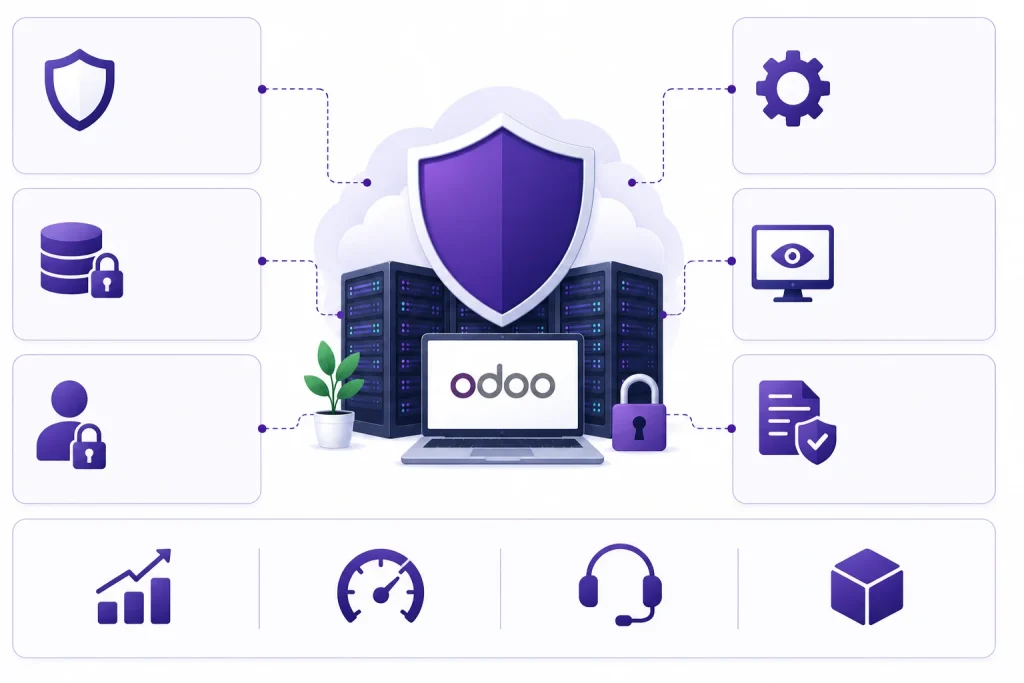
These capabilities help reduce operational risk while allowing internal teams to focus on business objectives rather than server administration.
Conclusion
ERP security is no longer just an IT concern it is a business continuity requirement. As organizations rely more heavily on Odoo to manage critical operations, securing the hosting environment becomes essential.
Many security incidents originate from infrastructure weaknesses rather than the ERP application itself. Poor server configurations, inadequate backups, weak access controls, delayed updates, and insufficient monitoring can all expose businesses to unnecessary risks.
Choosing a trusted Odoo Hosting Provider helps address these challenges by providing a secure, monitored, and professionally managed environment for Odoo ERP.
Investing in secure hosting today can help protect your data, reduce downtime, improve operational resilience, and support long-term business growth.

