
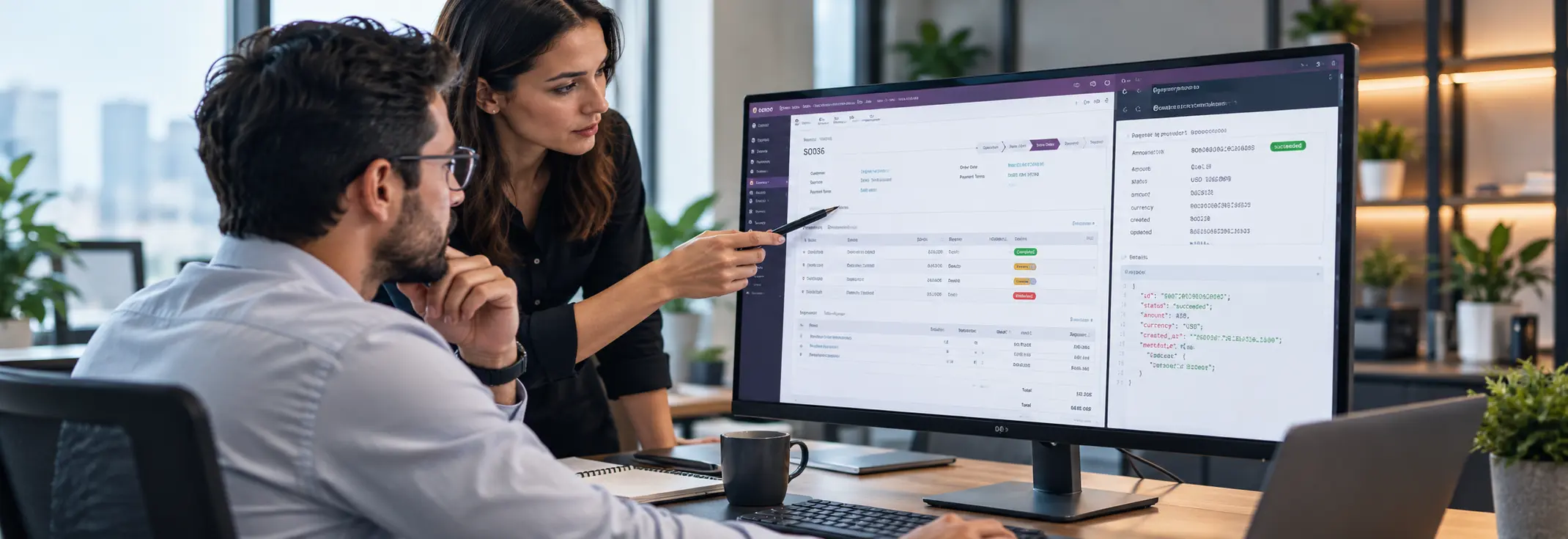
A payment gateway integration is not complete just because a transaction succeeds. Odoo must handle the resulting transaction status correctly, preserve payment references, and trigger the required business workflow. If your existing provider or connector cannot support these operations, you may need an Odoo developer to extend the integration or build a compatible payment module.
Custom development is not always necessary. The first step is to identify what your current Odoo payment setup cannot handle, verify the provider’s API capabilities, and define the missing functionality.
This guide explains when custom development is justified, which technical requirements matter, and how to evaluate an Odoo payment integration before commissioning the work.
When Does Your Business Need an Odoo Developer for Payment Gateway Integration?
Custom development is necessary when Odoo’s existing configuration or compatible payment connectors cannot meet your payment requirements.
Your Required Payment Gateway Is Not Supported
Check whether the provider offers a compatible Odoo connector, whether an existing third-party module meets your requirements, and whether the provider’s API supports the required transaction operations. If no suitable solution exists, a developer can assess custom integration.
Your Existing Connector Lacks Required Features
Your connector may not support required refunds, transaction metadata, payment status updates, or external system integration. Identify the missing functionality before commissioning modifications.
Payment Status Must Trigger Business Operations
If payment confirmation must trigger order processing or fulfilment, Odoo must handle transaction states correctly. Authorization, capture, failure, cancellation, and refunds represent different states that must be mapped to the provider’s supported workflow.
Your Payment Flow Requires Custom Processing
Deposits, partial payments, recurring transactions, and separate authorization and capture steps may require additional development. First verify that the payment provider and your Odoo version support the required operations.
Can You Integrate a Payment Gateway With Odoo Without Custom Development?
Yes. A supported payment provider or compatible connector may meet your requirements without custom development.
| Requirement | First action |
| Activate a supported provider | Configure it in Odoo. |
| Set up API credentials | Follow the provider’s integration requirements. |
| Restrict payment methods by country or currency | Check provider availability and configuration. |
| Enable supported refunds | Verify provider and connector capabilities. |
| Connect an unsupported provider | Check for a compatible connector and suitable API. |
| Add missing transaction functionality | Assess whether custom development is necessary. |
| Implement business-specific payment logic | Define the workflow and identify functionality gaps. |
Custom development is justified only when standard configuration and compatible connectors cannot meet a confirmed business requirement.
What Technical Work Does Odoo Payment Gateway Integration Involve?
Custom payment integration requires API communication, transaction-state handling, secure notifications, duplicate prevention, and correct updates to Odoo records.
Payment Provider API Integration
The developer must implement the provider’s API according to its supported version and authentication requirements. This includes payment requests, response processing, error handling, timeouts, and transaction references.
API credentials must be stored securely, excluded from source code and logs, and accessible only to authorized processes.
Payment Status and Transaction Processing
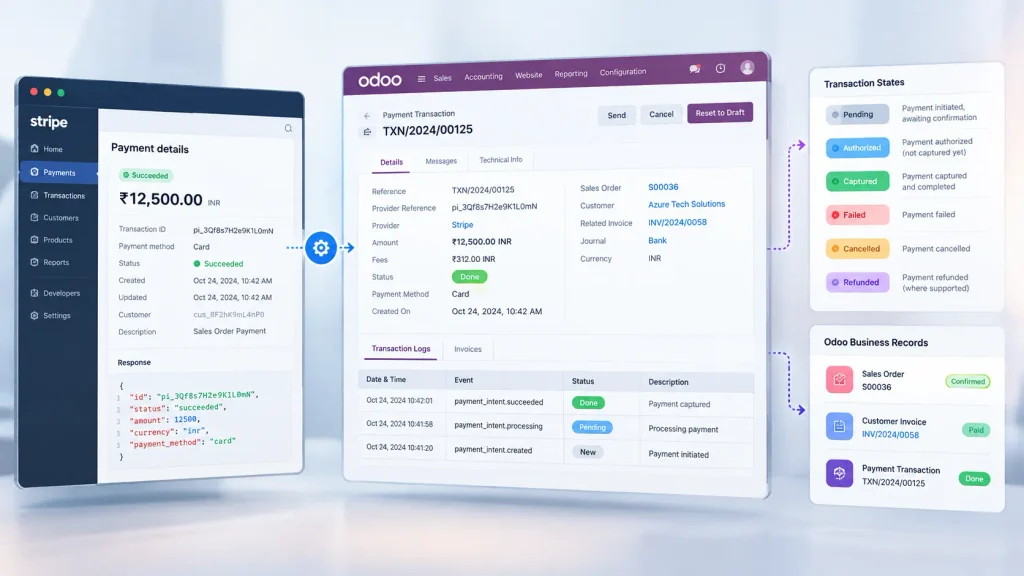
The integration must map provider responses to the appropriate Odoo transaction states, including pending, authorized, captured, failed, cancelled, and refunded transactions where supported.
It must also handle delayed or out-of-order updates without incorrectly overwriting a valid transaction state.
Webhooks and Duplicate Prevention
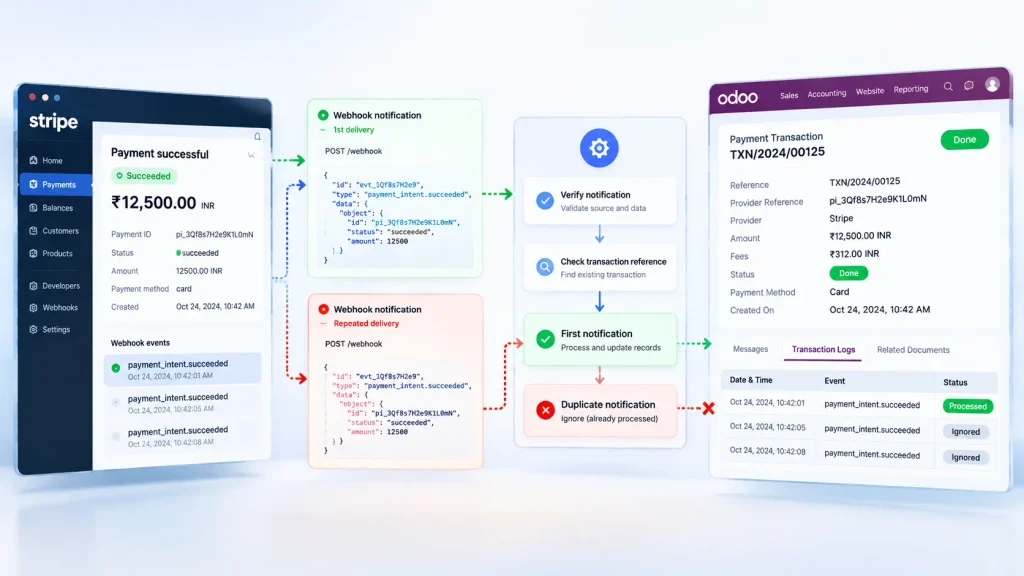
Provider notifications can confirm transaction changes even when customers do not return to Odoo after payment. The integration must verify notification authenticity and validate relevant transaction details rather than rely solely on browser redirects.
Repeated notifications and API retries must not trigger duplicate business operations. Where supported, use the provider’s verification and idempotency mechanisms, alongside appropriate Odoo-side checks.
Odoo Accounting and Order Workflows
Payment transactions must remain correctly associated with the relevant customer, sales order or invoice, and provider reference.
The developer must define how confirmed payments, failures, and refunds affect order processing and payment records. Accounting entries and reconciliation must follow the existing Odoo accounting configuration; a successful gateway response alone does not guarantee completed reconciliation.
What Should You Define Before Hiring an Odoo Payment Integration Developer?
Define the payment workflow before requesting a development proposal. This helps the developer identify the actual requirements and avoid unnecessary customisation.
Prepare these details before hiring:
- Odoo environment: Version, hosting arrangement, and relevant installed modules.
- Payment provider: Provider name, account availability, and API documentation.
- Business workflow: Whether payments support eCommerce checkout, customer portal payments, invoices, or subscriptions.
- Payment methods: Required cards, bank methods, wallets, or other payment options.
- Transaction operations: Payment, authorization, capture, cancellation, and refund requirements.
- Status handling: Expected behaviour for successful, failed, pending, and delayed payments.
- Accounting requirements: Payment references, transaction records, and reconciliation workflow.
- Security: Credential management, notification verification, and access restrictions.
- Testing and deployment: Acceptance criteria, release process, rollback plan, and maintenance responsibilities.
Use these requirements to determine whether standard configuration, an existing connector, or custom development is the appropriate solution.
What Can Go Wrong During Custom Payment Gateway Integration?
A payment integration can work during normal transactions yet fail when notifications are repeated, responses are delayed, or refunds do not complete as expected. These failures can affect order processing, transaction records, and payment reconciliation.
Incorrect Payment Status Updates
An accepted payment request does not necessarily mean the transaction is complete. If Odoo triggers order processing before the required payment confirmation, business workflows may proceed prematurely.
The integration must distinguish between request acceptance and the provider’s confirmed transaction state.
Duplicate Notifications and Processing
Payment providers may resend notifications when acknowledgements are delayed or missing. Without duplicate-processing safeguards, repeated notifications can trigger the same business operation more than once.
The integration must handle repeated notifications safely and validate the transaction before updating Odoo records.
Incomplete Refund Handling
A refund request may remain pending or fail. Marking it as completed without appropriate provider confirmation can create discrepancies between payment records and the actual refund status.
The integration must preserve the relationship between the original payment and its refund transaction.
Currency, Amount, and Reference Mismatches
Differences in transaction amounts, currencies, or payment references can prevent reliable matching between the provider and Odoo.
Validate the relevant transaction values and preserve consistent references throughout the payment lifecycle.
Insufficient Error Logging
Logs that record only a generic payment failure may not provide enough information to diagnose the problem.
Diagnostic records should capture relevant transaction references, status changes, error categories, and timestamps without exposing credentials, card details, or other sensitive payment information.
Odoo Version and Dependency Conflicts
Custom payment modules may depend on Odoo APIs, installed modules, and provider-specific behaviour. Changes to these dependencies can affect compatibility after an upgrade.
The developer should document dependencies and define how the integration will be tested and maintained when Odoo or the provider’s API changes.
How Should You Evaluate an Odoo Payment Gateway Developer?
General Python experience alone does not establish whether a developer can build a reliable Odoo payment integration. Evaluate their experience with Odoo’s payment framework, the provider’s API, transaction security, and failure handling.
Odoo Payment Framework Knowledge
The developer should understand Odoo’s payment-provider and transaction architecture for your specific version.
Ask how they would handle transaction state changes, provider notifications, and the relationship between payment transactions and business records.
API and Security Experience
The developer should explain the provider’s authentication requirements, secure credential storage, notification verification, timeout handling, and duplicate-request protection.
They should also describe how sensitive payment information will be protected from exposure in logs and browser-visible output.
Testing and Failure Recovery
Ask how the integration will be tested beyond a successful payment. The test plan should cover relevant failure scenarios, repeated notifications, delayed confirmations, refunds, invalid responses, and transaction mismatches.
Use the provider’s sandbox environment and test credentials where available before production deployment.
Maintainability and Upgrade Planning
The developer should document the module structure, dependencies, configuration requirements, and maintenance process.
The integration should remain understandable and maintainable by another qualified developer, with a defined approach to compatibility testing when Odoo or provider APIs change.
What Should a Payment Integration Proposal Include?
Before approving a project, confirm that the proposal defines the deliverables, technical scope, and conditions for acceptance.
A suitable proposal should specify:
- Scope: Payment provider, Odoo version, business workflow, and required transaction operations.
- Technical approach: Whether the solution uses standard configuration, an existing connector, or a custom module.
- Transaction handling: Expected behaviour for successful, failed, pending, and refunded transactions, including repeated notifications.
- Security: Credential management, notification verification, and sensitive-data protection.
- Testing: Test scenarios, acceptance criteria, and responsibilities for provider-side testing.
- Deployment: Installation, configuration, production release, and rollback arrangements.
- Documentation: Setup instructions, dependencies, known limitations, and maintenance requirements.
- Ownership and support: Source-code ownership, ongoing support responsibilities, and future compatibility work.
Avoid approving a proposal that promises only to connect a payment API without defining how transaction states, refunds, and related Odoo workflows will be handled.
The proposal should clearly distinguish features supported by the payment provider from those requiring additional development.
When Should You Hire an Odoo Developer for Payment Gateway Integration?
Hire an Odoo developer when a confirmed payment requirement cannot be met through standard configuration or a compatible existing connector.
Custom development may be necessary when you need:
- Integration with a payment provider that lacks a suitable Odoo connector.
- Business-specific transaction processing or payment workflows.
- Additional transaction-status handling or notification processing.
- Refund functionality that your current integration does not support.
- Payment integration with an external business system.
- Modifications to an existing custom payment module.
Before commissioning development, confirm that the requirement is supported by the payment provider’s API and cannot be addressed through an existing solution. Custom development should solve a defined gap, not duplicate functionality that already works.
If your requirements call for custom Odoo development, explore our Hire Odoo Developer to discuss your integration requirements and project scope.
Frequently Asked Questions
No. Custom development is needed only when standard configuration or an existing connector cannot meet your payment requirements.
Yes, if the provider’s API supports the required operations and is compatible with your Odoo version.
Not necessarily. Test the custom module against the target Odoo version before upgrading in production.
Conclusion
Hire an Odoo developer when your payment requirements exceed what standard configuration or existing connectors can support. Define the required transaction workflows, verify provider API compatibility, and establish clear testing and maintenance requirements before development begins.
Need custom payment gateway integration? Explore our Hire Odoo Developer services to discuss your requirements.

