
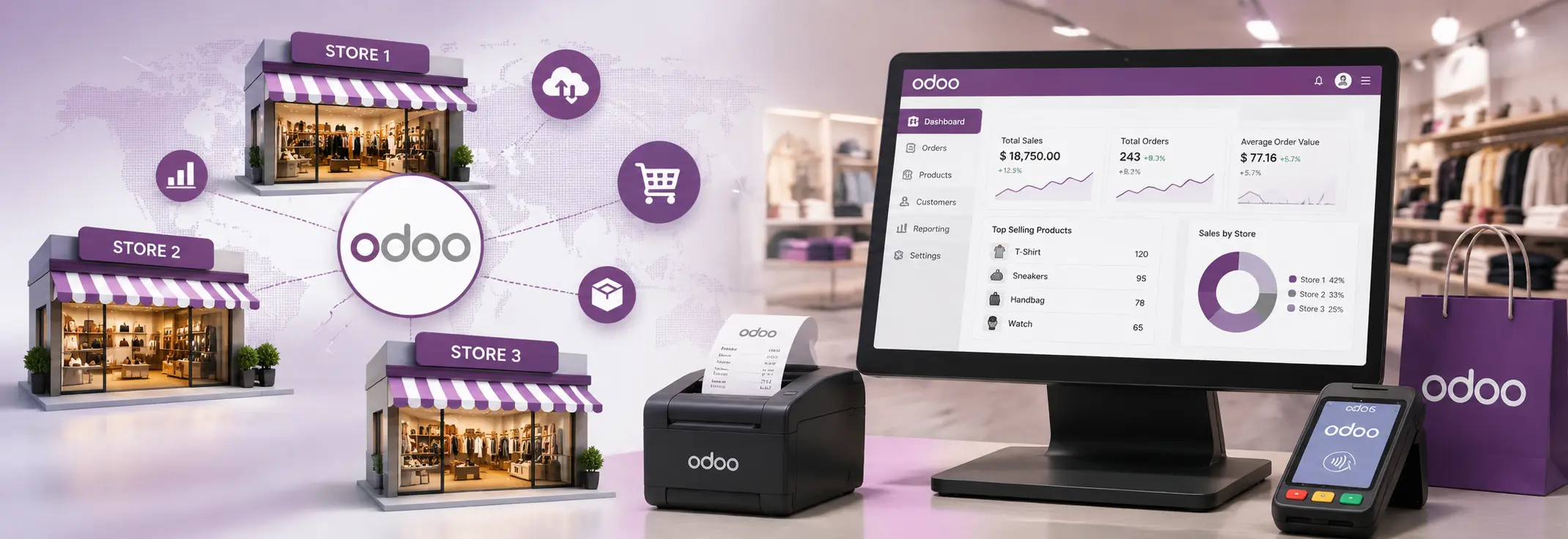
Managing multiple retail stores requires more than a standard point-of-sale system. Businesses need centralized inventory visibility, consistent pricing, unified customer data, and real-time reporting across every location. Odoo POS implementation helps multi-store retailers connect their operations on a single platform, enabling better decision-making and smoother customer experiences.
An effective Odoo POS implementation allows businesses to synchronize sales, inventory, accounting, purchasing, and customer management across all branches. Instead of managing separate systems for each store, organizations can operate from a centralized environment that supports scalability and operational efficiency.
This guide explains how Odoo POS implementation works for multi-store retail businesses, the challenges it solves, and the implementation practices that contribute to long-term success.
Challenges of Managing Multiple Retail Stores
Retail businesses with multiple branches often face operational complexities that affect productivity and customer satisfaction. When systems are disconnected, store managers and business owners struggle to maintain accurate and timely information.
Common challenges include:
- Inventory discrepancies between locations
- Inconsistent pricing and promotional campaigns
- Separate customer databases
- Manual consolidation of sales reports
- Delayed financial reconciliation
- Difficulty managing employee performance across stores
These challenges become more significant as businesses expand. A centralized retail management platform helps eliminate these inefficiencies by connecting all operations under one system.
What Is Odoo POS?
Odoo Point of Sale (POS) is an integrated retail management solution within the Odoo ERP ecosystem. It enables businesses to process sales while maintaining real-time connections with inventory, accounting, CRM, purchasing, and eCommerce operations.
Unlike standalone POS software, Odoo creates a unified operational framework where every transaction automatically updates related business processes.
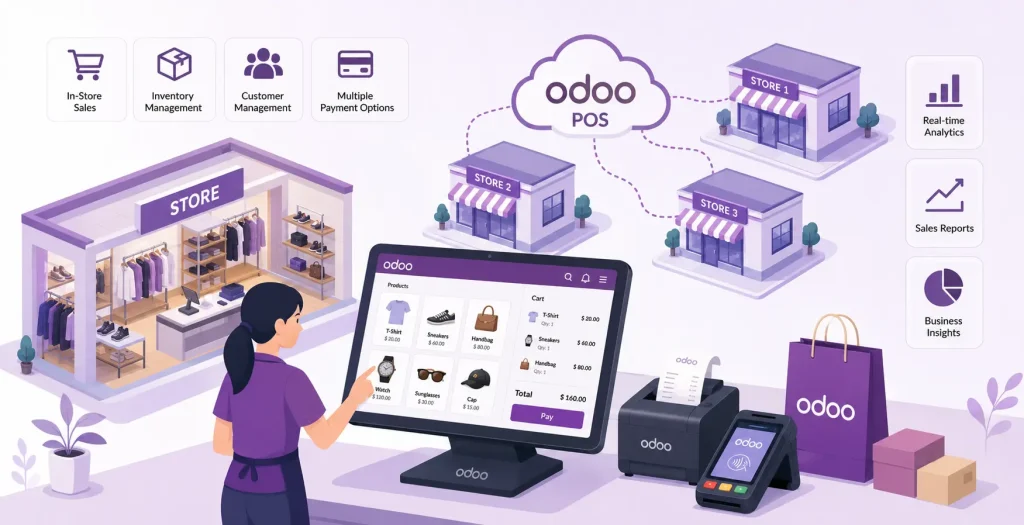
Key capabilities include:
- Multi-store management
- Real-time inventory synchronization
- Customer loyalty programs
- Integrated accounting
- Omnichannel retail support
- Employee access control
- Advanced reporting dashboards
- Offline transaction capabilities
For growing retailers, these features provide the operational visibility necessary to manage expansion efficiently.
Why Multi-Store Retail Businesses Choose Odoo POS
Modern retailers require technology that supports business growth without introducing additional complexity.
Odoo POS implementation offers several advantages for organizations operating multiple locations.
Centralized Business Management
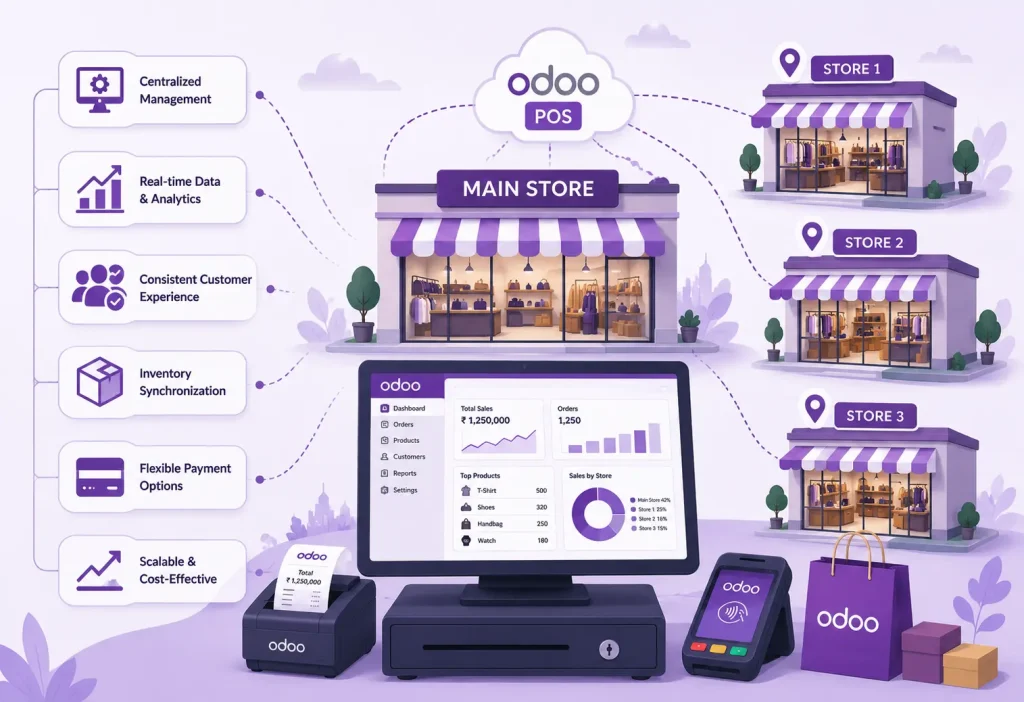
Business owners can monitor every store through a single dashboard. Sales performance, inventory levels, customer activity, and financial data become accessible from one system, eliminating the need for manual reporting.
This centralized approach improves decision-making and helps management respond quickly to operational changes.
Real-Time Inventory Synchronization
Inventory management becomes increasingly difficult when multiple stores operate independently.
Odoo automatically updates inventory quantities across locations whenever sales, purchases, or transfers occur. This real-time synchronization reduces stock discrepancies and helps businesses optimize replenishment strategies.
Retailers can:
- Track inventory across all stores
- Transfer products between branches
- Prevent overselling
- Improve stock availability
- Reduce inventory carrying costs
Multi-Store Pricing and Promotional Management
Retail organizations often run regional campaigns, seasonal discounts, and location-specific pricing strategies.
Odoo POS allows businesses to:
- Create centralized pricing rules
- Configure store-specific promotions
- Manage loyalty programs
- Apply customer-based discounts
- Maintain consistent brand experiences
This flexibility helps retailers execute marketing campaigns efficiently while maintaining operational control.
Unified Customer Experience Across Locations
Customer expectations have evolved significantly. Consumers expect personalized experiences regardless of which store they visit.
Odoo POS creates a shared customer database that enables:
- Customer purchase history tracking
- Loyalty point synchronization
- Personalized promotions
- Cross-store customer service
- Integrated CRM activities
This unified approach strengthens customer relationships and encourages repeat purchases.
Integrated Accounting and Financial Reporting
One of the biggest challenges for multi-store retailers is financial consolidation.
Traditional systems often require manual data entry between POS and accounting software. Odoo eliminates this problem through native integration with accounting processes.
Benefits include:
- Automated journal entries
- Real-time revenue tracking
- Tax management
- Expense monitoring
- Consolidated financial reports
- Faster month-end closing processes
This automation reduces administrative workloads and improves financial accuracy.
Odoo POS Implementation Process for Multi-Store Retail Businesses
Successful implementation requires a structured approach that aligns technology with operational requirements.
Business Requirement Analysis
Implementation begins by understanding:
- Number of retail locations
- Product categories
- Inventory workflows
- Pricing strategies
- Customer engagement processes
- Existing software systems
This analysis ensures the solution supports current operations while accommodating future growth.
Store Configuration and System Setup
Each retail location requires proper configuration, including:
- Warehouse assignments
- POS terminals
- Employee permissions
- Payment methods
- Tax structures
- Regional pricing rules
Standardized configurations help maintain operational consistency across all stores.
Inventory Migration and Synchronization
Product information and inventory records must be accurately transferred into the new system.
This process typically includes:
- Product catalog migration
- Barcode mapping
- Inventory verification
- Supplier data transfer
- Store-level stock allocation
Clean data migration reduces implementation risks and improves reporting accuracy after deployment.
Integration with Other Odoo Modules
The true value of Odoo POS emerges when connected with other business functions.
Common integrations include:
Odoo Inventory
Real-time stock updates and warehouse management capabilities improve inventory control throughout the retail network.
Odoo Accounting
Sales transactions automatically flow into accounting processes, eliminating duplicate data entry.
Odoo CRM
Customer interactions, loyalty activities, and marketing campaigns remain connected across all locations.
Odoo eCommerce
Online and offline retail channels operate within a single ecosystem, supporting omnichannel customer experiences.
User Training and Change Management
Technology adoption depends heavily on employee readiness.
Training programs typically focus on:
- POS operations
- Inventory management procedures
- Customer handling workflows
- Reporting tools
- Administrative functions
Proper change management ensures smoother transitions and faster adoption across all retail locations.
Benefits of Odoo POS Implementation for Multi-Location Retailers
Organizations that implement Odoo POS effectively often achieve significant operational improvements.
Improved Operational Visibility
Business leaders gain immediate access to sales performance, inventory levels, and customer insights across every store.
Better Inventory Utilization
Centralized stock management reduces overstocking and stock shortages while improving product availability.
Reduced Administrative Work
Integrated systems eliminate manual reconciliation processes and duplicate data entry activities.
Enhanced Customer Experience
Unified customer information enables personalized interactions and consistent service across locations.
Greater Scalability
As businesses expand, additional stores can be integrated into the existing infrastructure without significant operational disruptions.
Why Work with an Odoo ERP Implementation Company?
Retail implementations involve both technical and operational considerations. Working with an experienced implementation partner helps organizations reduce risks and accelerate deployment timelines.
Professional implementation services typically include:
- Business process analysis
- System configuration
- Custom workflow development
- Data migration
- Third-party integrations
- User training
- Post-go-live support
A structured implementation approach ensures the technology aligns with business objectives while supporting long-term scalability.
Conclusion
Multi-store retail management requires connected systems that provide real-time visibility across inventory, sales, customers, and financial operations. Odoo POS implementation enables businesses to centralize these functions within a single platform, improving efficiency and supporting sustainable growth.
By integrating retail operations with the broader Odoo ERP ecosystem, organizations can reduce operational complexity, enhance customer experiences, and make better business decisions based on accurate data.
Businesses planning to expand their retail presence should consider a strategic implementation approach that addresses both current operational requirements and future growth opportunities. A well-executed Odoo POS deployment creates a strong foundation for scalable and efficient multi-store retail management.

