

Organizations can minimize implementation challenges by establishing clear business goals, documenting operational workflows, preparing accurate data migration plans, engaging key teams from the beginning, validating processes through testing, and supporting employees with proper training. A structured implementation approach helps organizations minimize disruptions and improve long-term ERP adoption.
Implementing an ERP system is a significant business initiative that affects operations, employees, and customers. While Odoo provides flexibility and scalability, successful implementation depends on proper planning and execution. Understanding potential risks before deployment helps organizations make informed decisions and establish a stronger foundation for growth.
Why Risk Management Matters in Odoo ERP Implementation
An Odoo implementation typically brings together various operational areas, allowing finance, inventory, sales, procurement, production, workforce management, and customer-related activities to function within a single connected environment. Because these processes are interdependent, challenges in one area can influence overall business performance.
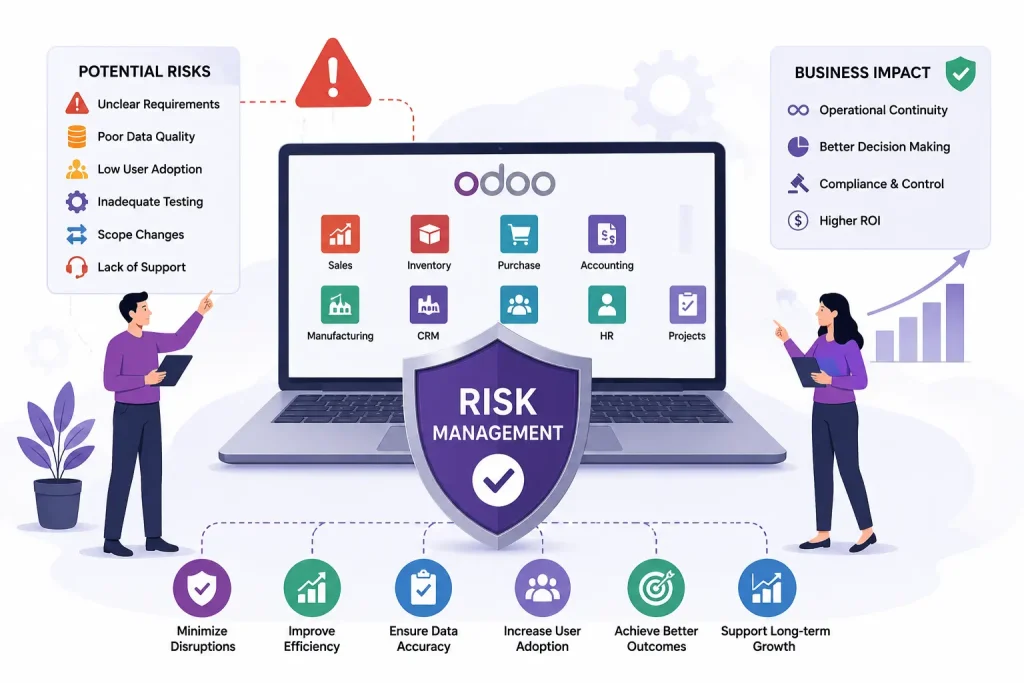
Common implementation risks include:
- Unclear business requirements
- Poor data migration planning
- Limited user adoption
- Insufficient testing
- Scope changes during implementation
- Inadequate stakeholder involvement
- Lack of post-go-live support
Managing these risks proactively helps businesses maintain operational continuity and achieve better implementation outcomes.
Common Risks and Their Business Impact
| Risk Area | Potential Impact | Prevention Strategy |
| Undefined Requirements | Project delays and rework | Conduct detailed requirement analysis |
| Poor Data Migration | Inaccurate business information | Validate and clean data before migration |
| User Resistance | Low adoption rates | Provide training and involve users early |
| Limited Testing | Operational disruptions | Perform end-to-end workflow testing |
| Scope Expansion | Increased costs and timelines | Define project boundaries clearly |
| Lack of Support | Post-launch challenges | Establish ongoing support processes |
Define Clear Business Objectives
Successful Odoo implementations begin with clearly defined goals.
Organizations should identify what they want to achieve through ERP adoption, such as:
- Improving operational efficiency
- Automating manual processes
- Enhancing reporting capabilities
- Reducing software fragmentation
- Supporting business expansion
- Increasing process visibility
Well-defined objectives help implementation teams align technology decisions with business priorities and reduce unnecessary customization.
Map Existing Business Processes
Understanding current workflows is essential before configuring any ERP system.
Process mapping helps businesses identify:
- Operational bottlenecks
- Manual activities
- Duplicate tasks
- Approval workflows
- Department dependencies
- Reporting requirements
Documenting existing processes enables organizations to design ERP workflows that support operational improvements rather than simply replicating outdated methods.
Plan Data Migration Carefully
Data migration remains one of the most critical aspects of ERP implementation.
Many organizations store operational data in multiple locations, including spreadsheets, older business applications, and separate software platforms that do not communicate with one another. Migrating inaccurate or incomplete data can create significant operational problems after go-live.
Best practices include:
- Cleaning duplicate records
- Standardizing data formats
- Verifying customer information
- Validating inventory records
- Testing migration procedures
- Maintaining backup copies
A well-planned migration approach improves data accuracy and supports a smoother transition to the new ERP environment.
Involve Key Stakeholders Early
ERP systems affect multiple departments, making stakeholder participation essential throughout the project lifecycle.
Important participants typically include:
- Department managers
- Finance teams
- Operations leaders
- IT personnel
- End users
- Executive sponsors
Early involvement helps organizations gather practical insights, address concerns, and improve user acceptance before implementation begins.
Train Users Before Go-Live
The effectiveness of an ERP system largely depends on how confidently employees adapt to new processes and incorporate the platform into their daily responsibilities. Even well-configured systems may encounter challenges if employees do not understand how to use new processes effectively.
Training programs should include:
- Module-specific guidance
- Workflow demonstrations
- Role-based learning sessions
- Practical exercises
- Documentation resources
- Post-launch support materials
Preparing users before deployment helps reduce resistance and improves overall productivity.
Test Business Workflows Thoroughly
Comprehensive testing helps identify issues before they affect daily operations.
Organizations should validate critical processes such as:
- Sales order management
- Inventory transactions
- Financial reporting
- Procurement workflows
- Manufacturing operations
- Customer management activities
Testing should involve real business scenarios to ensure that system configurations align with operational requirements.
Manage Project Scope Effectively
Expanding project requirements during implementation can increase costs and extend timelines.
Businesses should establish clear boundaries regarding:
- Initial module selection
- Custom development needs
- Integration requirements
- Reporting expectations
- Implementation phases
A phased approach often reduces complexity and allows organizations to adapt gradually while minimizing operational risks.
Establish Post-Go-Live Support
The period after deployment is equally important, as businesses continue refining processes, supporting users, and optimizing system performance. Post-launch support helps organizations:
- Resolve user questions
- Optimize workflows
- Address technical issues
- Monitor system performance
- Improve adoption rates
- Implement future enhancements
Continuous support enables businesses to maximize long-term value from their ERP investments.
Example: Reducing Risks Through Phased Implementation
A growing distribution company planning to implement Odoo may choose to deploy inventory and sales modules first before introducing accounting and procurement functionalities.
This phased approach allows teams to adapt gradually, validate workflows, and address issues early, reducing operational disruptions while improving user confidence.
Organizations that implement ERP systems in manageable stages often experience smoother transitions and stronger long-term adoption.
Best Practices for Risk Reduction in Odoo ERP Projects
Prioritize Business Requirements
Technology decisions should support operational goals rather than introducing unnecessary complexity.
Maintain Clear Communication
Regular project updates help stakeholders remain informed and aligned throughout implementation.
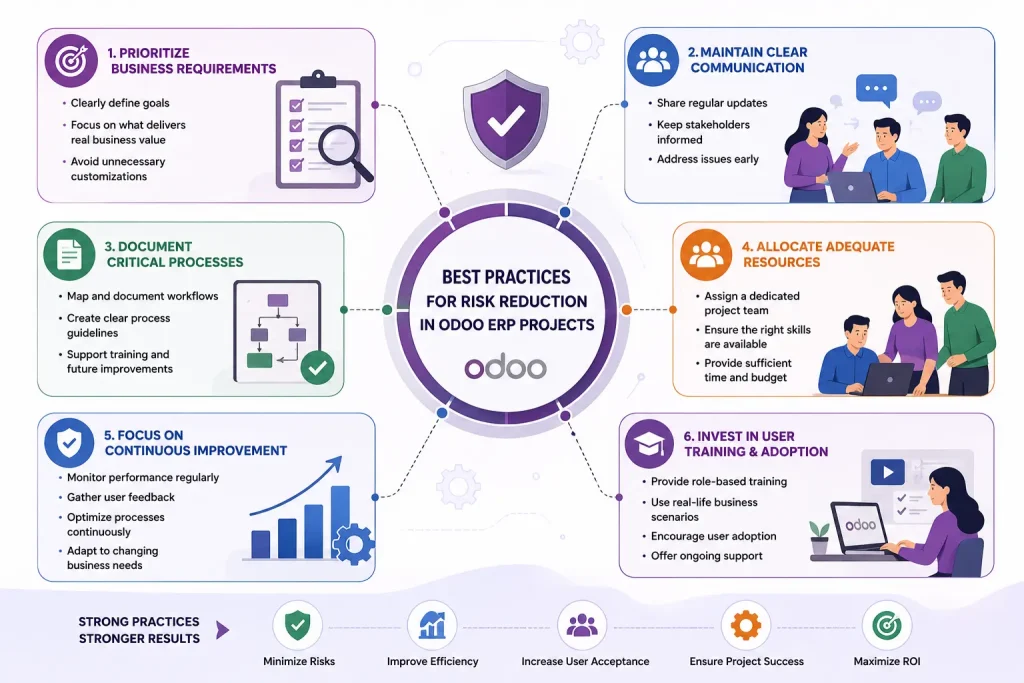
Document Critical Processes
Process documentation improves consistency and supports future training initiatives.
Allocate Adequate Resources
Dedicated project teams help organizations maintain momentum and address challenges more effectively.
Focus on Continuous Improvement
ERP implementation should support long-term business evolution rather than a one-time technology upgrade.
Frequently Asked Questions
Common risks include unclear requirements, poor data migration, insufficient testing, limited user adoption, scope changes, and inadequate post-go-live support.
Businesses can reduce risks through proper planning, process mapping, stakeholder involvement, user training, data validation, and phased implementation strategies.
User training improves adoption, reduces operational errors, and helps employees transition more effectively to new workflows and processes.
Many organizations benefit from phased implementations because they reduce complexity, minimize disruptions, and allow teams to adapt gradually.
Post-go-live support helps resolve issues, optimize workflows, improve user adoption, and ensure that the ERP system continues delivering business value over time.
Conclusion
Reducing risks in Odoo ERP implementation requires careful preparation, strong stakeholder involvement, effective training, and continuous support. Businesses that define clear objectives, manage data responsibly, and validate workflows thoroughly are better positioned for successful ERP adoption.
A structured implementation strategy not only minimizes operational disruptions but also creates a scalable foundation that supports future growth, improved collaboration, and long-term business performance.

