
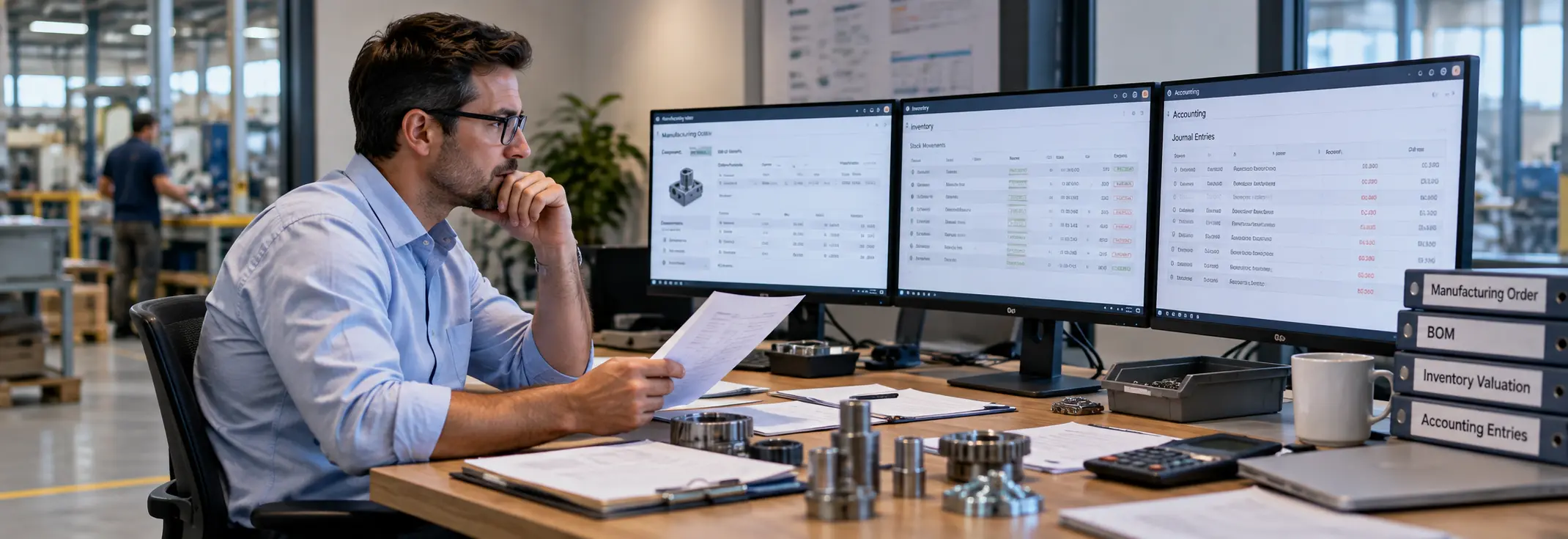
Manufacturing accounting problems in Odoo can appear as incorrect production costs, inventory valuation differences, unexpected journal entries, or balances that do not reconcile. These issues can affect the accuracy of product costing, inventory values, and financial reporting.
The challenge is that the accounting difference may originate earlier in the manufacturing flow — from material consumption, Bills of Materials, product costing, production operations, inventory valuation, or accounting configuration. This guide explains how to identify the root cause of Odoo manufacturing accounting problems, what to check at each stage, and how to resolve the underlying issue without relying on unnecessary manual adjustments.
What Causes Manufacturing Accounting Problems in Odoo?
Odoo manufacturing accounting connects production, inventory valuation, costing, and accounting. Problems can originate at different points in this flow:
Raw Materials → Component Consumption → Manufacturing Order → Finished Product → Inventory Valuation → Accounting
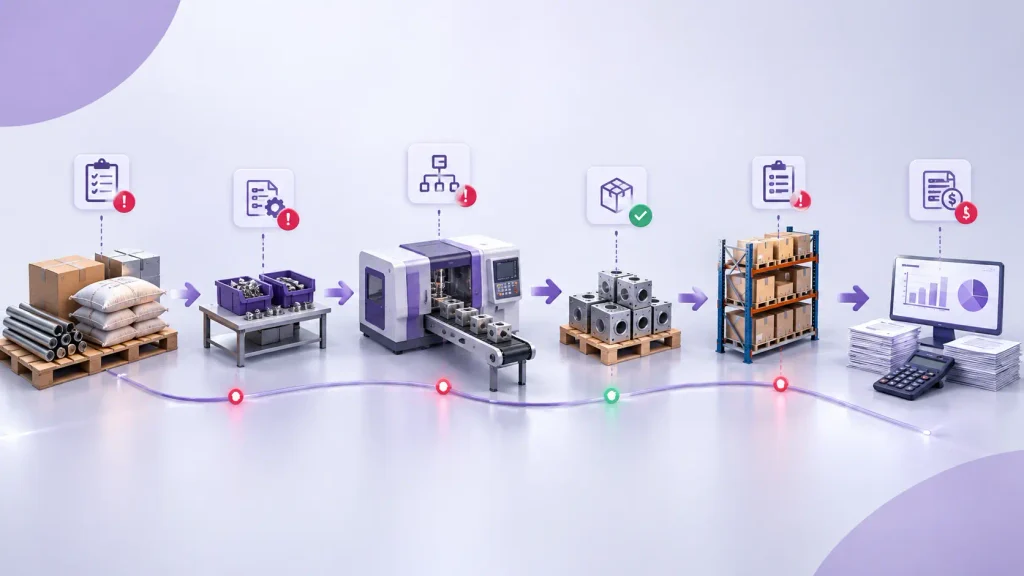
Common causes include:
- Incorrect product costing configuration
- Differences between planned and actual component consumption
- Incorrect Bill of Materials quantities
- Inventory valuation configuration issues
- Manufacturing operation cost differences
- Incorrect product category accounts
- Scrap or inventory adjustment transactions
- Unexpected stock valuation results
- Manual accounting adjustments
The key is to identify where the discrepancy first occurs, rather than correcting only the final accounting result.
Common Odoo Manufacturing Accounting Problems
Manufacturing Cost Does Not Match Accounting
A manufacturing order may show a production cost that differs from the corresponding inventory or accounting value. The difference can come from actual component consumption, product costing, manufacturing operations, or inventory valuation. Compare the planned and actual production data, then trace the related inventory valuation and accounting entries to identify where the values first diverge.
Finished Product Cost Is Incorrect
An incorrect finished-product cost can affect inventory valuation and profitability analysis. Review the BOM, actual component consumption, production quantity, component costs, and relevant costing configuration. Comparing the expected production cost with the actual manufacturing transaction can help determine whether the difference originated from materials, operations, or valuation.
Inventory Valuation Does Not Match Accounting
Manufacturing changes both inventory quantities and values, so valuation differences can affect accounting reconciliation. Review the relevant stock transactions, valuation method, product category configuration, adjustments, revaluations, and accounting entries. Trace the difference back to the transaction that created the unexpected valuation rather than correcting the final balance immediately.
Manufacturing Journal Entries Are Unexpected
Unexpected manufacturing-related journal entries should be traced to the transaction that generated them. Review the manufacturing order, component consumption, finished-product movement, stock valuation, and associated accounts. This helps determine whether the entry results from normal transaction processing or an underlying configuration issue.
Raw Material Cost Is Not Reflected Correctly
If consumed raw material costs do not appear as expected, compare the BOM quantity with actual consumption and review the component’s cost and inventory valuation. Differences can also result from units of measure, inventory adjustments, or previous valuation transactions. Planned Consumption vs Actual Consumption is an important comparison when investigating the discrepancy.
Manufacturing Variance Is Difficult to Explain
Manufacturing variance can result from differences between expected and actual production costs. Break the variance into material cost, quantity, production, operation, scrap, and valuation differences where applicable. This makes it easier to determine whether the variance originates from production activity, costing, inventory, or configuration.
How to Investigate an Odoo Manufacturing Accounting Problem
A structured investigation helps identify the source of a manufacturing accounting discrepancy before any accounting correction is made.
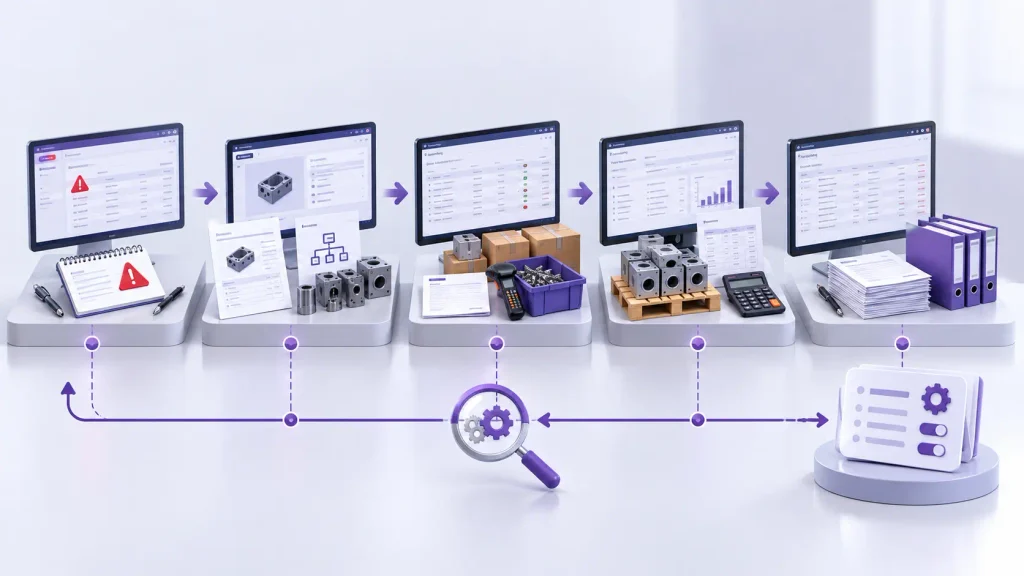
Step 1: Identify the Exact Difference
Define the specific discrepancy first, such as a production cost difference, incorrect finished-product value, inventory valuation mismatch, or unexpected journal entry.
Step 2: Review the Manufacturing Order and BOM
Check the finished product, production quantity, components, actual consumption, operations, and BOM. Compare the planned production requirements with what actually occurred.
Step 3: Trace Inventory Transactions
Review the component consumption and finished-product movements related to the manufacturing order. Include relevant scrap, adjustments, revaluation, and valuation transactions where applicable.
Step 4: Review Inventory Valuation
Determine how the related stock transactions affected inventory value and compare the result with the corresponding accounting information.
Step 5: Trace the Accounting Entry
Identify the journal entries generated by the relevant inventory transactions. If the result is unexpected, trace the entry back to the transaction and configuration that produced it.
Configuration to Review
If the same discrepancy occurs across multiple transactions, review the related product and category settings, BOM configuration, inventory valuation settings, and accounting accounts. The appropriate configuration should be assessed according to the Odoo version and the business’s accounting workflow.
This process helps locate where the discrepancy first occurs, making it easier to address the underlying manufacturing, inventory, valuation, or accounting issue.
How to Prevent Odoo Manufacturing Accounting Problems
Prevent recurring manufacturing accounting problems by keeping production, inventory, and accounting configurations aligned.
Regularly review Bills of Materials, product costing, inventory valuation, and manufacturing operations. Compare planned and actual material consumption and investigate recurring production variances.
When manufacturing processes or configurations change, validate the accounting and inventory impact before applying the changes to larger production volumes.
If the same discrepancy continues across multiple manufacturing orders, affects inventory valuation, creates unexplained accounting entries, or requires repeated manual adjustments, a detailed Odoo configuration and transaction review may be necessary.
Need Help Resolving Odoo Manufacturing Accounting Problems?
If your Odoo manufacturing costs, inventory valuation, or accounting entries do not reconcile as expected, identifying the source of the discrepancy should come before making a manual correction.
OdooBots can review your Manufacturing, Inventory, costing, valuation, and accounting workflows to identify configuration or transaction-level issues and implement an appropriate solution.
Talk to our Odoo experts to investigate and resolve your manufacturing accounting problems.
Frequently Asked Questions
Common problems include incorrect manufacturing costs, finished-product valuation differences, unexpected journal entries, inventory valuation discrepancies, raw material cost differences, and unexplained manufacturing variances.
The difference can result from actual material consumption, product costing, manufacturing operations, inventory valuation, product configuration, or accounting configuration. The manufacturing transaction should be traced through inventory valuation and accounting to identify the source.
Differences may be related to stock valuation transactions, product category configuration, valuation settings, inventory adjustments, revaluation, timing differences, or manual accounting entries. The relevant inventory transactions should be reconciled with their accounting impact.
Start with the affected manufacturing order. Review the BOM, actual component consumption, production quantity, operations, scrap, inventory movements, stock valuation, and related journal entries. Then review the configuration responsible for the transaction.
Conclusion
Odoo manufacturing accounting problems can originate from manufacturing transactions, component consumption, product costing, inventory valuation, or accounting configuration. Identifying the source of the discrepancy is more effective than correcting only the final accounting balance.
A structured review of the Manufacturing, Inventory, Valuation, and Accounting flow helps businesses identify recurring issues and maintain more accurate production costing and financial records.

