

Businesses planning to implement Odoo Accounting often want to understand the implementation process, timeline, potential challenges, and expected business outcomes. Knowing what to expect before deployment helps organizations prepare their teams, data, and financial workflows for a successful transition.
Odoo Accounting provides an integrated solution that connects financial operations with sales, purchasing, inventory, manufacturing, and other business functions within a single ERP environment. However, successful adoption requires more than simply installing software. A structured implementation process ensures that the accounting system aligns with business requirements, regulatory obligations, and operational workflows.
Understanding what to expect during an Odoo accounting implementation helps organizations prepare for the transition, minimize disruptions, and maximize long-term value.
How long does Odoo Accounting implementation take?
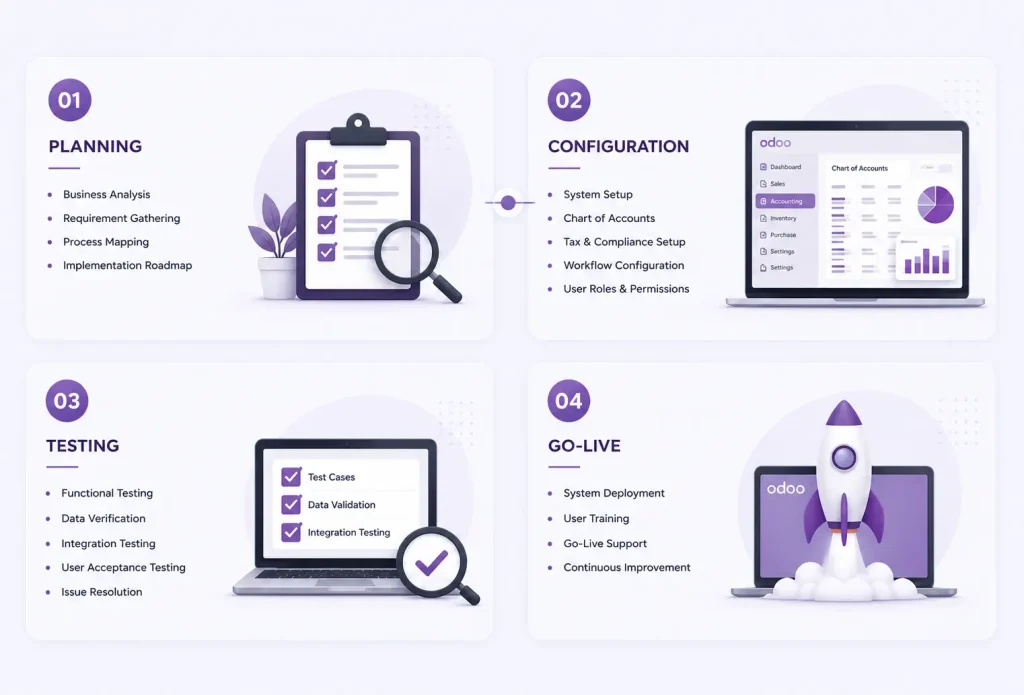
- Small businesses: 2–4 weeks
- Medium-sized companies: 1–3 months
- Complex enterprises: 3–6 months or longer
The timeline depends on:
- Data migration requirements
- Customizations
- Integrations
- User training
- Compliance needs
What Is Odoo Accounting Implementation?
Odoo accounting implementation is the process of configuring, deploying, and integrating the Odoo Accounting module according to an organization’s financial processes and reporting requirements.
The implementation typically includes:
- Financial requirement analysis
- Chart of accounts configuration
- Tax and compliance setup
- Customer and vendor migration
- Bank integration
- Invoice and payment workflows
- Multi-company or multi-currency configuration
- User roles and access permissions
- Testing and employee training
- Go-live support
The goal is to create a centralized accounting environment that improves accuracy, automation, and financial visibility across the business.
Understanding Business Requirements Before Implementation
The first stage of implementation focuses on understanding how the organization currently manages its finances.
Businesses generally evaluate:
- Existing accounting software and processes
- Financial reporting requirements
- Tax regulations and compliance needs
- Multi-branch or multi-company operations
- Approval workflows
- Integration requirements with other systems
- Future growth plans
A clear understanding of these requirements helps avoid unnecessary customization and ensures that the implementation supports both current and future business objectives.
Setting Up the Financial Structure
One of the most important activities during implementation is configuring the financial foundation within Odoo.
Chart of Accounts
The chart of accounts determines how financial transactions are categorized and reported. Businesses may adopt standard accounting templates or create custom account structures based on their operational needs.
Tax Configuration
Tax rules must be properly configured to support local regulations, GST requirements, international taxes, or industry-specific compliance obligations.
Fiscal Positions
Organizations operating across multiple regions can use fiscal positions to automate tax mapping and financial treatment for different customers or jurisdictions.
Multi-Currency Management
Companies with international operations can configure multiple currencies, exchange rate updates, and foreign currency transactions within the accounting system.
Proper financial configuration ensures accurate reporting and reduces manual intervention in day-to-day accounting activities.
Data Migration and Financial Record Transfer
Most businesses already maintain financial information within legacy accounting software or spreadsheets.
An Odoo accounting implementation typically includes migration of:
- Customer records
- Vendor information
- Opening balances
- Outstanding invoices
- Historical transactions
- Product-related accounting data
- Tax configurations
Data quality is essential during this phase. Inaccurate or incomplete migration can create reconciliation challenges and impact financial reporting after go-live.
Businesses should validate migrated data through multiple testing cycles before moving into production.
Integration with Other Business Functions
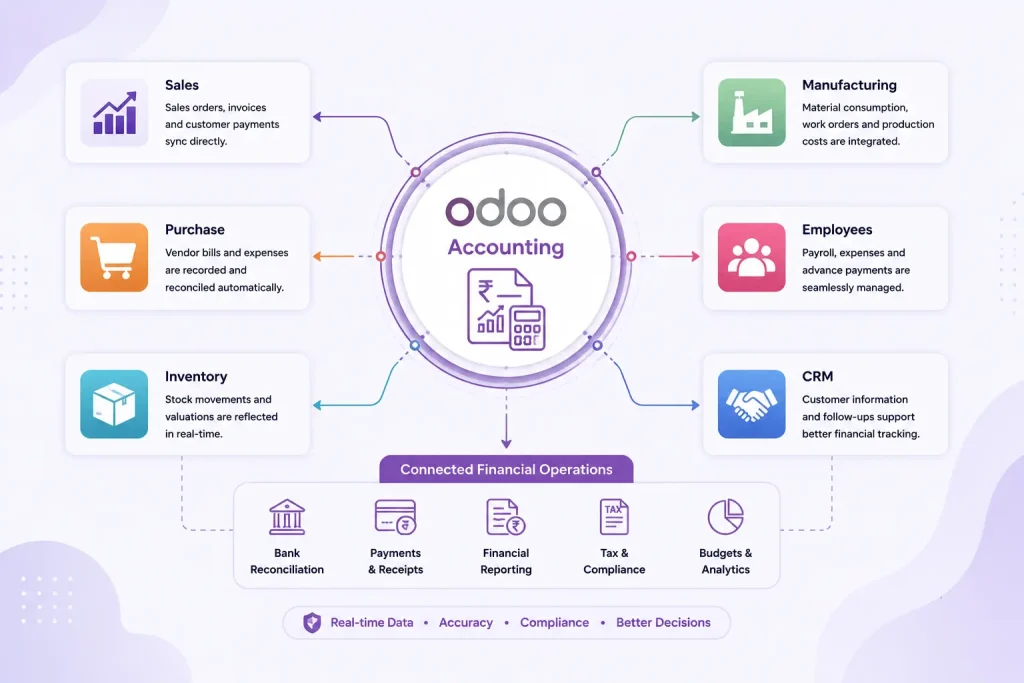
One of the biggest advantages of Odoo Accounting is its integration with other operational modules.
Sales Integration
Sales orders automatically generate invoices and customer payment records, reducing duplicate data entry.
Purchase Integration
Vendor bills and procurement expenses are linked directly to purchasing activities, improving cost visibility.
Inventory Integration
Stock movements can create accounting entries automatically, enabling accurate inventory valuation and financial reporting.
Manufacturing Integration
Manufacturing costs, raw materials, and production expenses can be reflected within financial statements without manual adjustments.
These integrations create a unified business environment where accounting data remains consistent across departments.
Workflow Configuration and Automation
Modern businesses expect accounting systems to automate repetitive tasks while maintaining internal controls.
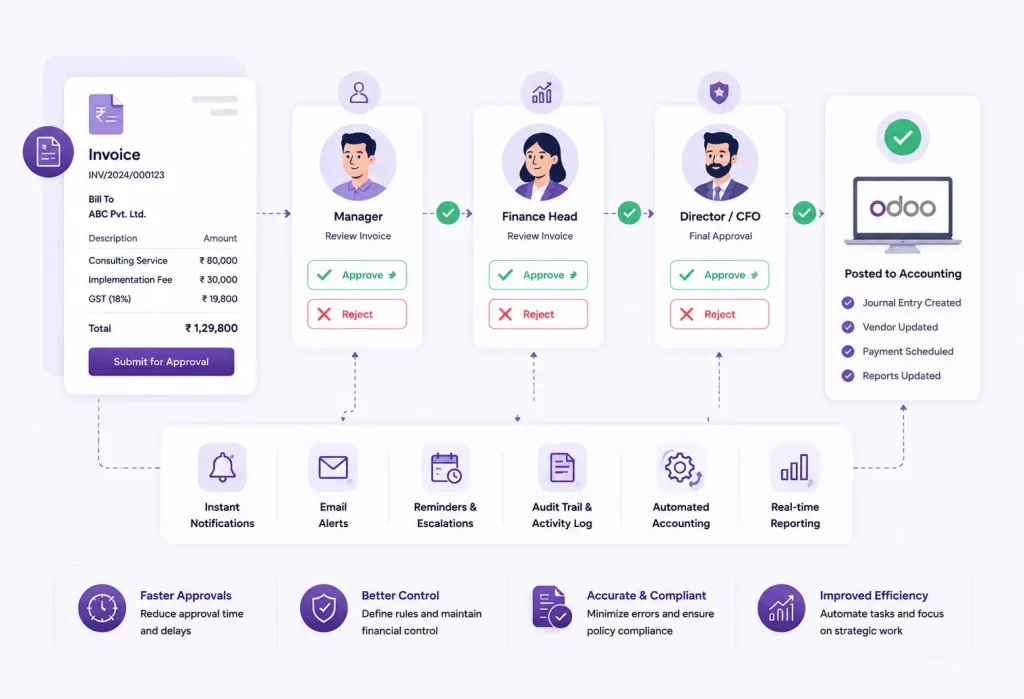
During implementation, organizations often configure:
- Invoice approval workflows
- Payment authorization processes
- Automated bank reconciliation
- Recurring invoices
- Expense approval systems
- Customer follow-up reminders
- Financial reporting schedules
Workflow automation reduces administrative effort and allows finance teams to focus on strategic activities rather than manual operations.
User Roles, Permissions, and Security
Financial information requires strict access control.
Odoo enables businesses to create role-based permissions for different users, including:
- Finance managers
- Accountants
- Auditors
- Sales teams
- Procurement personnel
- Business executives
Role-based security ensures that employees access only the information relevant to their responsibilities while maintaining financial data integrity.
Organizations should review user permissions carefully before deployment to support governance and compliance requirements.
Testing Before Go-Live
Testing is one of the most critical phases of any Odoo accounting implementation.
Businesses typically perform:
Functional Testing
Verifying that accounting processes work according to business requirements.
Integration Testing
Ensuring that accounting data flows correctly between sales, purchasing, inventory, and other modules.
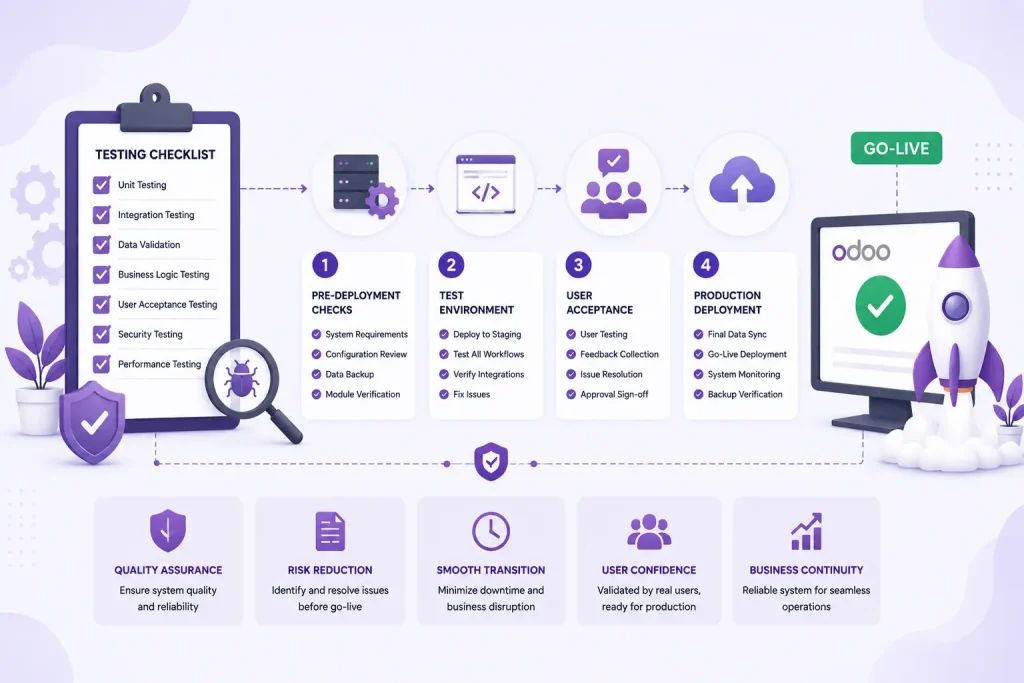
User Acceptance Testing
Allowing finance teams to validate real-world scenarios before full deployment.
Financial Validation
Checking opening balances, tax calculations, reports, and reconciliation processes for accuracy.
Comprehensive testing reduces implementation risks and helps identify potential issues before the system goes live.
Employee Training and Change Management
Technology adoption depends heavily on user readiness.
Training programs often cover:
- Invoice management
- Customer payments
- Vendor bills
- Bank reconciliation
- Financial reporting
- Tax processing
- Month-end closing procedures
Organizations that invest in proper training generally achieve faster adoption rates and fewer operational disruptions after implementation.
Change management initiatives also help employees understand new processes and adapt to integrated ERP workflows.
What Businesses Can Expect After Go-Live
After implementation, businesses typically experience improvements across several areas.
Improved Financial Visibility
Real-time dashboards and reports provide better insights into business performance and cash flow.
Reduced Manual Work
Automation eliminates repetitive tasks such as invoice generation, reconciliation, and financial consolidation.
Better Decision-Making
Integrated data enables management teams to make decisions using accurate and up-to-date financial information.
Enhanced Compliance
Standardized processes and configurable tax rules support regulatory requirements and audit readiness.
Scalability
The accounting system can expand alongside business growth without requiring multiple disconnected applications.
The full benefits generally become more apparent as employees become familiar with the platform and additional modules are integrated into operations.
Common Challenges During Odoo Accounting Implementation
Although implementation offers significant advantages, businesses should prepare for common challenges.
Data Migration Issues
Poor data quality can delay deployment and create reporting inconsistencies.
Process Alignment
Existing workflows may require adjustments to align with ERP best practices.
User Adoption
Employees often need training and support to adapt to new systems.
Customization Requirements
Excessive customization can increase complexity and maintenance costs.
Working with experienced implementation professionals helps organizations address these challenges more effectively.
Best Practices for a Successful Odoo Accounting Implementation
Businesses can improve project outcomes by following several best practices:
- Define clear implementation objectives.
- Document existing accounting processes.
- Clean and validate data before migration.
- Minimize unnecessary customizations.
- Conduct thorough testing.
- Train employees before deployment.
- Implement role-based security controls.
- Plan post-go-live support activities.
A structured approach reduces project risks and ensures a smoother transition to the new accounting environment.
Conclusion
Odoo accounting implementation is more than a software deployment project. It is a strategic initiative that transforms how organizations manage financial operations, reporting, compliance, and business integration.
From requirement analysis and financial configuration to testing, training, and post-go-live support, every stage contributes to long-term success. Businesses that understand what to expect during implementation can make better decisions, prepare their teams effectively, and maximize the value of their ERP investment.
With proper planning and execution, Odoo Accounting can become a centralized financial platform that supports efficiency, transparency, and sustainable business growth.
Frequently Asked Questions
Most implementations take between two weeks and three months, depending on business complexity, data migration requirements, and integrations.
Yes. Businesses can migrate customers, vendors, invoices, opening balances, products, and financial records from their existing systems into Odoo.
Yes. Odoo supports GST configuration and other tax requirements through customizable tax rules and fiscal positions.
Not always. Many organizations can use standard Odoo Accounting features with minimal customization, reducing implementation costs and future maintenance requirements.

