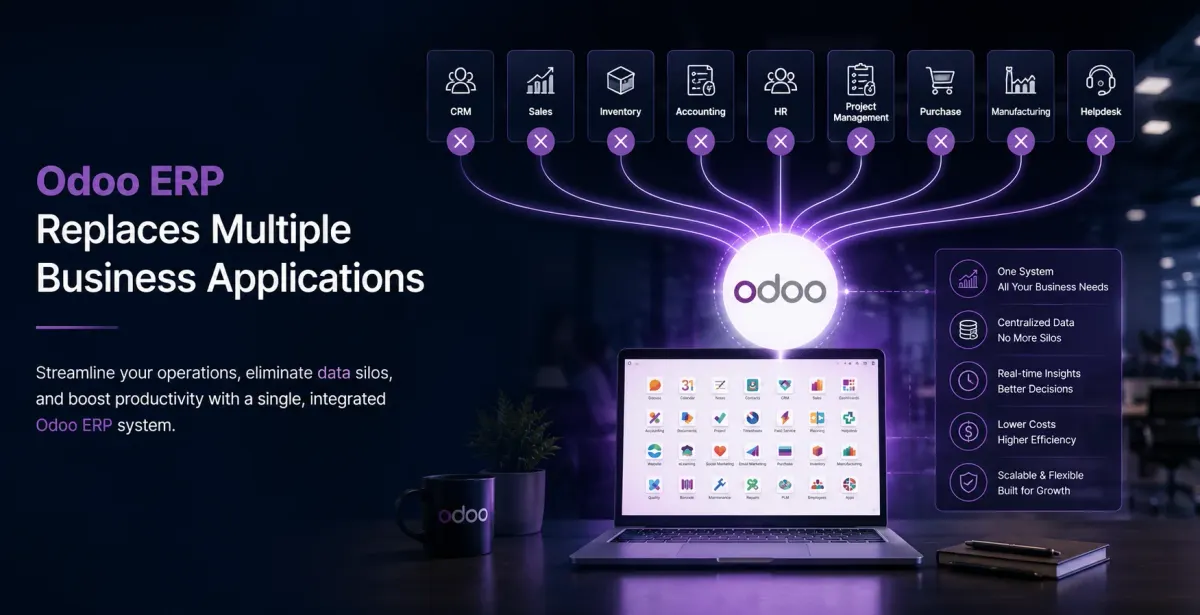
Can Odoo Replace All the Software Your Business Uses Today?
Many growing businesses rely on a collection of different software applications to manage their daily operations. Accounting teams use one platform, sales departments work with separate CRM systems, inventory is tracked through another tool, and human resources often operate on entirely different software.
While these applications solve individual problems, managing multiple systems creates new challenges. Data becomes fragmented, teams work in silos, reporting takes longer, and manual data entry increases the risk of errors.
These operational challenges often lead decision-makers to evaluate a broader question:
Can Odoo replace all the software a business uses today?
The goal is not necessarily to replace every application but to establish Odoo as the central operational platform that connects business processes and data. Its integrated applications help organizations manage finance, inventory, sales, customer relationships, manufacturing, human resources, and more through one connected environment.
Why Businesses End Up Using Multiple Software Applications
Most companies do not intentionally build disconnected technology environments. Software adoption often happens gradually as businesses grow.
A typical organization might use:
- Accounting software for financial management
- CRM tools for sales activities
- Spreadsheets for inventory tracking
- HR platforms for employee management
- Project management applications for internal teams
- eCommerce software for online sales
- Separate procurement systems
Over time, employees spend more effort moving information between systems than focusing on strategic business activities.
As operations expand, maintaining consistency across multiple applications becomes increasingly difficult.
The Hidden Costs of Managing Disconnected Systems
Using multiple software products creates costs that are not always immediately visible.
Duplicate Data Entry
Employees often enter the same information into different systems, increasing administrative workloads and creating opportunities for human error.
Limited Business Visibility
Management teams struggle to obtain real-time insights when critical information exists across multiple platforms.
Higher Software Expenses
Licensing, maintenance, and training costs increase as businesses add more applications to support operations.
Integration Challenges
Connecting independent systems frequently requires custom integrations and ongoing technical maintenance.
Slower Decision-Making
Without centralized information, generating accurate reports and making informed business decisions becomes more difficult.
These challenges encourage many organization
What Business Functions Can Odoo Replace?
One of Odoo’s biggest advantages is its modular ecosystem. Businesses can implement only the applications they need while maintaining a connected operational environment.
Accounting Software
- Invoicing
- Bank reconciliation
- Financial reporting
- Expense management
- Accounts receivable and payable
- Tax management
For many organizations, this reduces the need for separate accounting applications.
Customer Relationship Management Systems
The Odoo CRM module helps businesses manage:
- Leads
- Opportunities
- Sales pipelines
- Customer communications
- Forecasting activities
Sales teams can work directly within the ERP environment instead of using disconnected CRM tools.
Inventory Management Solutions
- Real-time stock tracking
- Multi-warehouse management
- Barcode operations
- Batch traceability
- Automated replenishment
This eliminates the need for spreadsheets and standalone inventory applications.
Human Resource Management Platforms
The HR applications support:
- Employee records
- Leave management
- Recruitment processes
- Attendance tracking
- Performance evaluations
Organizations can therefore manage workforce activities within the same business system.
Manufacturing Software
Manufacturing companies can utilize:
- Bills of materials
- Production planning
- Work orders
- Quality controls
- Shop floor operations
Integrated manufacturing processes improve coordination between procurement, inventory, and production teams.
Project Management Applications
Project teams benefit from:
- Task management
- Resource allocation
- Timesheets
- Project tracking
- Collaboration tools
These capabilities reduce the need for separate project management platforms.
Can Odoo Replace Excel Spreadsheets?
Many businesses continue to rely heavily on spreadsheets for operational processes.
While spreadsheets provide flexibility, they also introduce challenges:
- Manual updates
- Version control issues
- Limited collaboration
- Inconsistent reporting
- Data accuracy concerns
Odoo enables organizations to move many operational activities into structured workflows and centralized databases.
Examples include:
- Examples include:
- Customer information
- Inventory management
- Purchase tracking
- Sales reporting
- Financial analysis
- Employee records
Spreadsheets may still serve analytical purposes, but day-to-day operations often become more efficient within an integrated ERP environment.
When Businesses Still Need Third-Party Integrations
Although Odoo covers a broad range of business functions, some organizations require specialized applications that continue operating alongside their ERP platform.
Examples include:
Industry-Specific Software
Healthcare, logistics, and engineering companies may use specialized solutions designed for unique operational requirements.
Advanced Business Intelligence Tools
Some organizations integrate Odoo with external analytics platforms for enterprise reporting needs.
Customer-Facing Applications
Existing eCommerce platforms or mobile applications may remain part of the technology ecosystem.
The goal is not necessarily to replace every application but to establish Odoo as the central operational platform that connects business processes and data.
Benefits of Running Your Business on One ERP Platform
Organizations that operate through a unified ERP platform typically gain greater operational visibility, improved collaboration, and more efficient business processes.
Improved Data Accuracy
Information is entered once and shared across departments, reducing inconsistencies and duplication.
Better Collaboration
Sales, accounting, inventory, HR, and procurement teams work from the same source of information.
Faster Decision-Making
Real-time dashboards and integrated reporting provide management with more accurate operational insights.
Lower Technology Complexity
Managing fewer software systems simplifies maintenance, training, and support activities.
Greater Scalability
Organizations can introduce additional Odoo applications as business requirements evolve.
These benefits contribute to stronger operational efficiency and long-term business growth.
How Odoo Implementation Supports Software Consolidation
Moving from multiple applications to an integrated ERP environment requires careful planning and execution.
Businesses must consider:
- Business process mapping
- Data migration strategies
- User training
- Change management activities
- System integrations
- Future scalability requirements
Organizations pursuing software consolidation often work with experienced Odoo ERP implementation services to ensure a structured transition and minimize operational disruptions.
Professional implementation support helps businesses align technology investments with long-term operational goals.
Conclusion
Managing numerous disconnected applications creates challenges that affect productivity, reporting accuracy, collaboration, and operational visibility.
For many organizations, Odoo provides an opportunity to consolidate accounting, CRM, inventory, manufacturing, HR, procurement, and project management processes within a single integrated platform.
Although certain specialized applications may still be necessary, Odoo can often become the central system that connects business operations and eliminates unnecessary complexity.
Businesses evaluating digital transformation initiatives should carefully assess their requirements and implementation strategies to determine how much of their existing software environment Odoo can effectively replace.
Frequently Asked Questions
Yes. Odoo Accounting includes invoicing, reconciliation, financial reporting, expense management, and tax capabilities that can replace separate accounting systems for many businesses.
Yes. The Odoo CRM module manages leads, opportunities, customer interactions, and sales pipelines within the same ERP environment.
Yes. Odoo supports manufacturing operations through production planning, work orders, bills of materials, inventory integration, and quality management capabilities.
Many operational processes can move into Odoo workflows and databases, reducing reliance on spreadsheets for everyday business activities.
Not always. Some organizations continue using industry-specific software or advanced analytics tools while integrating them with Odoo as their central ERP platform.
Yes. Odoo offers integrated applications for accounting, CRM, inventory, manufacturing, procurement, HR, sales, project management, and eCommerce. Businesses can implement the modules they require while managing operations through a single connected platform.