How Odoo ERP Replaces Multiple Business Applications
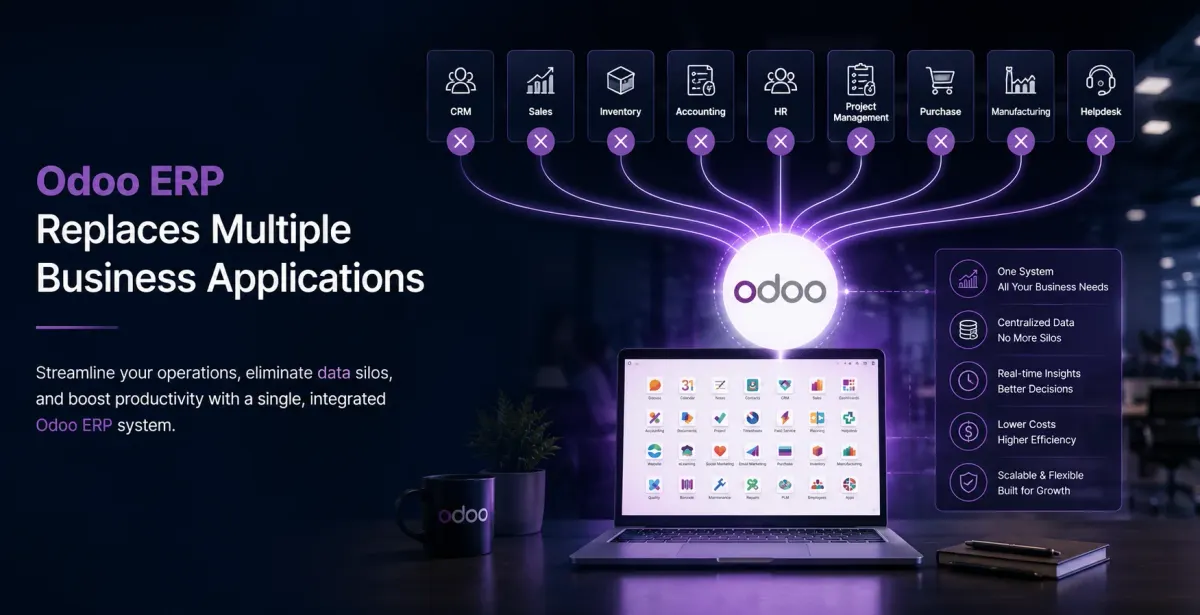
Odoo ERP Replaces Multiple Business Applications
Many growing businesses rely on multiple software applications to manage their daily operations. One tool handles accounting, another manages customer relationships, while separate applications are used for inventory, sales, purchasing, HR, and project management. Although this approach may work initially, it often leads to disconnected data, manual work, higher software costs, and reduced productivity.
This is where Odoo ERP provides a significant advantage. Instead of switching between multiple business applications, Odoo brings every core business function into a single, integrated platform. With centralized data and automated workflows, organizations can improve efficiency, reduce operational costs, and make better business decisions.
In this article, we’ll explore how Odoo ERP replaces multiple business applications and why businesses are increasingly choosing an integrated ERP solution over managing numerous standalone systems.
Why Businesses Outgrow Multiple Applications
Businesses often adopt separate applications to manage specific functions such as accounting, customer relationship management (CRM), inventory, human resources, and project management. While each application performs its role effectively, managing multiple systems becomes increasingly challenging as the business grows.
Since these applications operate independently, information is often scattered across different platforms instead of being shared automatically. This can lead to several operational challenges, including:
- Duplicate data entry across multiple systems
- Manual information sharing between departments
- Inconsistent reports and business data
- Higher software subscription and maintenance costs
- Limited visibility into overall business performance
- Difficulty scaling business operations
For example, when a sales representative creates a new customer in a CRM, the finance team may need to enter the same customer details again in accounting software, while the warehouse updates inventory in another application. These disconnected workflows increase administrative effort, delay decision-making, and create opportunities for data errors.
How Odoo ERP Unifies Business Operations
In many implementations, businesses initially connect their Accounting, Sales, and Inventory modules before expanding to HR, Manufacturing, or Project Management. This phased approach simplifies user adoption and reduces implementation complexity.
Accounting and Finance
Many businesses use separate accounting software alongside spreadsheets for financial reporting.
With Odoo ERP, organizations can manage:
- General accounting
- Customer invoices
- Vendor bills
- Bank reconciliation
- Financial reporting
- Tax management
- Budget tracking
Because accounting is connected with sales, purchasing, and inventory, financial data updates automatically without manual intervention.
Can Odoo Replace CRM Software?
Yes. Odoo includes a built-in CRM module that manages leads, opportunities, quotations, customer communication, and sales pipelines. Since it integrates with accounting, inventory, and sales, businesses no longer need separate CRM software in many cases.
Customer Relationship Management (CRM)
Sales teams often depend on dedicated CRM software that operates independently from invoicing or inventory systems.
Odoo CRM allows businesses to:
- Track leads
- Manage opportunities
- Schedule follow-ups
- Monitor sales pipelines
- Generate quotations
- Convert quotations into sales orders
Every customer interaction remains connected throughout the sales cycle.
Sales Management
Instead of using separate quotation and order management software, Odoo provides an integrated sales module that streamlines the complete sales process.
Businesses can:
- Create quotations
- Approve orders
- Apply pricing rules
- Track deliveries
- Generate invoices automatically
Sales teams gain real-time visibility into product availability and customer history without switching between applications.
Inventory and Warehouse Management
Inventory management is often handled using standalone warehouse software or spreadsheets.
Odoo ERP centralizes inventory operations, including:
- Stock management
- Barcode scanning
- Warehouse transfers
- Batch and serial number tracking
- Inventory forecasting
- Automated stock replenishment
By integrating inventory with purchasing and sales workflows, Odoo maintains consistent stock records across departments, reducing discrepancies caused by disconnected applications.
Purchase Management
Purchasing becomes more efficient with automated procurement workflows.
Businesses can:
- Create purchase orders
- Manage supplier information
- Track vendor performance
- Automate reordering
- Monitor incoming shipments
This reduces manual purchasing activities while ensuring inventory remains available.
Human Resources
Instead of maintaining separate HR software, Odoo centralizes employee management.
Features include:
- Employee records
- Attendance management
- Leave management
- Recruitment
- Appraisals
- Payroll integration
- Expense management
HR teams spend less time managing administrative tasks and more time supporting employees.
Project Management
For service-based businesses, project management is essential.
Odoo allows organizations to manage:
- Tasks
- Project timelines
- Timesheets
- Resource allocation
- Team collaboration
- Customer billing
Because projects integrate directly with sales and accounting, businesses gain complete visibility into project profitability.
Manufacturing
Manufacturers often rely on multiple production systems.
Odoo Manufacturing includes:
- Bills of Materials (BoM)
- Production planning
- Work orders
- Quality checks
- Maintenance scheduling
- Production reporting
Manufacturing activities remain synchronized with inventory and purchasing.
Website and eCommerce
Instead of using separate website builders and online store platforms, Odoo offers integrated digital commerce.
Businesses can manage:
- Corporate websites
- Online stores
- Customer portals
- Product catalogs
- Online payments
- Marketing campaigns
Orders placed online automatically update inventory and accounting without manual processing.
Key Benefits of Replacing Multiple Applications with Odoo ERP
Implementing Odoo ERP provides more than software consolidation.
Improved Data Accuracy
A single source of truth eliminates duplicate records and inconsistent information.
Better Productivity
Employees no longer spend time entering the same data into multiple systems.
Lower Software Costs
Replacing multiple subscriptions with one integrated ERP reduces long-term operational expenses.
Real-Time Reporting
Managers gain instant access to financial, operational, sales, and inventory data through unified dashboards.
Easier Collaboration
Departments work together using shared information instead of isolated applications.
Business Scalability
As the organization grows, additional Odoo modules can be activated without replacing the entire system.
Is Odoo ERP the Right Choice for Every Business?
Odoo ERP is suitable for businesses that:
- Use multiple disconnected software applications
- Struggle with manual processes
- Experience data inconsistencies
- Plan to scale operations
- Need better reporting and automation
- Want to centralize business management
Whether you’re in manufacturing, retail, distribution, healthcare, education, professional services, or eCommerce, Odoo offers flexible modules that adapt to different business requirements.
Successful ERP Implementation Matters
Choosing the right ERP software is only one part of the journey. A successful implementation requires careful planning, business process analysis, data migration, module configuration, user training, and ongoing support.
Working with an experienced Odoo ERP Implementation Company helps ensure that the platform aligns with your operational goals while minimizing disruption during deployment. Professional implementation also reduces customization risks, improves user adoption, and helps businesses achieve a faster return on investment.
Conclusion
Managing multiple business applications may seem practical at first, but it often leads to fragmented data, higher costs, and inefficient workflows. Odoo ERP solves these challenges by bringing accounting, CRM, sales, inventory, purchasing, HR, manufacturing, projects, and eCommerce into one integrated platform.
As your business grows, having a unified ERP system improves collaboration, streamlines operations, and provides better visibility into every aspect of your organization.
If you’re planning to replace multiple business applications with a modern ERP solution, partnering with an experienced Odoo ERP Implementation Company can help you implement Odoo successfully and maximize its long-term value.