

If you are comparing Odoo, SAP, Zoho, and Microsoft Dynamics 365, the right choice depends on your business size, operational complexity, budget, existing systems, and implementation requirements.
You may be asking:
- Which ERP fits our business requirements?
- Is Odoo suitable for our operations?
- When should we consider SAP or Dynamics 365?
- Could Zoho meet our requirements?
- How much customization and implementation effort will we need?
Instead of comparing features alone, evaluate each ERP against your actual business processes, integration needs, required capabilities, and future plans.
Odoo vs SAP vs Zoho vs Microsoft Dynamics 365: What Is the Difference?
All four platforms can support core business operations, but they are suited to different business requirements.
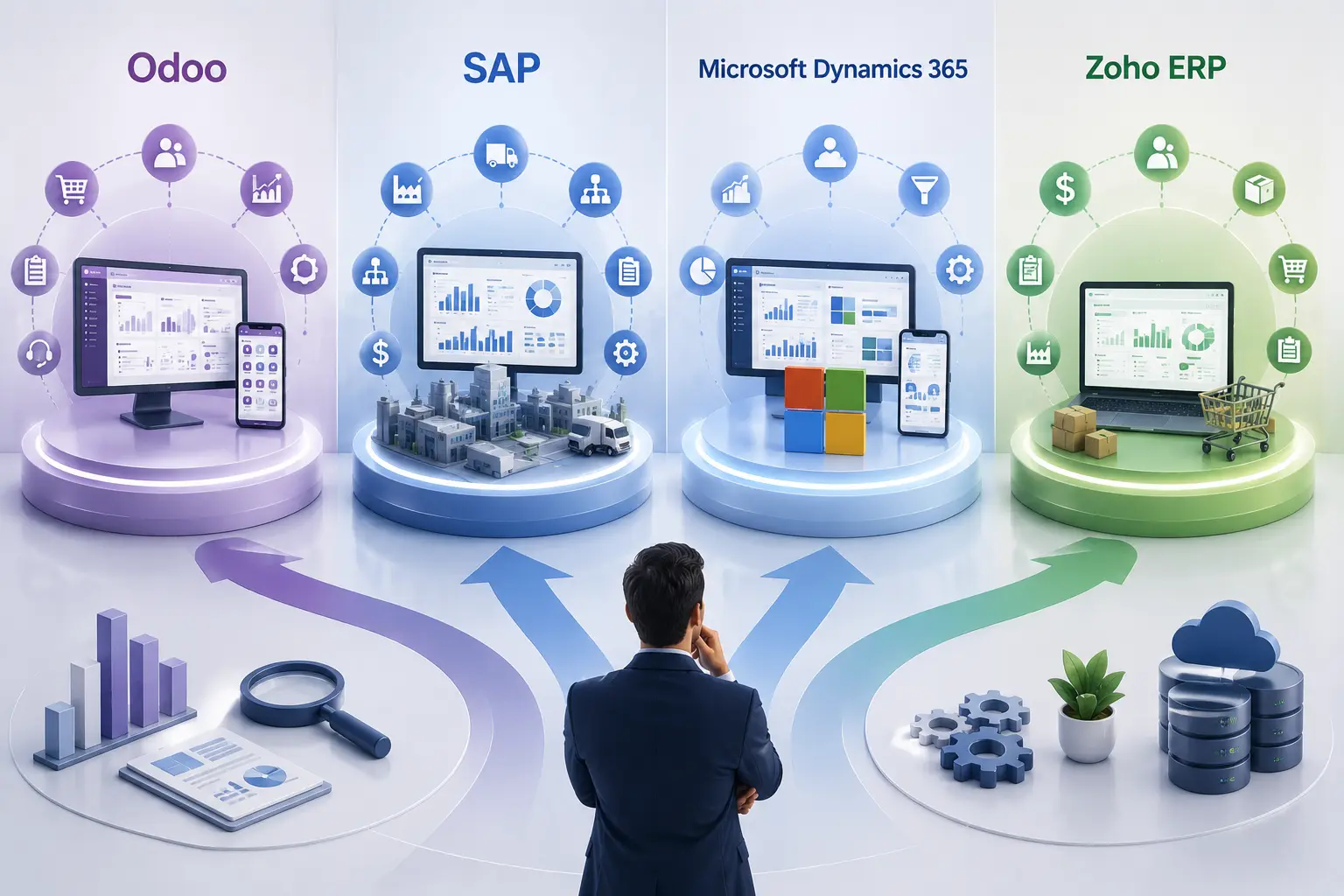
For a small or growing business, the decision should also consider implementation complexity, user adoption, integration requirements, and the ability to add capabilities as the business grows.
For businesses with complex enterprise operations, factors such as multi-entity processes, advanced supply-chain requirements, manufacturing complexity, financial controls, and governance may have greater importance.
The question is therefore not simply “Which ERP has the most features?”
It is:
“Which ERP can meet our business requirements with the right level of functionality, complexity, customization, integration, and implementation effort?”
| ERP | May be a better fit when your business needs |
| Odoo | An integrated and modular ERP covering multiple business functions with flexibility to configure and extend the system |
| SAP | Complex enterprise operations, advanced manufacturing, supply chain, finance, and broader organizational requirements |
| Microsoft Dynamics 365 | ERP and CRM capabilities, particularly when your business already relies on the Microsoft ecosystem |
| Zoho ERP | Connected finance, inventory, manufacturing, sales, purchasing, and other business functions within the Zoho ecosystem |
When Should You Consider Odoo?
Odoo can be a strong fit when your business wants to connect multiple functions in one ERP while keeping the flexibility to expand as requirements change.
- Multiple business functions in one platform
- Integrated sales, purchasing, inventory, accounting, and operations
- Manufacturing, eCommerce, projects, or customer support
- Integration with existing business systems
- Configuration that reflects your business processes
- A platform that can support changing requirements as your business grows
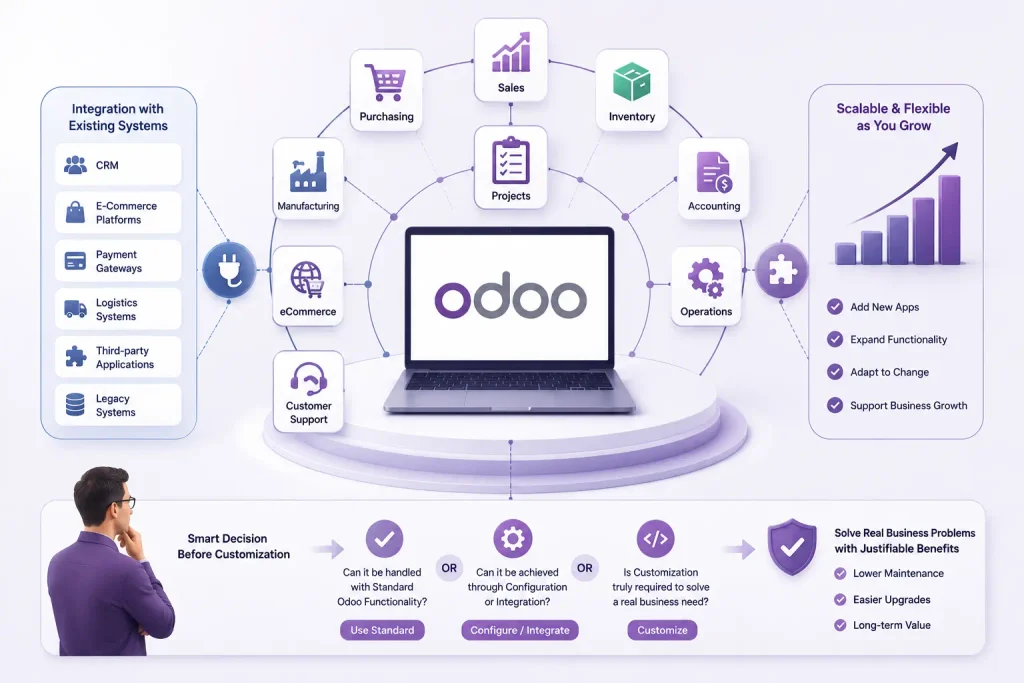
However, Odoo’s flexibility should not mean unnecessary customization. Before developing a custom solution, your implementation partner should determine whether the requirement can be handled through standard Odoo functionality, configuration, or integration.
If customization is genuinely required, it should solve a clear business problem and have a justifiable benefit compared with the additional maintenance and upgrade considerations.
Odoo vs SAP vs Zoho vs Dynamics: What Should You Compare?
Instead of comparing hundreds of features, compare the factors that can affect your ERP decision and implementation.
| Business consideration | Odoo | SAP | Microsoft Dynamics 365 | Zoho |
| Growing business flexibility | Strong | Depends on requirements | Strong | Strong |
| Complex enterprise operations | Strong, depending on scope | Very strong | Strong | Depends on requirements |
| Manufacturing | Strong | Very strong | Strong | Available |
| Finance & accounting | Strong | Very strong | Strong | Strong |
| CRM & sales | Strong | Available within ecosystem | Very strong | Strong |
| Supply chain | Strong | Very strong | Very strong | Strong |
| Existing ecosystem advantage | Odoo ecosystem | SAP ecosystem | Microsoft ecosystem | Zoho ecosystem |
Which ERP Should You Choose for Your Business?
The right ERP depends on your business requirements, operational complexity, existing technology environment, and future plans.
Choose Odoo when:
You want an integrated and flexible ERP that can connect multiple business functions and adapt to your processes.
Consider SAP when:
You have complex enterprise, manufacturing, financial, or supply-chain requirements that require extensive operational control.
Consider Microsoft Dynamics 365 when:
Your business already relies heavily on Microsoft products and wants ERP and CRM capabilities within that ecosystem.
Consider Zoho when:
You want to connect finance, sales, inventory, manufacturing, and other operations within the Zoho ecosystem.
The final decision should be based on your actual business processes, users, locations, data, integrations, compliance requirements, implementation effort, and future needs.
What If Odoo Is the Better Fit?
Once you determine that Odoo fits your requirements, the next step is to plan how it will support your business.

- Which Odoo applications are required
- How your processes will be mapped to Odoo
- What data needs to be migrated
- Which systems need integration
- What should be configured or customized
- How users will be trained and workflows tested
- What post-go-live support is required
This is where implementation quality becomes important.
A suitable implementation partner should translate your business requirements into a practical Odoo solution rather than simply activate applications.
If Odoo is the right fit for your business, explore our Odoo ERP implementation company to discuss your requirements and implementation needs.
Frequently Asked Questions
Not universally. Odoo can be a strong fit for businesses seeking an integrated and flexible ERP, while SAP may be more suitable for complex enterprise, financial, manufacturing, and supply-chain requirements.
It depends on your requirements. Odoo may suit businesses prioritizing an integrated and flexible ERP, while Dynamics 365 can be particularly relevant for organizations already invested in the Microsoft ecosystem.
Neither is automatically better. Compare them based on your business processes, required functionality, integrations, customization, implementation effort, and future needs.
There is no universal answer. Evaluate flexibility, scalability, implementation requirements, total cost, integrations, user adoption, and operational complexity.
No. Compare the complete cost and implementation scope, including configuration, customization, data migration, integrations, training, support, and future maintenance.
Start with your business requirements, workflows, users, data, integrations, reporting needs, and future plans. Then compare each ERP against those requirements rather than comparing features or price alone.
Conclusion
The best ERP is not necessarily the one with the most features.
Odoo, SAP, Zoho, and Microsoft Dynamics 365 can each fit different business requirements. The right choice depends on your processes, operational complexity, existing technology environment, and future needs.
If Odoo fits your requirements, the next step is to plan the implementation around your business processes and objectives.
If you are evaluating Odoo for your business, explore our Odoo ERP implementation company page to discuss your requirements.

