OdooBots
Loading
Industry · Healthcare

Odoo ERP for Healthcare

Healthcare runs on two clocks: the appointment book and the expiry date. Both are usually managed outside the accounting system, which is why stock write-offs and billing gaps are found at month end rather than when they happen.

Odoo connects appointments, consumable and pharmacy stock, purchasing, billing, documents and HR so the clinical operation and the business operation share one set of records.

Arun KumarOdoo Functional Consultant, 8+ years| Reviewed by Suresh Babu| Updated 18 October 2026| Covers Odoo 16–19, Community & Enterprise
0Odoo projects delivered
0Consultants & developers
ExpiryTracked on every batch
ChennaiAmbattur, Tamil Nadu
Odoo ERP for healthcare — an ERP dashboard in use in the healthcare sector
DH
Daisy Hospitalsour healthcare project

Businesses running Odoo with OdooBots

Dhanalakshmi Industries logo Sanjeev Autoparts logo Electro Flux Equipments logo Anchor Marine Equipment Company logo NEXG logo PV Constructions logo SESS logo
Definition

What is Odoo ERP for healthcare?

Odoo ERP for healthcare connects the administrative side of a clinic or hospital: appointments, patient contact records, pharmacy and consumable inventory, purchasing, billing, documents and staff management. It is an ERP, not a clinical system — it manages the operation around care rather than the medical record itself.

Be clear about the boundary. Odoo does not replace an HIS or EMR, and it is not certified for clinical records. Where a clinical system exists, Odoo integrates with it and runs the business underneath.

Appointments
Bookable resources and time slots, online or at the desk, linked to the patient contact record.
Lot and expiry
Batch tracking with expiry dates and removal strategy, so FEFO stock actually leaves first.
Consumables vs pharmacy
Different costing and different control. Often different warehouses too.
HIS / EMR
The clinical record system. Separate from Odoo, and usually integrated rather than replaced.

Experience · our own project

A healthcare business we implemented Odoo for

Taken from the project itself, not from a capability list.

Daisy Hospitals

Healthcare · India
What we implemented

Centralised patient records, consultations, laboratory reports, billing and inventory in an integrated hospital management system built on Odoo.

Why it mattered

Consultation, laboratory and pharmacy were billing separately, so a patient episode had no single cost or revenue figure until the accounts were closed.

See every industry we implement Odoo for, or the full Odoo ERP implementation service.

Modules

Odoo healthcare modules for your business

Odoo connects the applications a healthcare business runs on outside clinical care: Appointments for scheduling, CRM for patient and referrer contact, Inventory for pharmacy and consumables, Purchase for suppliers, Accounting for billing, Documents for records, and HR for staff and rosters.

Appointments

Bookable resources, time slots and online booking, with reminders, linked to the patient contact record and the staff member delivering care.

Online bookingResourcesReminders

CRM

Patient and referrer contact management, enquiry capture from phone, website and WhatsApp, and follow-up activity that does not live in one person’s notebook.

ContactsReferrersFollow-up

Inventory management

Pharmacy and consumable stock with lot tracking, expiry dates and first-expiry-first-out removal, across separate locations where control differs.

LotsExpiryFEFO

Purchase management

Supplier management, rate contracts, approval limits and replenishment driven by real consumption rather than by a monthly estimate.

Rate contractsApprovalsReplenishment

Accounting

Patient billing, package billing, receipts, insurance and corporate accounts, GST where applicable, and department-level profitability.

BillingReceiptsDepartment P&L

Documents

Consent forms, reports, invoices and administrative records stored against the contact they belong to, with access controlled by role.

RecordsAccess control

HR & payroll

Staff master, rosters, attendance, leave and payroll rules, including the shift patterns clinical staffing actually runs on.

RostersAttendancePayroll

Website

Public site with online appointment booking and enquiry forms that land as real records rather than as email.

BookingEnquiry forms
Workflow

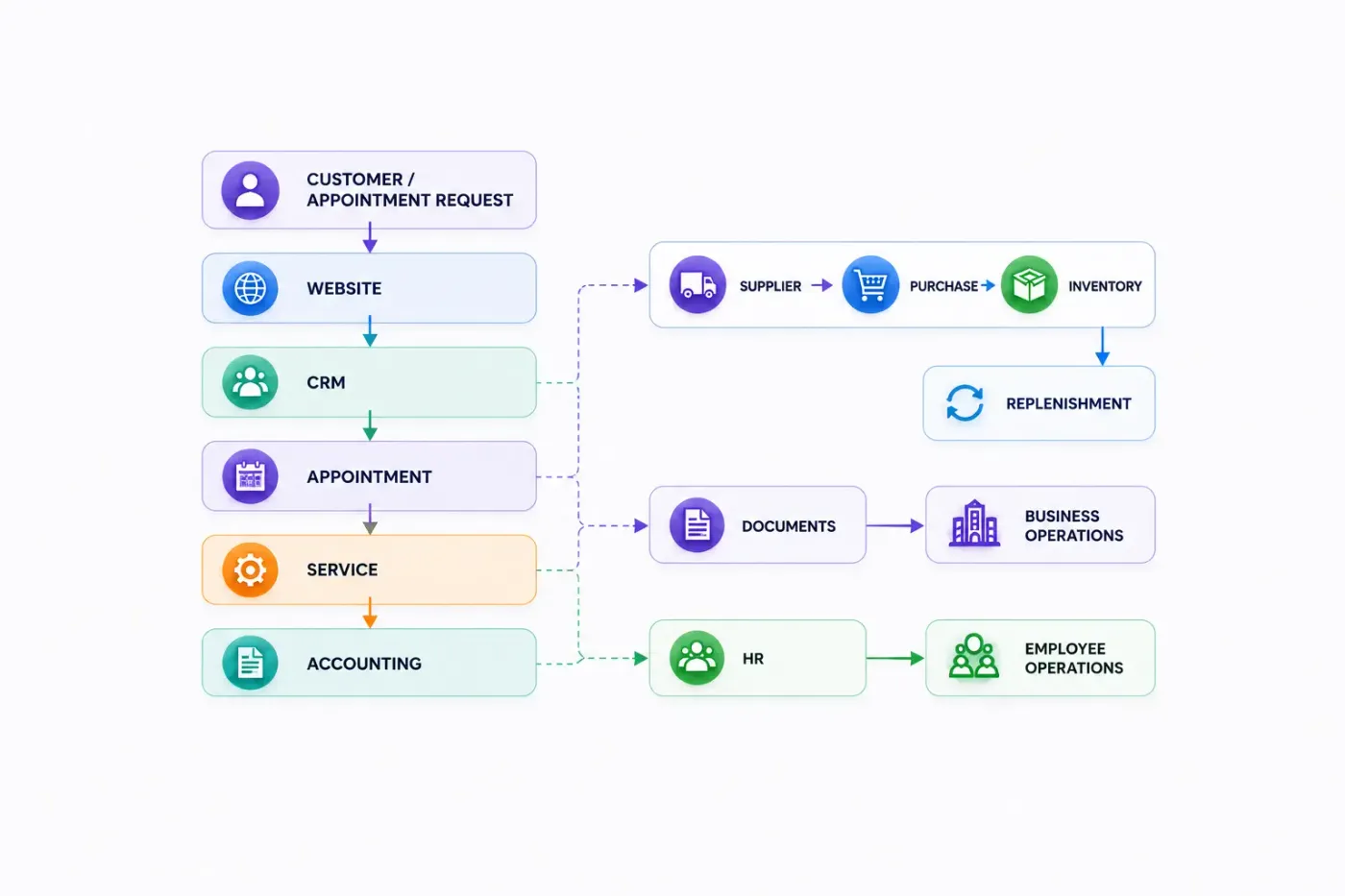
How Odoo connects healthcare operations

A booked appointment creates the activity; consumables used are issued from the same stock purchasing replenishes; billing posts against the same contact record; and expiry is tracked on the batch rather than on a wall chart.

  • Appointments bookable online and at the desk, against real resource availability
  • Pharmacy and consumable batches tracked with expiry and FEFO removal
  • Purchasing driven by actual consumption rather than by a monthly guess
  • Billing and receipts posted against the same patient contact record
Diagram of connected healthcare operations in Odoo ERP
Connected operations — how the healthcare applications above share one database.
Expertise · how we work

What we settle in week one of a healthcare implementation

These are the configuration decisions that are cheap to make now and structural to change later. We walk through each one before a single record is migrated.

  1. Where the clinical boundary sits

    Exactly which records live in Odoo and which stay in your HIS or EMR. Getting this vague is how a healthcare ERP project loses a year.

  2. Expiry and removal strategy

    First-expiry-first-out has to be configured deliberately, with lot tracking on the products that need it. Without it, expiry write-offs are discovered by counting.

  3. Pharmacy and consumables separation

    Different locations, different costing and different access rights. Mixing them makes both harder to control.

  4. Billing model

    Item-wise, package, or a mix with insurance and corporate accounts. This decides the product structure, not just the invoice layout.

  5. Access rights by role

    Who can see which contact records, which documents and which financials. In healthcare this is a confidentiality requirement before it is a convenience.

  6. Appointment resources

    Whether a slot books a doctor, a room, a machine or all three. Booking the wrong resource is what produces double-booked equipment.

  7. Roster and shift rules

    Clinical shift patterns rarely match a standard working calendar, and payroll depends on getting this right from the start.

Business models

Odoo for different healthcare business models

The right configuration depends on how your business actually operates, not on your sector label.

Single-clinic practices

One location, a handful of practitioners, where simplicity matters more than configuration depth.

Multi-speciality clinics

Several departments sharing stock and billing but needing their own schedules and profitability.

Hospitals

Inpatient and outpatient flows, department-level accounting, and a clinical system Odoo must sit alongside.

Diagnostic centres

Test catalogues, sample handling, reagent stock with expiry, and report delivery.

Pharmacy-led operations

Retail pharmacy with batch, expiry and scheduled-drug control as the primary constraint.

Equipment distributors and service

Supplying and servicing medical equipment, with AMC contracts and spare parts.

Trust · honest advice

Where Odoo needs work for healthcare businesses

We would rather say this before you buy licences than after. These are the areas where we scope real development, recommend a bolt-on, or tell you Odoo is the wrong tool.

Clinical records and EMR

Odoo is not an electronic medical record and is not certified as one. Diagnosis, prescriptions and clinical notes belong in a clinical system that Odoo integrates with.

Regulatory certification

Healthcare data and clinical software carry certification requirements that vary by country. Odoo meets none of them out of the box and we will say so plainly.

Insurance claim processing

Claim submission, adjudication and reimbursement tracking against insurers almost always needs development or a specialist system.

Scheduled drug compliance

Narcotic and scheduled-drug registers with statutory formats are country-specific and need custom work.

Lab instrument interfaces

HL7 and instrument integrations are a specialist domain. They can be built, and they are not a configuration setting.

Bed and ward management

Inpatient bed allocation, transfers and occupancy need either a hospital module or custom development.

Our services

Odoo healthcare ERP implementation services

Implementing Odoo for healthcare needs more than installing the applications. Your ERP should reflect how your operations actually run.

  1. Requirement analysis

    Understand your appointment flow, which clinical system you keep, how you bill, how pharmacy and consumables are controlled today, and your staffing patterns.

  2. Workflow design

    Map appointment, consumption, billing and purchasing flows onto Odoo, and fix the clinical boundary and the expiry strategy before anything is configured.

  3. Odoo configuration

    Configure the applications above around your requirements rather than installing them at their defaults.

  4. Data migration

    Prepare and migrate masters, open items and opening balances. Data cleaning is scoped explicitly, because it is usually the largest single task. See Odoo migration.

  5. Integration & customisation

    Connect the systems you are keeping and build only what configuration genuinely cannot reach. See integration and customization.

  6. Testing & user training

    Your own team runs real transactions in a test database before go-live. Role-based training for the people who key them daily. See Odoo training.

  7. Go-live & support

    Cutover planning, opening balance freeze, hypercare in the first weeks, then ongoing support and AMC.

Trust · what it costs

What an Odoo implementation costs for healthcare businesses

We do not publish one implementation price, because the same application list costs very differently depending on the factors below. We do publish what moves the number, and the price is fixed in writing before work starts.

  • Clinical system integrationWhether Odoo must exchange data with an HIS or EMR, and in which direction. This is usually the largest scope item.
  • Billing complexityItem-wise billing is simple. Packages, insurance, corporate accounts and department splits are configuration and sometimes development.
  • Number of departmentsEach one adds schedules, access rights, stock control and profitability reporting.
  • Pharmacy scopeRetail pharmacy with batch, expiry and scheduled-drug control is a project of its own.
  • Staffing and payroll rulesShift patterns, allowances and statutory requirements drive HR configuration effort.
  • Data migration qualityPatient contact and supplier masters are usually messier than expected, and cleaning is scoped explicitly.
Why us

Why choose OdooBots for Healthcare ERP implementation

We are explicit about where Odoo stops. Our healthcare work includes Daisy Hospitals, where we centralised patient records, consultations, laboratory reports, billing and inventory — and we scope the clinical boundary in writing before anything is built.

Based inAmbattur, ChennaiTamil Nadu 600053, India
Phone+91 98414 81435Mon–Sat, business hours IST
Delivered630+ Odoo projects30+ consultants and developers
Versions supportedOdoo 16 – 19Community and Enterprise
FAQ

Odoo ERP for healthcare: frequently asked questions

What is Odoo ERP for healthcare?
Odoo ERP for healthcare manages the operation around care: appointments, patient and referrer contact records, pharmacy and consumable inventory, purchasing, billing, documents and staff management. It is an ERP, not a clinical records system.
Can Odoo manage healthcare appointments?
Yes. Odoo Appointments provides bookable resources and time slots with online booking and reminders, linked to the contact record and to the staff member delivering care. Deciding whether a slot books the practitioner, the room or the equipment is a configuration decision worth making carefully.
Can Odoo connect appointments with CRM?
Yes. Appointments, enquiries and follow-up activity all sit against the same contact record, so a referral, a booking and a follow-up call are one history rather than three.
Can Odoo manage healthcare inventory?
Yes, including lot tracking with expiry dates and a first-expiry-first-out removal strategy so near-expiry batches leave first. Pharmacy and general consumables are usually kept in separate locations with different access rights.
Can Odoo connect purchasing with inventory?
Yes. Replenishment is driven by actual consumption through reordering rules, and rate contracts with suppliers can be held against each product.
Can Odoo manage healthcare accounting and billing?
Yes: patient billing, package billing, receipts, corporate and insurance accounts, and department-level profitability. Insurance claim adjudication and reimbursement tracking, however, usually need development or a specialist system.
Is Odoo an EMR or hospital information system?
No, and this is the most important thing to be clear about. Odoo is not an electronic medical record, is not certified as clinical software, and should not hold diagnoses or prescriptions. Where a clinical system exists, Odoo integrates with it and runs the business operation underneath.
Can Odoo support healthcare employees and HR operations?
Yes. Staff master, rosters, attendance, leave and payroll, including the shift patterns clinical staffing runs on. Shift rules are worth settling before go-live because payroll depends on them.
References

Sources and official documentation

Product capabilities stated on this page are documented by Odoo. The configuration advice and limitations come from our own implementations.

Ready to connect your healthcare operations with Odoo?

Tell us which clinical system you keep and how you bill today. Those two answers define the scope, and we put the clinical boundary in writing before anything is built.