OdooBots
Loading
Industry · Trading

Odoo ERP for Trading

A trading business makes its margin in the gap between what it buys for and what it sells for — and loses it to stock nobody could see, pricing nobody could enforce, and import costs that arrived after the sale was made.

Odoo connects CRM, sales, purchase, inventory and accounting so availability, price and true landed cost are the same numbers everyone is working from.

Arun KumarOdoo Functional Consultant, 8+ years| Reviewed by Suresh Babu| Updated 18 October 2026| Covers Odoo 16–19, Community & Enterprise
0Odoo projects delivered
0Consultants & developers
LandedCost on every import
ChennaiAmbattur, Tamil Nadu
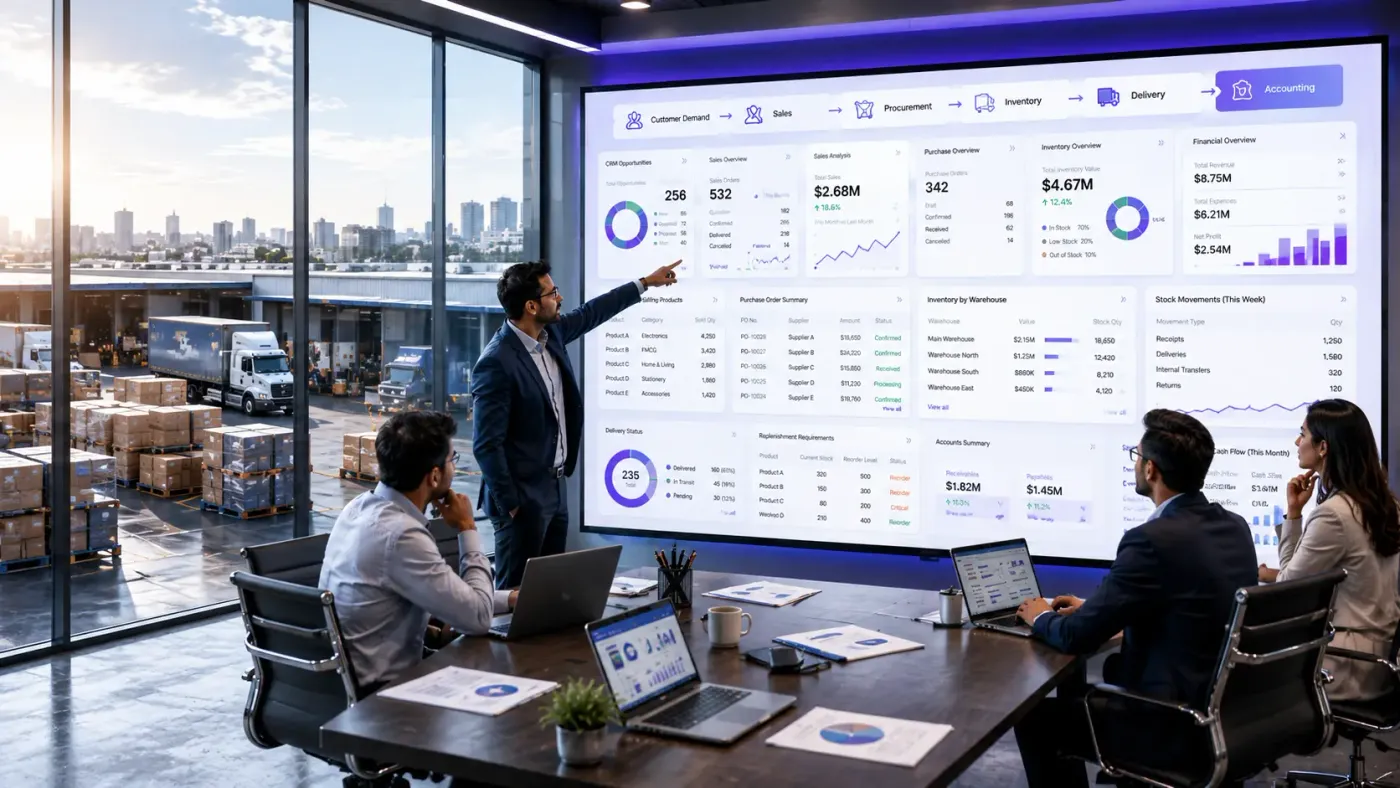
Odoo ERP for trading — an ERP dashboard in use in the trading sector
AM
Anchor Marine Equipment …our trading project

Businesses running Odoo with OdooBots

Dhanalakshmi Industries logo Sanjeev Autoparts logo Electro Flux Equipments logo Anchor Marine Equipment Company logo NEXG logo PV Constructions logo SESS logo
Definition

What is Odoo ERP for trading?

Odoo ERP for trading connects buying, selling, stock and accounting in one database. Customer-specific and quantity-based pricelists control what is quoted, live stock across warehouses controls what can be promised, purchase and landed cost control what the margin actually is, and accounting posts it all without re-keying.

For importers, landed cost configuration is the difference between a margin report that is right and one that is confidently wrong. Freight, duty and clearing must attach to the receipt, not to a general expense account.

Pricelist
Rules that set price by customer, quantity, currency or date. This is how discounting stops being personal.
Landed cost
Freight, duty, insurance and clearing added onto the product cost at receipt, so margin is real.
Multi-warehouse
Separate stock locations with their own reordering rules and inter-warehouse transfers.
Replenishment
Reordering rules per product per warehouse, so buying follows demand instead of memory.

Experience · our own project

A trading business we implemented Odoo for

Taken from the project itself, not from a capability list.

Anchor Marine Equipment Company LLC logo

Anchor Marine Equipment Company LLC

Marine equipment trading & service · Gulf
What we implemented

Integrated CRM, sales, inventory, service operations, purchasing, job costing, invoicing and financial reporting on one Odoo ERP platform.

Why it mattered

Trading and service were run as separate businesses sharing a stock room. Putting them on one platform meant a part issued to a service job and a part sold over the counter finally came out of the same stock figure.

See every industry we implement Odoo for, or the full Odoo ERP implementation service.

Modules

Odoo trading modules for your business

Odoo connects the five applications a trading business actually runs on: CRM for enquiries, Sales for quotations and orders, Purchase for supplier management, Inventory for stock across locations, and Accounting underneath.

CRM

Enquiries from phone, website and WhatsApp captured as leads, assigned by rules rather than by whoever is free, with activity tracking that survives a salesperson leaving.

Lead captureAssignmentPipeline

Sales

Quotation templates, customer pricelists, quantity breaks, discount approval limits and delivery dates checked against live stock before they are promised.

PricelistsApprovalsAvailability

Purchase

RFQs to multiple suppliers, vendor pricelists, purchase agreements and approval limits, with replenishment driven by reordering rules per warehouse.

RFQVendor pricingReplenishment

Inventory

Multiple warehouses and locations, internal transfers, lot and serial tracking where it is needed, and landed cost applied to receipts.

Multi-warehouseTransfersLanded cost

Accounting

Customer invoices, vendor bills, GST and e-invoice, multi-currency for import and export, and the margin reports that make sense of all of it.

GSTMulti-currencyMargin
Workflow

How Odoo connects trading operations

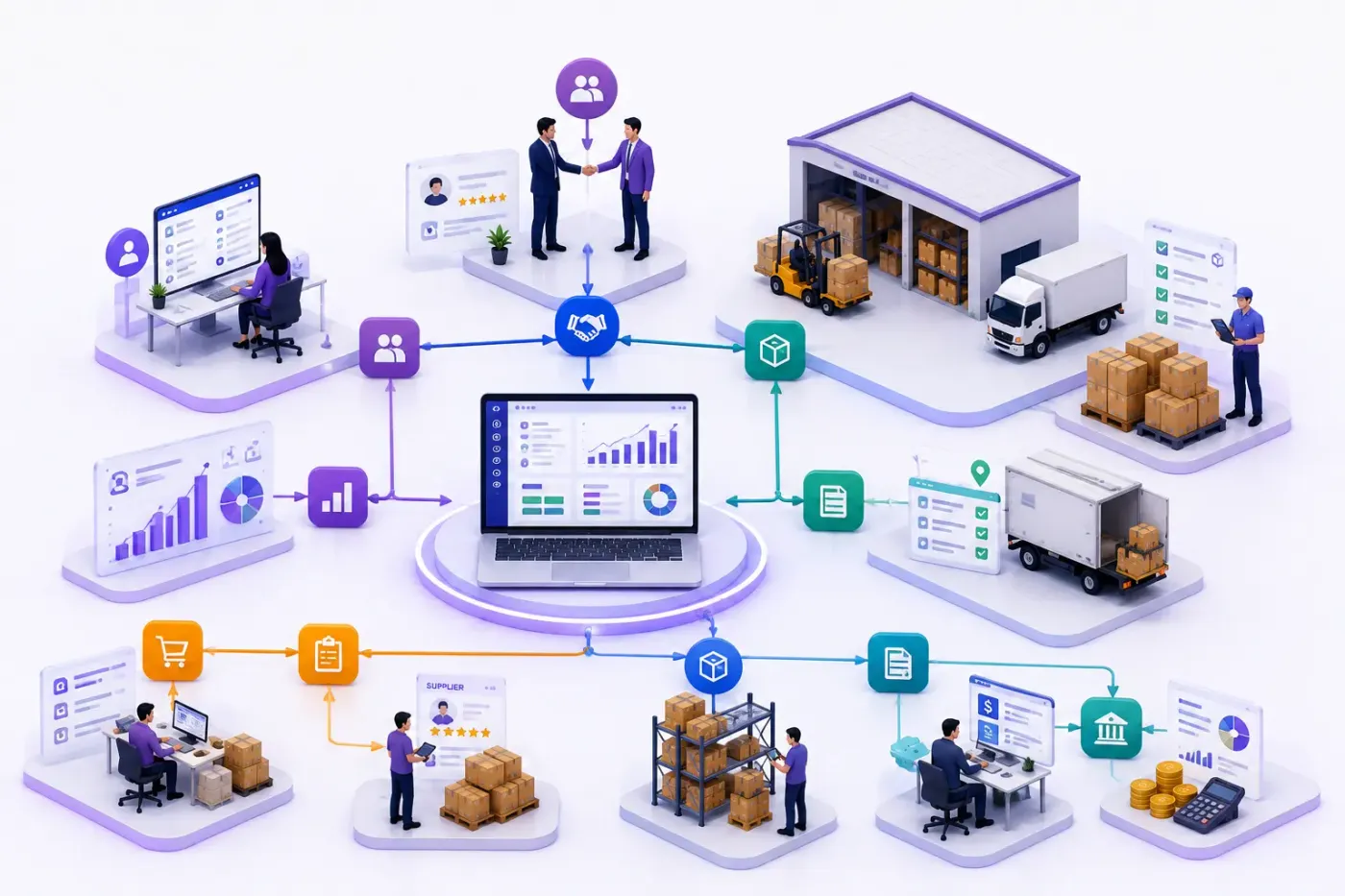
A quotation checks live availability before it promises a date. A confirmed order creates the delivery and, where stock is short, the purchase requirement. The receipt carries landed cost into the product value, so the invoice posts a margin that is true.

  • Customer-specific and quantity-break pricing applied automatically, not from memory
  • Live stock across every warehouse visible at quotation time
  • Freight, duty and clearing landed onto product cost at receipt
  • Reordering rules per warehouse so buying follows real demand
Diagram of connected trading operations in Odoo ERP
Connected operations — how the trading applications above share one database.
Expertise · how we work

What we settle in week one of a trading implementation

These are the configuration decisions that are cheap to make now and structural to change later. We walk through each one before a single record is migrated.

  1. Costing method per product category

    Standard, FIFO or AVCO. For importers with moving exchange rates and freight, this choice decides whether your margin report is believable.

  2. Landed cost treatment

    Whether freight, duty, insurance and clearing attach to the receipt or get expensed. Expensing them is simpler and makes product margin meaningless.

  3. Pricelist strategy

    Customer pricelists, quantity breaks, currency and validity dates agreed up front, so discounting becomes a rule rather than a negotiation each time.

  4. Warehouse steps

    One, two or three-step receipts and deliveries. Three-step gives you a quality or staging gate and costs training; one-step is faster and sees less.

  5. Lot and serial depth

    Tracking everything doubles data entry. We track only where warranty, recall or a customer contract genuinely requires it.

  6. Reordering rules vs manual buying

    Which products are on automatic replenishment and which are bought on judgement. Running both on the same product creates duplicate purchase orders.

  7. Credit limits and blocking

    Whether Odoo warns or actually blocks an order for a customer over limit, and who can override. This is a policy decision before it is a setting.

Business models

Odoo for different trading business models

The right configuration depends on how your business actually operates, not on your sector label. Two companies with the same description on paper often need different warehouse steps, different approval chains and different reports.

  • Wholesale trading — Volume, quantity-break pricing and credit control; margin is thin so pricing discipline matters most.
  • Distribution businesses — Territory, route and multi-warehouse stock, with replenishment driven by regional demand.
  • Multi-product traders — Wide catalogue, variable demand, and reordering rules that have to be set per product rather than by a blanket policy.
  • Import and export operations — Multi-currency, landed cost, documentation and long lead times that make forecasting the control point.
  • Multi-location organisations — Several branches sharing suppliers and customers, with inter-branch transfers and consolidated reporting.
  • Trading with service — Parts sold and parts consumed on service jobs coming out of the same stock, as at Anchor Marine.
Odoo ERP configured for different trading business models
Business models — the same applications, configured differently for each operating model.
Trust · honest advice

Where Odoo needs work for trading businesses

We would rather say this before you buy licences than after. These are the areas where we scope real development, recommend a bolt-on, or tell you Odoo is the wrong tool.

Complex import documentation

Bills of lading, certificates of origin and letters of credit are not modelled natively. They are usually attachments plus custom fields, and sometimes a separate system.

Advanced demand forecasting

Odoo replenishes from reordering rules and forecast demand; it is not a statistical forecasting engine with seasonality modelling.

Commission schemes

Layered sales commission by product, margin and tier almost always needs development. The standard commission handling is basic.

Rebates and supplier claims

Volume rebates, supplier claims and retrospective discounts are not native and need custom logic to accrue correctly.

Very high SKU counts

Catalogues in the hundreds of thousands need infrastructure planning and careful module choices, not a default hosting plan.

Route and van sales

Van stock, route planning and mobile invoicing need a dedicated app or significant customisation.

Our services

Odoo trading ERP implementation services

Implementing Odoo for trading needs more than installing the applications. Your ERP should reflect how your operations actually run.

  1. Requirement analysis

    Understand your product catalogue, pricing structure, warehouse layout, supplier terms, import process and how you currently decide what to buy.

  2. Workflow design

    Map quote-to-cash and procure-to-pay onto Odoo, and settle costing method and landed cost treatment before any stock is loaded.

  3. Odoo configuration

    Configure the applications above around your requirements rather than installing them at their defaults.

  4. Data migration

    Prepare and migrate masters, open items and opening balances. Data cleaning is scoped explicitly, because it is usually the largest single task. See Odoo migration.

  5. Integration & customisation

    Connect the systems you are keeping and build only what configuration genuinely cannot reach. See integration and customization.

  6. Testing & user training

    Your own team runs real transactions in a test database before go-live. Role-based training for the people who key them daily. See Odoo training.

  7. Go-live & support

    Cutover planning, opening balance freeze, hypercare in the first weeks, then ongoing support and AMC.

Trust · what it costs

What an Odoo implementation costs for trading businesses

We do not publish one implementation price, because the same application list costs very differently depending on the factors below. We do publish what moves the number, and the price is fixed in writing before work starts.

  • Catalogue size and variantsProduct master cleanliness drives migration effort more than any other factor in trading.
  • Number of warehousesEach location adds configuration, transfer routes, reordering rules and training.
  • Pricing complexityA single price list is quick. Customer-specific, quantity-break, multi-currency pricing with approval limits is real configuration.
  • Import and multi-currencyLanded cost, exchange differences and import documentation each add scope.
  • IntegrationsMarketplaces, eCommerce, e-invoice, e-way bill and shipping providers are each separately scoped.
  • Opening stock accuracyIf physical stock and system stock do not agree on day one, nothing downstream is trusted. Counting is part of the project.
Why us

Why choose OdooBots for Trading ERP implementation

Trading implementations fail on two things: product master data and landed cost. We scope both explicitly rather than discovering them in month three, and we have delivered trading and distribution ERP including Anchor Marine Equipment Company LLC in the Gulf.

Based inAmbattur, ChennaiTamil Nadu 600053, India
Phone+91 98414 81435Mon–Sat, business hours IST
Delivered630+ Odoo projects30+ consultants and developers
Versions supportedOdoo 16 – 19Community and Enterprise
FAQ

Odoo ERP for trading: frequently asked questions

What is Odoo ERP for trading?
Odoo ERP for trading connects CRM, sales, purchase, inventory and accounting in one database, so quoted price, promised availability, true landed cost and posted margin all come from the same records.
Can Odoo support multi-warehouse trading operations?
Yes. Odoo handles multiple warehouses and internal locations, inter-warehouse transfers, and reordering rules set per product per warehouse so each location replenishes against its own demand.
Can Odoo connect sales with purchasing and inventory?
Yes. A confirmed sales order creates the delivery and, where stock is short, the purchase requirement. Availability is checked at quotation time rather than discovered at dispatch.
Can Odoo support import and export trading operations?
Yes. Multi-currency purchasing and selling, exchange difference handling, and landed cost so freight, duty, insurance and clearing are added to product cost at receipt. Import documentation such as bills of lading and certificates of origin is usually handled as attachments with custom fields.
Can Odoo support different customer and supplier pricing?
Yes. Pricelists set price by customer, quantity break, currency and validity date, on both the sales and purchase side, so pricing is enforced by rule instead of remembered.
How does Odoo calculate margin for an importer?
Correctly, if landed cost is configured. Freight, duty and clearing are added to the product value on the receipt, which means the cost of goods sold on the invoice reflects what the item really cost to land. If those charges are expensed separately instead, product margin looks better than it is.
Can Odoo block orders for customers over their credit limit?
Yes, and you choose whether it warns or blocks, and who may override. This is worth deciding as a policy before it is configured as a setting.
Can OdooBots implement Odoo ERP for trading businesses?
Yes. Our trading implementations include Anchor Marine Equipment Company LLC, covering CRM, sales, inventory, service operations, purchasing, job costing, invoicing and financial reporting on one platform.
References

Sources and official documentation

Product capabilities stated on this page are documented by Odoo. The configuration advice and limitations come from our own implementations.

Ready to connect your trading operations with Odoo?

Tell us your catalogue size, how many warehouses you run and whether you import. Those three answers shape most of the configuration, and the diagnosis call is free.