

Choosing Odoo is only the first step. The more important question is what you should expect from the company implementing it.
If your business is dealing with disconnected systems, manual processes, limited visibility, duplicate data, or difficult workflows, an Odoo implementation can help create a more connected operating environment. However, the outcome depends heavily on how the implementation is planned and delivered.
Before choosing an Odoo ERP implementation company, you may want clear answers to these questions:
- Will Odoo fit our current business processes?
- Which Odoo applications do we actually need?
- Can our existing data be migrated accurately?
- Can Odoo integrate with our current systems?
- When is customization necessary?
- What training and support will employees receive?
- How will we know whether the implementation is delivering value?
Understanding what to expect helps you define requirements, evaluate implementation companies, avoid unnecessary customization, and choose an approach that fits your business.
What Does an Odoo ERP Implementation Company Do?
An Odoo ERP implementation company helps your business turn its operational requirements into a working Odoo system.
Depending on your requirements, this may include business analysis, process assessment, Odoo configuration, customization, data migration, integrations, testing, user training, go-live preparation, and post-go-live support.
The exact scope should depend on your business processes, users, locations, existing systems, and operational requirements.
The key question is not simply:
“Can this company implement Odoo?”
It is:
“Can this company understand our business problems and translate them into a practical Odoo solution?”
That distinction matters when comparing implementation partners because a successful implementation should be based on your business requirements, not just the technical deployment of Odoo.
What Should You Expect Before Hiring an Odoo Implementation Company?
Before you agree to an implementation, the company should first understand how your business operates and what you need Odoo to solve.
A professional discussion should cover:
- Current processes: How your teams manage key business operations.
- Existing systems: Which software, spreadsheets, or applications you currently use.
- Business problems: Where manual work, delays, errors, duplicate data, or limited visibility affect operations.
- Requirements: Your workflow, reporting, approval, integration, and business-specific needs.
- Future needs: How your users, locations, or processes may change as the business grows.
This gives the implementation company a clear basis for defining the implementation scope.
Start With Your Business Problems
Before choosing Odoo applications, identify the problems you want the ERP to solve.
Ask:
- Where are we doing too much manual work?
- Which processes cause delays or errors?
- Where do departments lack visibility?
- Which tasks depend on spreadsheets or disconnected systems?
Once these problems are clear, they can be mapped to business requirements and then evaluated against standard Odoo functionality, configuration, integration, or customization.
This problem-first approach helps ensure that your Odoo setup is based on what your business needs to improve, rather than simply which applications are available.
How Should an Implementation Company Understand Your Business Processes?
Your implementation partner should understand how work and information move across your business rather than simply recommending Odoo applications.
This may involve reviewing processes across sales, purchasing, inventory, warehouse operations, manufacturing, accounting, projects, customer support, eCommerce, and other relevant areas.
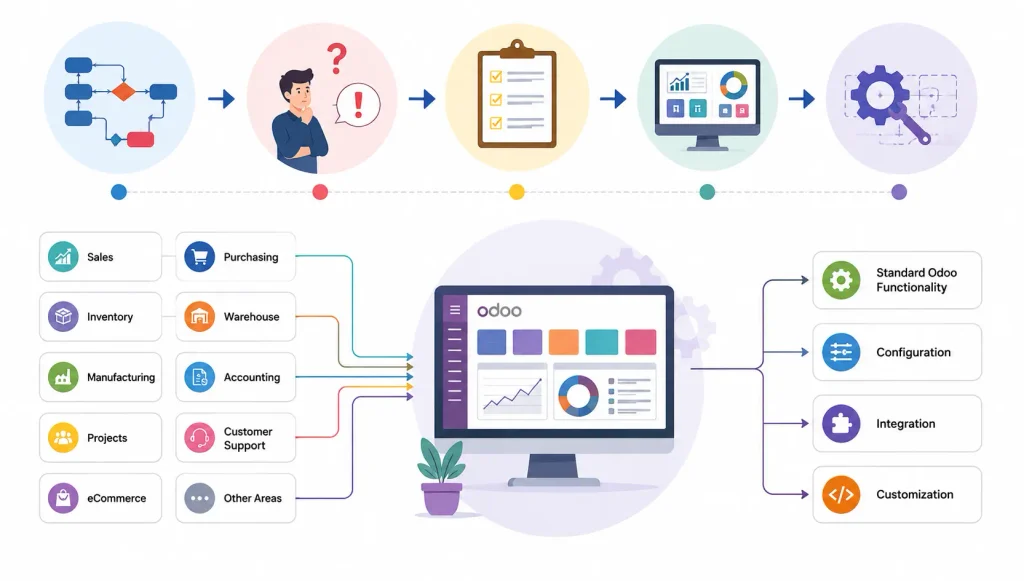
Existing process → Business problem → Business requirement → Odoo functionality → Configuration or customization
This helps identify what needs to change, why it needs to change, and how Odoo can support the required workflow.
It also provides a clearer basis for deciding whether a requirement can be handled through standard Odoo functionality, configuration, integration, or custom development.
Should You Implement Every Odoo Application?
No.
The right Odoo setup should be based on your business requirements, not on the number of applications available.
Your implementation company should explain:
- Which applications are relevant to your business
- Why each application is needed
- How it supports your workflows
- Whether the requirement can be handled without additional development
A focused Odoo environment can be easier for employees to use and manage than a system containing unnecessary applications and processes.
When Do You Need Odoo Customization?
Not every business requirement requires customization.
An implementation company should first determine whether standard Odoo functionality or configuration can meet the requirement.
Customization may be appropriate for specific business workflows, calculations, reports, automation, portals, or integrations that cannot reasonably be handled through standard functionality.
Before approving custom development, ask:
- Why can’t standard Odoo handle this requirement?
- What business problem will the customization solve?
- How could it affect maintenance and future upgrades?
- Is the additional complexity justified by the business benefit?
This helps prevent customization from being added simply because a requirement is different from the standard Odoo workflow.
What Should You Expect From Data Migration?
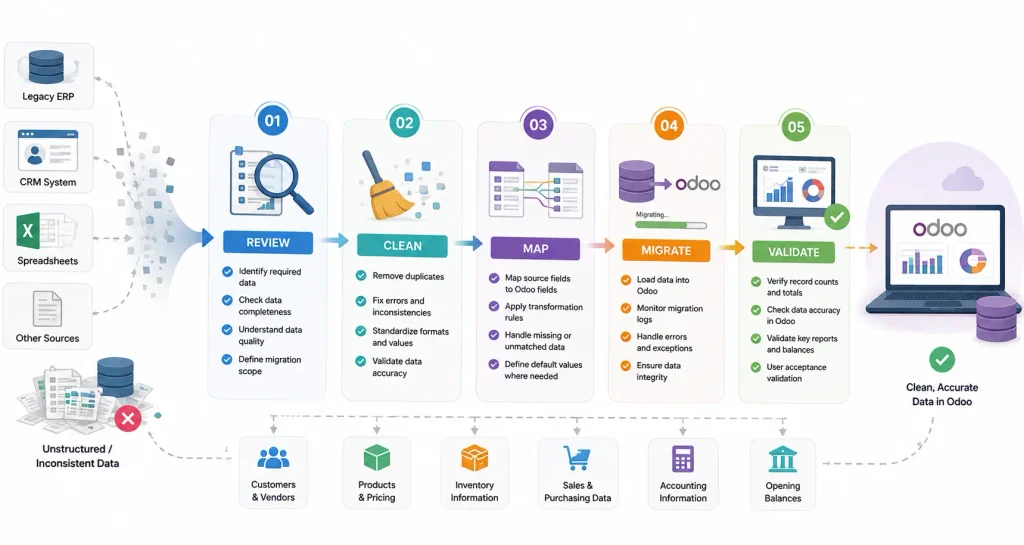
If your business is moving from an existing ERP, CRM, accounting system, or spreadsheets, your implementation company should help determine which data needs to move into Odoo.
This may include:
- Customers and vendors
- Products and pricing
- Inventory information
- Sales and purchasing data
- Accounting information
- Opening balances
Review → Clean → Map → Migrate → Validate
The goal is not necessarily to move every historical record. It is to ensure that the data required for your business is accurate, usable, and correctly mapped into Odoo.
You should also clarify who is responsible for data preparation, migration, validation, and resolving migration issues.
What Should You Expect From Odoo Integrations?
If your business relies on external systems, your implementation company should identify integration requirements before go-live.
These may include payment platforms, shipping systems, marketplaces, banking systems, eCommerce platforms, or other business applications.
You should understand:
- Which systems will be connected
- What information will be exchanged
- How synchronization will work
- What happens if synchronization fails
- Who will maintain the integration
Clear integration planning helps prevent unexpected issues after deployment and ensures that Odoo works effectively with the other systems your business relies on.
What Should You Expect From Odoo Testing, Training and Go-Live?
Testing should focus on the business workflows your employees actually use.
The implementation company should verify that the required workflows work correctly, including relevant permissions, reports, integrations, customizations, inventory processes, and accounting requirements.
Training should be based on employee roles and daily responsibilities. The goal is not to teach every Odoo feature, but to help employees perform their required workflows confidently.
Before go-live, your implementation company should confirm that:
- Data is ready and validated
- User access is configured
- Key workflows have been tested
- Required integrations are working
- Employees have received training
- Critical issues are addressed
- Go-live responsibilities are clear
You should also know who will handle important issues during and immediately after launch.
For more information about implementation timelines, see our guide on how long Odoo ERP implementation takes.
What Should You Expect After Odoo Goes Live?
Go-live is not necessarily the end of the implementation relationship.
Once employees begin using Odoo, you may identify workflow adjustments, additional training needs, reporting changes, integration issues, or new requirements.
Before choosing an implementation company, clarify:
- What post-go-live support is included?
- How are issues reported and resolved?
- How are additional requirements handled?
- Who will support future improvements?
Clear post-go-live support expectations can help your business manage issues and continue improving the Odoo system after launch.
For more detail, see our guide on what happens after Odoo ERP goes live.
How Do You Measure Odoo Implementation Success?
An Odoo implementation should be measured against the business problems it was intended to solve, not simply whether the system has gone live.

- Reduction in manual data entry
- Faster order processing
- Improved inventory visibility
- Fewer duplicate records
- Faster reporting
- Reduced process errors
- Better coordination between departments
- User adoption
The right metrics depend on your original business objectives. Define them before implementation so you can compare the expected outcomes with actual results after go-live.
This creates a clear connection between your business requirements and the value delivered by the Odoo implementation.
What Questions Should You Ask an Odoo ERP Implementation Company?
Before selecting an implementation partner, ask questions that show how the company will approach your business requirements.
Business requirements
- How will you analyze our current processes?
- How will you map our requirements to Odoo?
- What areas of our operations can Odoo improve?
Configuration and customization
- Can our requirements be handled through standard Odoo?
- If customization is required, why is it necessary?
- How could customization affect maintenance and future upgrades?
Data and integrations
- What data should be migrated?
- How will migrated data be validated?
- Which external systems need to be integrated?
Training and support
- How will employees be trained?
- Will training be based on user roles?
- What support is included after go-live?
- How will future requirements be handled?
Clear answers help you compare implementation companies based on their approach, understanding of your business, and ability to deliver the required solution, rather than simply comparing prices.
How Do You Choose the Right Odoo ERP Implementation Company?
The right implementation partner should be able to connect your business requirements with a practical Odoo solution.
When comparing implementation companies, look for:
- Business understanding: Can they understand your current processes and identify what needs to improve?
- Implementation approach: Can they explain how your requirements will be mapped to Odoo?
- Customization discipline: Do they use standard Odoo where appropriate and recommend customization only when necessary?
- Technical capability: Can they handle data migration, integrations, testing, and other technical requirements?
- User adoption: Do they provide practical training based on employee roles?
- Ongoing support: Are post-go-live support and future improvements clearly defined?
- Transparent scope: Are responsibilities, deliverables, timelines, and costs clearly explained?
The best implementation partner is not necessarily the company offering the most applications or the lowest price.
Look for a company that can clearly explain what your business needs, why it needs it, how Odoo can address those requirements, and what you should expect throughout the implementation.
Frequently Asked Questions
An Odoo ERP implementation company helps businesses analyze requirements, configure Odoo, manage necessary customization, migrate data, integrate external systems, test workflows, train users, prepare for go-live, and provide post-implementation support.
Implementation support can be particularly useful when your business has complex workflows, multiple departments or locations, existing data to migrate, third-party integrations, custom requirements, or many users.
No. Many requirements can be handled through standard Odoo functionality and configuration. Customization should be considered when an important business requirement cannot reasonably be addressed through standard functionality.
Ask how they analyze your business processes, map requirements to Odoo, decide between configuration and customization, manage data migration and integrations, test workflows, train users, handle go-live, and provide post-go-live support.
Measure the implementation against your original business objectives. Depending on your requirements, this may include process efficiency, order-processing time, inventory visibility, reporting speed, reduction in manual work, process accuracy, and user adoption.
Conclusion
Choosing an Odoo ERP implementation company should be based on more than technical capability, the number of applications offered, or the lowest price.
The right partner should understand your business problems, connect them to the right Odoo solution, and provide a clear approach to implementation, customization, data migration, integrations, training, and ongoing support.
Start with your business problems and desired outcomes, then evaluate how each implementation company plans to address them.
If you are evaluating Odoo for your organization, explore our Odoo ERP implementation services to discuss your business requirements and implementation needs.

