
Appointments
Bookings by staff, chair or room with duration per service, walk-in handling, reminders and no-show tracking.
SlotsStaffReminders
A salon looks like a service business and is actually three businesses at once: services billed at the chair, retail products sold at the counter, and consumables used behind both. The third one is where the money goes missing.
Odoo holds all three on one database: appointments and billing, retail stock, and consumable usage per service, with commission and outlet margin falling out of the same records instead of being assembled at month end.
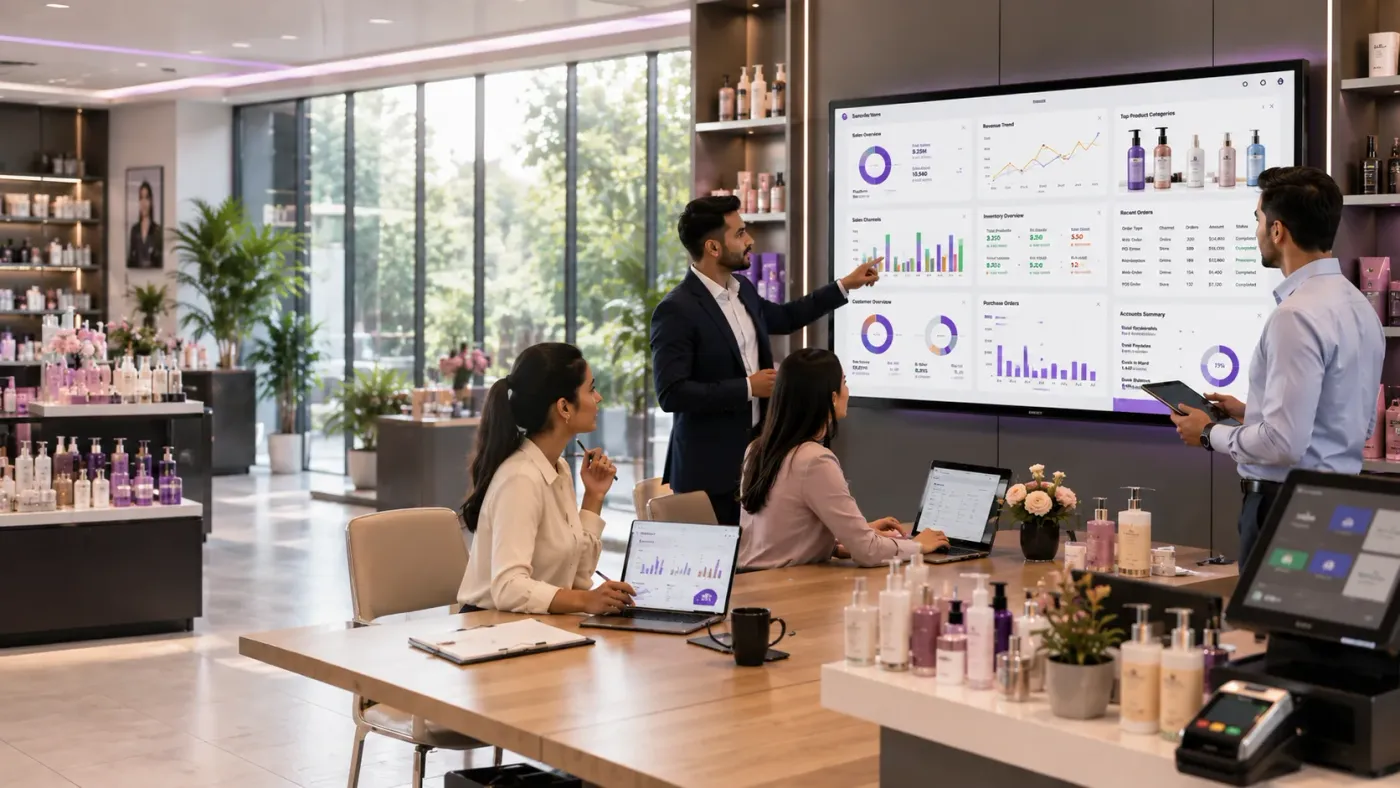
Businesses running Odoo with OdooBots







Odoo ERP for salons and spas bills services and retail at one counter, tracks consumable usage behind services, and settles stylist commission from the same records. Appointments manage bookings by staff and chair, Point of Sale bills service and product together, Inventory separates retail stock from back-bar consumables, prepaid packages and memberships are tracked as balances, and analytic accounting reports margin per outlet.
Consumable usage is the blind spot in salon accounting. Retail stock gets counted because it is sold; back-bar colour, shampoo and wax get used and never reconciled, and that is where a chain quietly loses margin.
Odoo connects what a salon or spa chain runs on: Appointments for bookings, Point of Sale for billing, Inventory for retail and back-bar stock, Purchase for replenishment, Employees for staff and commission, and Accounting for outlet-wise margin.
Bookings by staff, chair or room with duration per service, walk-in handling, reminders and no-show tracking.
One bill for service and retail, package redemption, split payment, discount control and shift-wise closing.
Retail stock for resale and back-bar consumables for service, with expiry on products and outlet-wise counts.
Replenishment per outlet against actual consumption, brand-wise vendor terms and scheme or offer handling.
Stylist and therapist records, shift rosters, attendance and commission on service and retail at different rates.
Outlet-wise profit and loss, package liability, GST on services and products, and daily cash reconciliation.
A booking is made against a stylist and a time slot. At billing, the service and any product sold go on one bill attributed to that stylist, consumables are consumed against the service, and a prepaid package is drawn down rather than re-charged. Commission and outlet margin then come from the records instead of from a reconstruction.
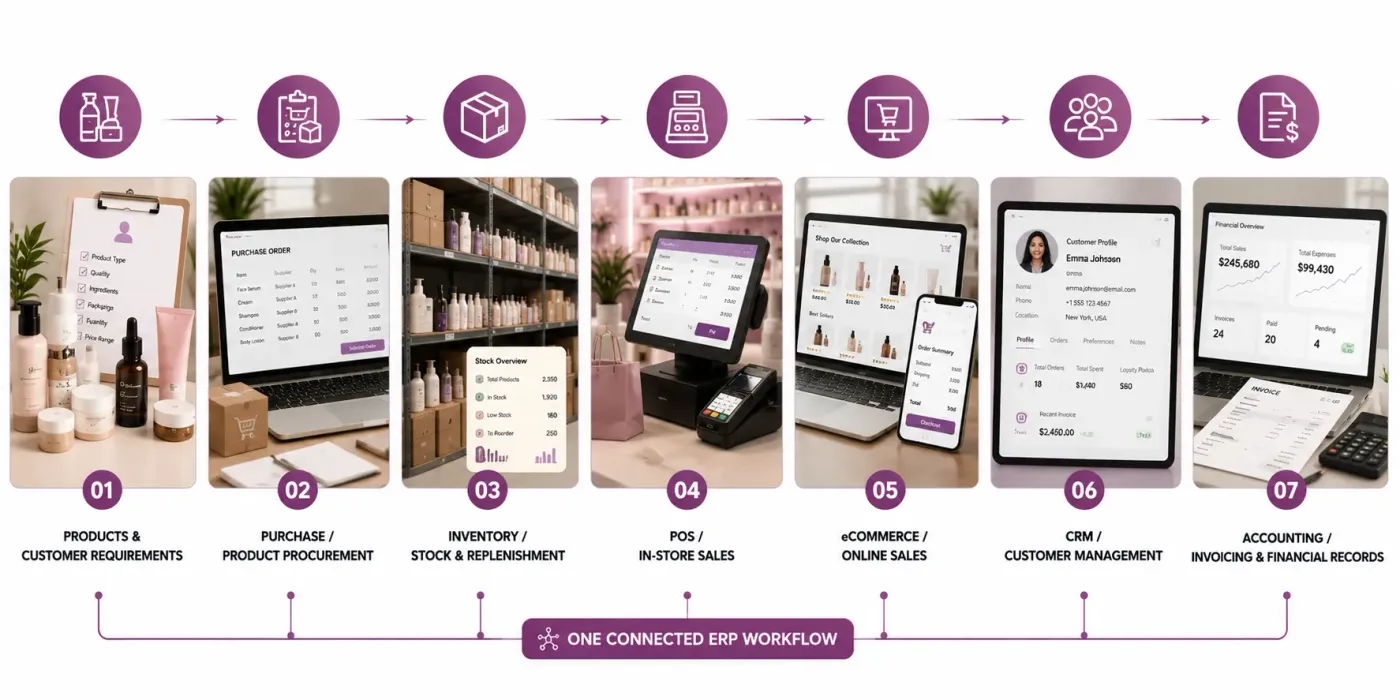
These are the configuration decisions that are cheap to make now and structural to change later. We walk through each one before a single record is migrated.
Whether consumables are a distinct product set consumed against services. Without this, service cost is unknown and stock never reconciles.
Session-based or value-based, transferable or not, with an expiry. This is a liability on your books and should be modelled as one.
Different rates for service and retail, split commission on assisted services, and whether it is on bill value or net of discount.
Who can discount and by how much, enforced at the counter rather than negotiated at the chair.
Standard quantity per service or recorded actual usage. Standard is practical; actual is accurate. Pick deliberately.
Per outlet, and whether per stylist as well. Every sale and cost tags to it, so it is decided first.
Who closes the counter, how cash variance is handled, and what the manager signs each night.
The right configuration depends on how your business actually operates, not on your sector label. Two companies with the same description on paper often need different warehouse steps, different approval chains and different reports.
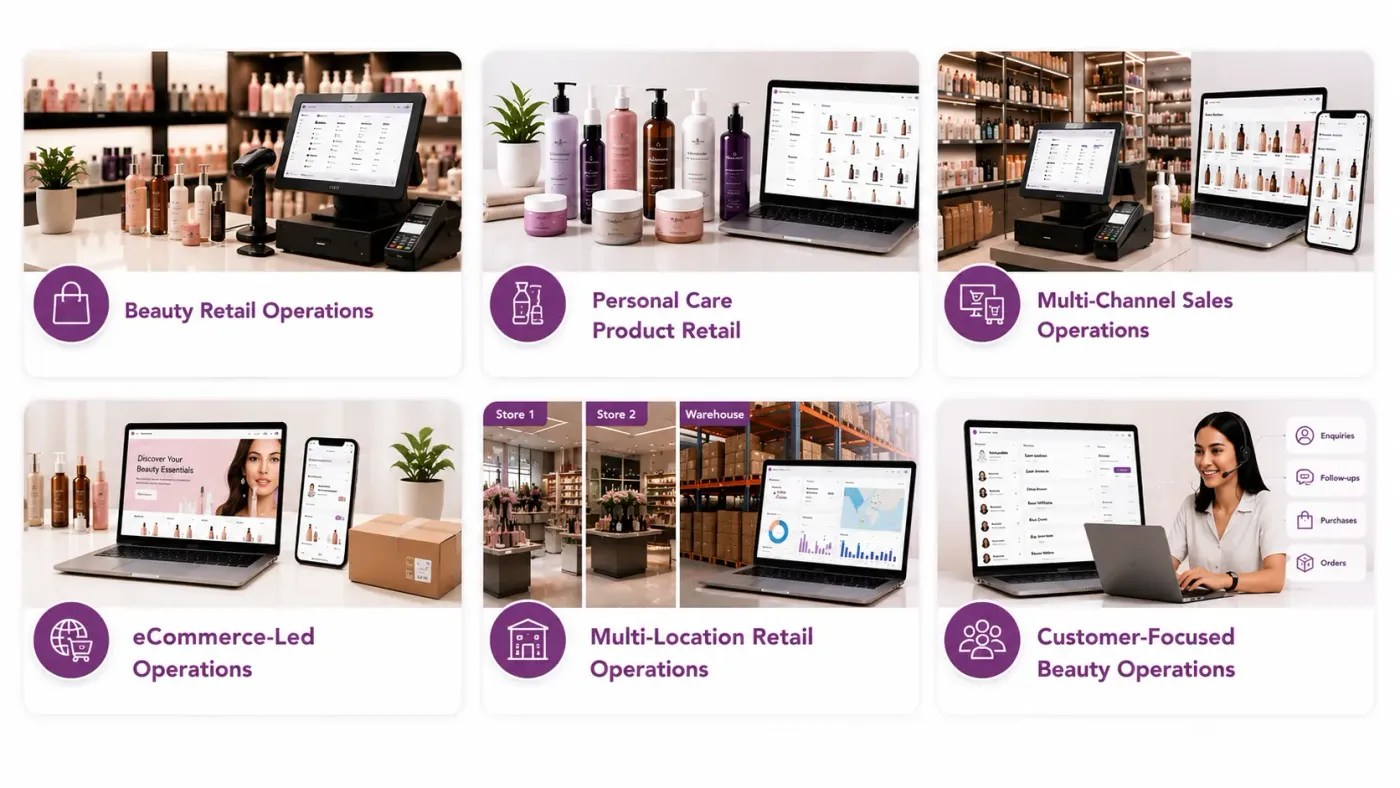
We would rather say this before you buy licences than after. These are the areas where we scope real development, recommend a bolt-on, or tell you Odoo is the wrong tool.
Multi-resource online booking that solves for stylist, room and equipment together usually needs a specialist booking product.
A branded booking and loyalty app is a separate product connected to Odoo rather than an Odoo feature.
Tiered points, referrals and gamified rewards go beyond standard loyalty configuration and need development.
For aesthetic clinics, patient clinical history and consent documentation needs careful custom work or a dedicated system.
Behaviour-triggered campaign sequences are better run in marketing tools fed from Odoo data.
Staff biometric attendance devices connect through an integration, not a configuration setting.
Implementing Odoo for beauty & personal care needs more than installing the applications. Your ERP should reflect how your operations actually run.
Understand your service menu, how consumables are used and counted today, your package and commission structures, and how many outlets you run.
Map booking to bill to stock consumption onto Odoo, and settle retail versus back-bar separation and commission rules before configuration.
Configure the applications above around your requirements rather than installing them at their defaults.
Prepare and migrate masters, open items and opening balances. Data cleaning is scoped explicitly, because it is usually the largest single task. See Odoo migration.
Connect the systems you are keeping and build only what configuration genuinely cannot reach. See integration and customization.
Your own team runs real transactions in a test database before go-live. Role-based training for the people who key them daily. See Odoo training.
Cutover planning, opening balance freeze, hypercare in the first weeks, then ongoing support and AMC.
We do not publish one implementation price, because the same application list costs very differently depending on the factors below. We do publish what moves the number, and the price is fixed in writing before work starts.
Every salon counts its retail stock and almost none of them track back-bar consumption, which is exactly where the margin goes. We separate the two in week one, so service cost is a number rather than an assumption.
Product capabilities stated on this page are documented by Odoo. The configuration advice and limitations come from our own implementations.
Tell us how many outlets you run and whether back-bar consumption is tracked today. Those two answers decide most of the configuration, and the diagnosis call is free.