
Manufacturing
Recipe BOMs, batch manufacturing orders, work orders for processing and packing, and by-product handling where a batch yields more than one output.
RecipesBatchesBy-products
Food and beverage businesses lose margin in two places: yield that nobody measures and stock that expires on the shelf. Both are invisible until the month closes.
Odoo connects recipe production, batch and expiry traceability, quality checks and costing so yield variance and near-expiry stock are visible while you can still do something about them.
Businesses running Odoo with OdooBots







Odoo ERP for food and beverage manages recipe-based production, batch and expiry traceability, quality checks and cost per batch. BOMs hold recipes, manufacturing orders produce tracked batches with shelf-life dates, first-expiry-first-out removal drives picking, quality control points gate release, and lot genealogy supports the traceability a food safety authority expects.
Yield is the number most food businesses do not measure properly. Odoo records expected versus actual output per batch, which turns a vague sense that "we lose some" into a figure per product per month.
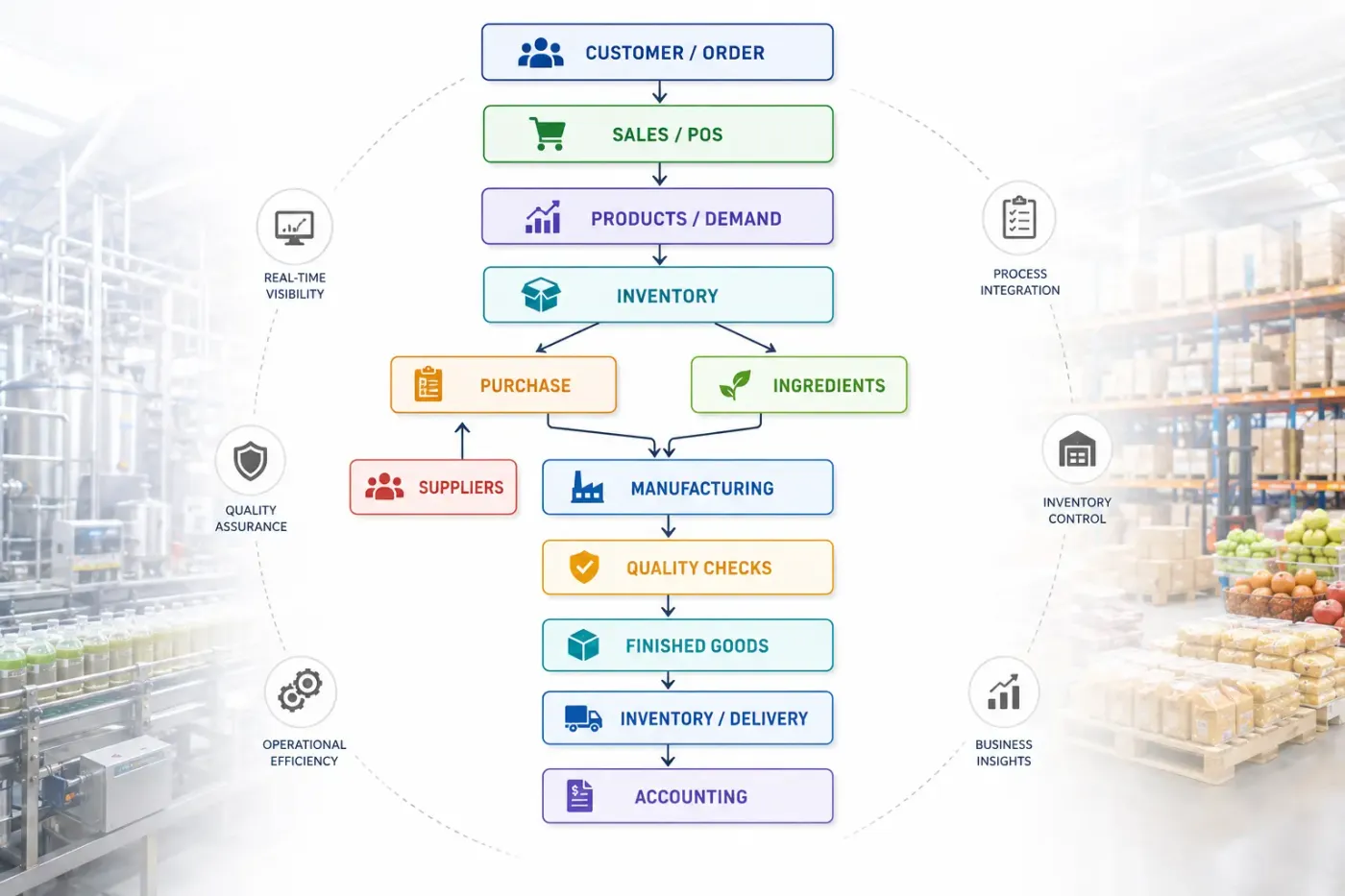
Odoo connects the applications food production depends on: Manufacturing for recipe batches, Inventory for lot and expiry control, Quality for checks, Purchase for ingredient sourcing, Sales for distribution and Accounting for cost and margin.
Recipe BOMs, batch manufacturing orders, work orders for processing and packing, and by-product handling where a batch yields more than one output.
Lot tracking with expiry, best-before, removal and alert dates, and FEFO removal so near-dated stock leaves first.
Checks on ingredient receipt, in process and before release, with measurements recorded against the batch and alerts raised on failures.
Ingredient sourcing with approved suppliers, incoming quality checks and lead times that reflect perishable supply.
Customer pricing, order capture and delivery against live batch availability, including allocation of specific shelf life to specific customers.
Batch costing, yield variance, write-off visibility, GST and e-invoice, and margin by product and customer.
An ingredient lot arrives with its own expiry. A manufacturing order consumes it against the recipe and produces a batch with a shelf life. Picking takes the earliest expiry first. Actual yield against expected is recorded as the batch closes.
These are the configuration decisions that are cheap to make now and structural to change later. We walk through each one before a single record is migrated.
Which of expiry, best-before, removal and alert dates you actually use, and how each is calculated from production date. Using all four without deciding why is a common source of confusion.
Removal strategy set where shelf life matters rather than globally. This is the configuration that prevents expiry write-offs.
Fixed quantities or scalable batch sizes, and whether intermediate preparations are their own BOMs. This decides how much shop-floor recording is required.
Whether variance posts to cost or is only recorded. Posting it makes batch costing honest and makes some months look worse than people expect.
If a batch yields more than one saleable output, how cost is split between them. Odoo supports by-products but not automatic market-value allocation.
Whether operators record which ingredient lot went into which batch. Traceability is only as good as this, and it is a training question more than a software one.
Where allergen, nutritional and specification information lives, and who keeps it current.
The right configuration depends on how your business actually operates, not on your sector label. Two companies with the same description on paper often need different warehouse steps, different approval chains and different reports.
We would rather say this before you buy licences than after. These are the areas where we scope real development, recommend a bolt-on, or tell you Odoo is the wrong tool.
Recipes where usable quantity depends on measured properties need custom consumption logic. Odoo assumes a defined quantity.
Products sold by weight but stocked by piece, with each unit a different weight, is not native and needs development.
Calculating nutritional panels and generating compliant labels from recipe data is a specialist function requiring customisation.
Odoo Quality supports checks and records; a full HACCP plan with hazard analysis and CCP monitoring usually needs additional structure.
Splitting batch cost across co-products by market value or yield requires development on manufacturing order valuation.
Short-shelf-life forecasting with weather and promotional effects is beyond Odoo’s replenishment rules.
Implementing Odoo for food & beverage needs more than installing the applications. Your ERP should reflect how your operations actually run.
Understand your recipes, batch sizes, shelf-life rules, quality checkpoints, traceability obligations and how yield is recorded today.
Map ingredient receipt to dispatch onto Odoo, and settle shelf-life dates and FEFO strategy before any stock is loaded.
Configure the applications above around your requirements rather than installing them at their defaults.
Prepare and migrate masters, open items and opening balances. Data cleaning is scoped explicitly, because it is usually the largest single task. See Odoo migration.
Connect the systems you are keeping and build only what configuration genuinely cannot reach. See integration and customization.
Your own team runs real transactions in a test database before go-live. Role-based training for the people who key them daily. See Odoo training.
Cutover planning, opening balance freeze, hypercare in the first weeks, then ongoing support and AMC.
We do not publish one implementation price, because the same application list costs very differently depending on the factors below. We do publish what moves the number, and the price is fixed in writing before work starts.
We configure shelf life and FEFO per product category rather than switching expiry tracking on globally and hoping. And we make yield variance visible from the first batch, because that is usually the number nobody has measured honestly.
Product capabilities stated on this page are documented by Odoo. The configuration advice and limitations come from our own implementations.
Tell us your shelf-life rules and whether you measure yield today. Those two answers shape the configuration, and the diagnosis call is free.