
Sales
Configured products with attribute-driven pricing, quotation templates, deposits and delivery date commitments.
ConfiguratorDepositsDates
Furniture businesses sell variety and manufacture repetition. The customer picks a finish, a fabric and a size; production needs a BOM, a cut list and a delivery slot.
Odoo connects configurable products, multi-level BOMs, production and delivery so a customised order reaches the floor as an instruction rather than as a note on an invoice.
Businesses running Odoo with OdooBots







Odoo ERP for furniture connects configurable product selling with the production and delivery that fulfil it. Product attributes capture finish, fabric and dimension choices; bills of materials carry components and operations; manufacturing orders drive the workshop; and delivery scheduling handles the part most furniture businesses get wrong — the last fifty metres into the customer’s home.
The decision that matters is whether a customised item is a product variant or a one-off configured order. Variants are clean until your options multiply; configured orders are flexible and need deliberate costing.
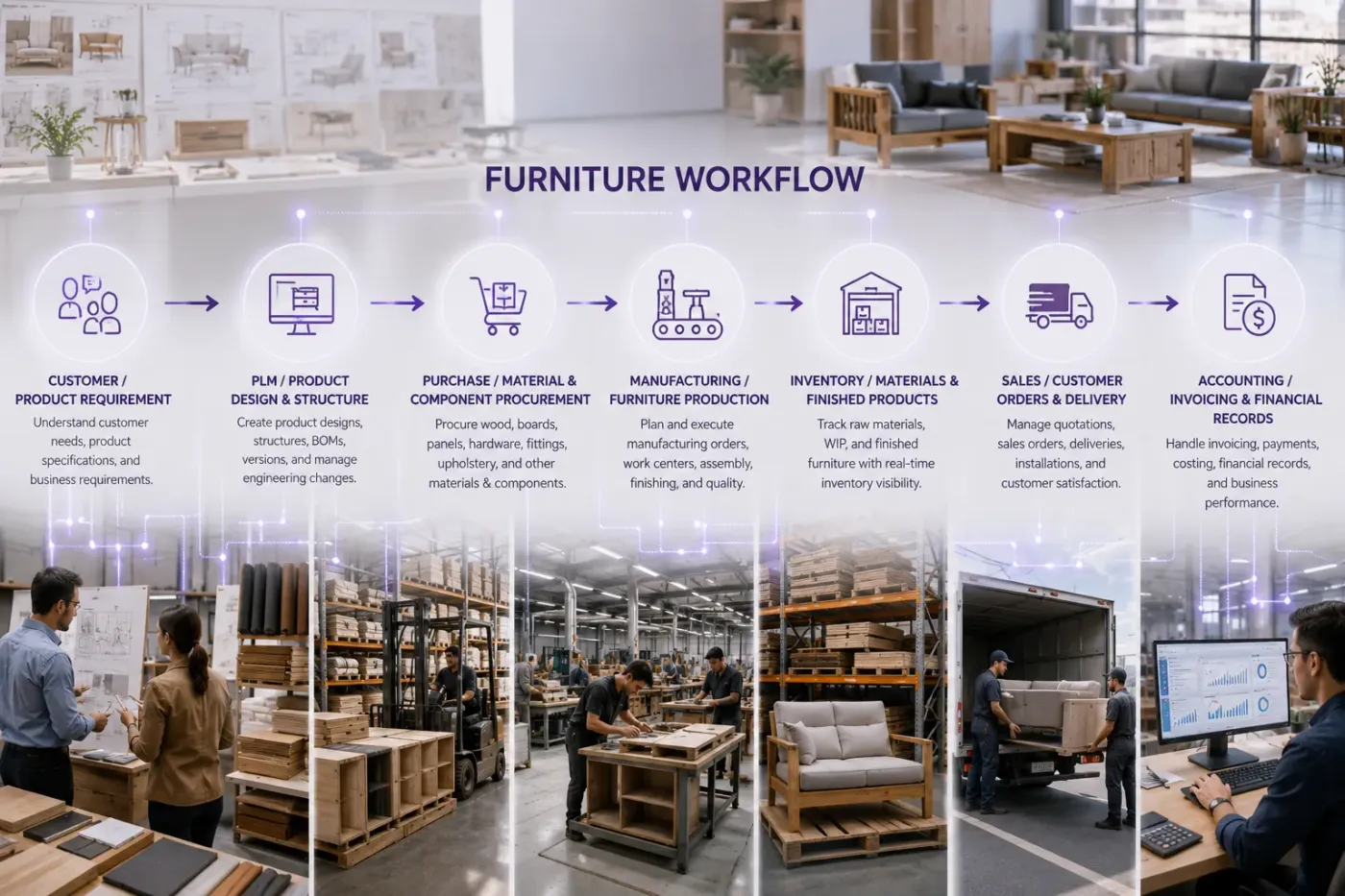
Odoo connects what a furniture business runs on: Sales for configured orders, Manufacturing for the workshop, Inventory for timber, board, fabric and finished items, Purchase for materials, and Field Service or Planning for delivery and installation.
Configured products with attribute-driven pricing, quotation templates, deposits and delivery date commitments.
Multi-level BOMs for frames, drawers and upholstery, with work orders across cutting, assembly, finishing and upholstery.
Sheet goods, timber, hardware and fabric with their real units of measure, plus finished goods by variant.
Material sourcing with lead times that reflect seasoning, import and finishing schedules.
Delivery and installation visits scheduled with the crew, closed on a phone with proof of delivery.
Deposits, part payments, GST and e-invoice, with job-level costing so custom work is priced on evidence.
A configured order generates the manufacturing order with the right BOM; components are issued; the finished item enters stock; and delivery is scheduled with the installation crew rather than guessed.
These are the configuration decisions that are cheap to make now and structural to change later. We walk through each one before a single record is migrated.
Whether customer options generate product variants or a one-off configured line. Variants are cleaner until the option count explodes; configured orders are flexible and need costing designed deliberately.
Whether frames, drawers and doors are their own manufacturing orders or phantom sub-assemblies. This decides workshop paperwork and WIP visibility.
Board bought by sheet, issued by square foot, costed per piece. Conversions set up wrongly here distort every job cost.
Which ranges are produced to stock and which only on order. Running everything make-to-order lengthens lead times unnecessarily.
Advance, pre-delivery and completion. Configure these rather than invoicing manually each time.
Whether the delivery slot is checked against crew availability. Promising a date the crew cannot meet is the most common complaint in this sector.
How offcuts are treated — scrapped, returned to stock, or ignored. Ignoring them is why material cost never matches purchases.
The right configuration depends on how your business actually operates, not on your sector label. Two companies with the same description on paper often need different warehouse steps, different approval chains and different reports.
We would rather say this before you buy licences than after. These are the areas where we scope real development, recommend a bolt-on, or tell you Odoo is the wrong tool.
A 3D or image-based configurator on the website is not native. Odoo handles the attribute logic; the visual layer needs a dedicated tool or development.
Optimising sheet layouts is specialist CAM software. Odoo records consumption rather than planning the cut.
Sequencing deliveries and planning van loads needs a routing system or an integration.
Floor-stock tagging and showroom reservation workflows usually need customisation.
Pricing that calculates from height × width × finish needs custom pricing logic beyond standard attribute pricing.
Site survey, measurement capture and sign-off before production need Field Service plus configuration.
Implementing Odoo for furniture needs more than installing the applications. Your ERP should reflect how your operations actually run.
Understand your product ranges, customer options, BOM depth, material units of measure, payment stages and how delivery is scheduled today.
Map order to installation onto Odoo, and settle the variant-versus-configured-order question before any catalogue is loaded.
Configure the applications above around your requirements rather than installing them at their defaults.
Prepare and migrate masters, open items and opening balances. Data cleaning is scoped explicitly, because it is usually the largest single task. See Odoo migration.
Connect the systems you are keeping and build only what configuration genuinely cannot reach. See integration and customization.
Your own team runs real transactions in a test database before go-live. Role-based training for the people who key them daily. See Odoo training.
Cutover planning, opening balance freeze, hypercare in the first weeks, then ongoing support and AMC.
We do not publish one implementation price, because the same application list costs very differently depending on the factors below. We do publish what moves the number, and the price is fixed in writing before work starts.
Furniture projects fail at two points: the configurator decision and the delivery promise. We settle how options drive the BOM before anything is loaded, and we check delivery dates against crew capacity rather than stock alone.
Product capabilities stated on this page are documented by Odoo. The configuration advice and limitations come from our own implementations.
Tell us how many options a customer picks and whether you deliver and install. Those two answers decide most of the configuration, and the diagnosis call is free.