
Point of Sale
Restaurant mode with tables, courses, split bills, KOT printing and offline operation, across several outlets and counters.
TablesKOTOffline
Hospitality has two halves and Odoo is strong at exactly one of them. Food and beverage operations — counter sales, recipes, kitchen, central production, multi-outlet stock and procurement — fit Odoo well. Room reservations do not.
So the honest position is this: run your restaurants, kitchens, bars and banquets on Odoo, and if you operate rooms, keep your property management system and connect it. That is a better outcome than forcing one tool to do both badly.
Businesses running Odoo with OdooBots







Odoo ERP for hospitality runs food and beverage operations end to end and sits behind a hotel rather than replacing its PMS. Point of Sale handles restaurant, bar and counter service including offline operation, recipes are modelled as bills of materials so consumption and cost are real, Inventory covers multi-outlet and central kitchen stock, Purchase handles daily procurement, and Accounting carries outlet-wise margin and GST.
Odoo has no room reservation engine, night audit or channel manager. For a hotel, the right architecture is a PMS for rooms and Odoo for F&B, stock, procurement, payroll and accounts, with an integration between them.
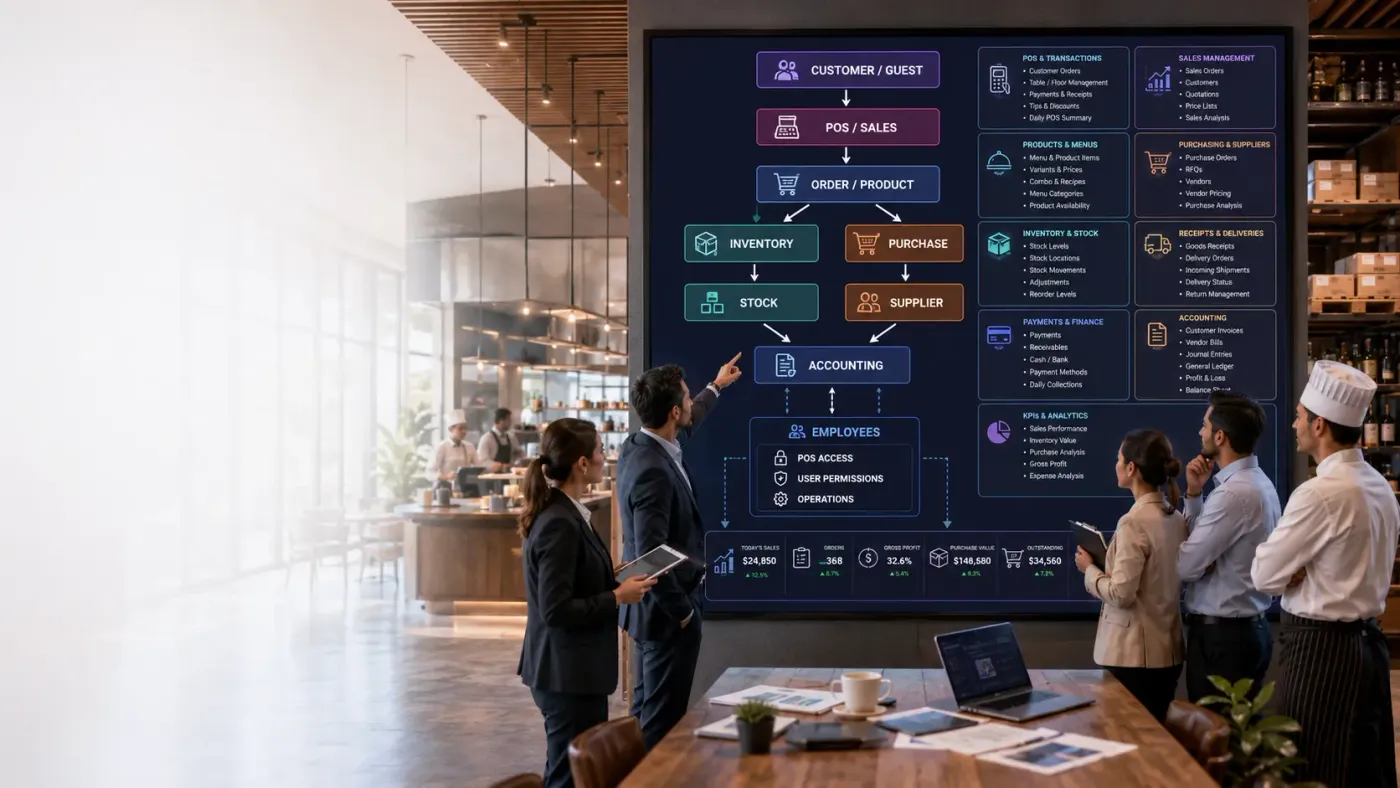
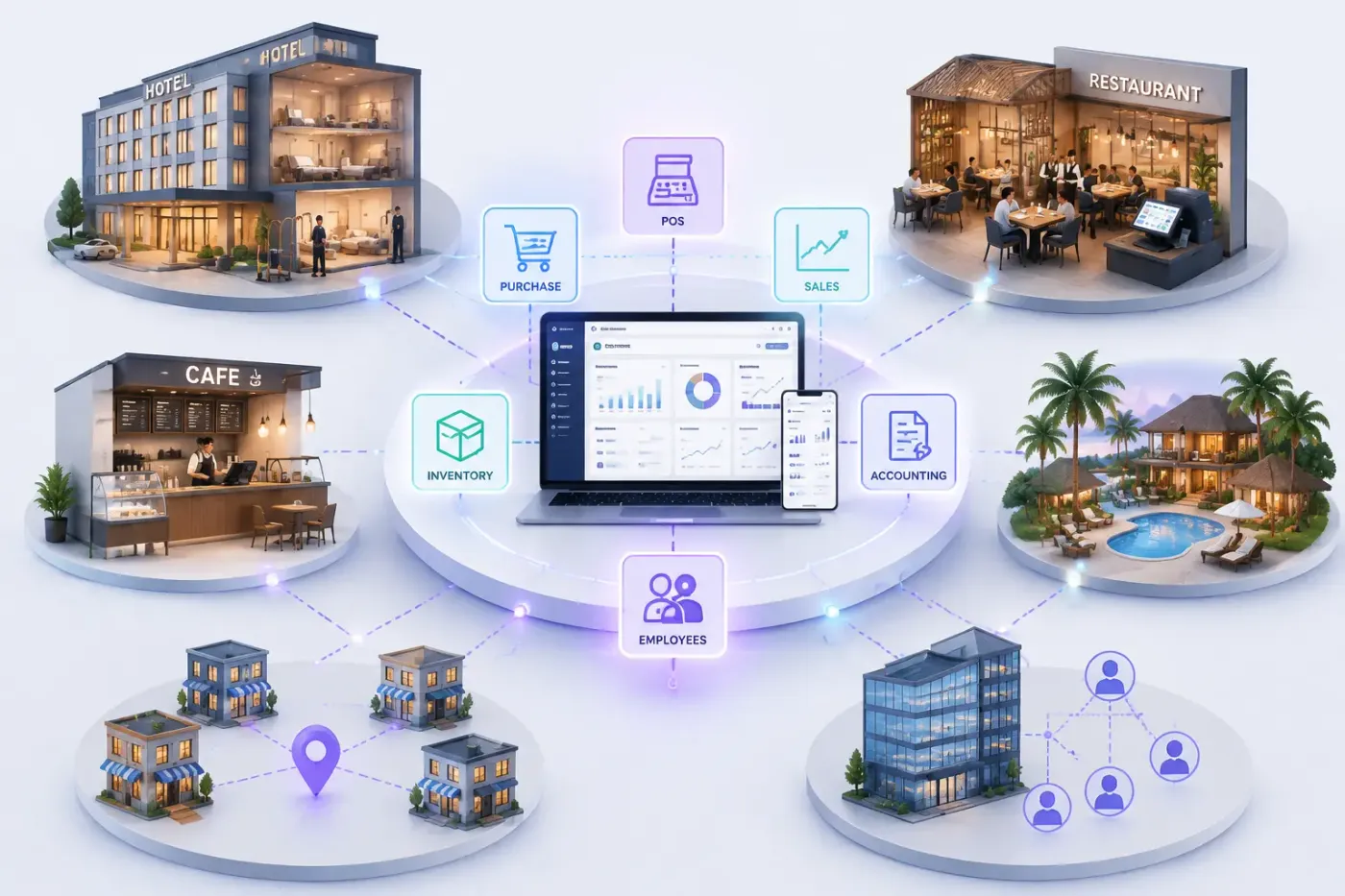
Odoo connects what a food and beverage business runs on: Point of Sale for service, Manufacturing for recipes and central production, Inventory for outlet and store stock, Purchase for daily buying, Employees and Payroll for shift-based staff, and Accounting for outlet margin.
Restaurant mode with tables, courses, split bills, KOT printing and offline operation, across several outlets and counters.
Recipes as bills of materials, central kitchen production orders, sub-recipes for sauces and bases, and measured yield.
Outlet and store stock with expiry on perishables, wastage recorded against a reason, and transfers between kitchen and outlets.
Daily vegetable and dairy buying alongside monthly groceries, with vendor rate contracts and short shelf-life handling.
Shift-based rosters, attendance and payroll for staff with high turnover and varied allowance structures.
Outlet-wise profit and loss through analytic accounts, GST on food and beverage rates, and daily cash reconciliation.
A dish sold at the counter consumes its recipe from outlet stock. The central kitchen produces against a bill of materials and transfers to outlets. Procurement replenishes against actual consumption rather than against a manager’s estimate, and the cost per cover is a report.
These are the configuration decisions that are cheap to make now and structural to change later. We walk through each one before a single record is migrated.
If you operate rooms, the decision is which PMS stays and what the integration carries. Attempting rooms in Odoo is the most common way a hospitality project disappoints.
Whether sub-recipes for sauces and bases are modelled. It is more setup and it is the difference between real plate cost and an approximation.
Outlet supply as an internal transfer at cost or as an inter-company sale. This changes both stock and the outlet profit and loss.
Whether wastage is recorded with a reason at the outlet. Without it, consumption variance has no explanation and nobody trusts the figures.
How delivery platform orders enter the system, and whether commission and packaging are costed per order.
Bought by kilogram, issued in grams, sold as a portion. Conversions decide whether plate cost is believable.
Who closes a counter, how variance is handled, and what the manager signs off each night.
The right configuration depends on how your business actually operates, not on your sector label. Two companies with the same description on paper often need different warehouse steps, different approval chains and different reports.
We would rather say this before you buy licences than after. These are the areas where we scope real development, recommend a bolt-on, or tell you Odoo is the wrong tool.
Odoo has no reservation engine, rate plans or night audit. Keep a PMS and integrate it rather than customising one into existence.
Online travel agency distribution and rate parity are PMS and channel manager territory.
Dynamic room pricing based on demand and competitor rates needs specialist software.
Pulling orders from delivery platforms into Odoo works, as a per-platform integration that is scoped and maintained.
Guest-facing booking and loyalty apps are usually separate products connected to Odoo.
KOT printing is standard; full kitchen display systems with order timing often need additional work.
Implementing Odoo for hospitality needs more than installing the applications. Your ERP should reflect how your operations actually run.
Understand your outlets, whether a central kitchen supplies them, how recipes are documented today, and whether rooms are in scope or stay on a PMS.
Map counter sale to ingredient consumption and procurement, and settle central kitchen treatment and recipe depth before configuration begins.
Configure the applications above around your requirements rather than installing them at their defaults.
Prepare and migrate masters, open items and opening balances. Data cleaning is scoped explicitly, because it is usually the largest single task. See Odoo migration.
Connect the systems you are keeping and build only what configuration genuinely cannot reach. See integration and customization.
Your own team runs real transactions in a test database before go-live. Role-based training for the people who key them daily. See Odoo training.
Cutover planning, opening balance freeze, hypercare in the first weeks, then ongoing support and AMC.
We do not publish one implementation price, because the same application list costs very differently depending on the factors below. We do publish what moves the number, and the price is fixed in writing before work starts.
We will tell you in the first call that Odoo should not run your rooms. What it runs very well is food and beverage: recipe-level consumption, central kitchen transfers and outlet-wise margin, which is where hospitality money actually leaks.
Product capabilities stated on this page are documented by Odoo. The configuration advice and limitations come from our own implementations.
Tell us how many outlets you run and whether a central kitchen supplies them. Those two answers decide most of the configuration, and the diagnosis call is free.