
Project
Engagements with phases, tasks and budgets, resource allocation across parallel projects, and planned versus actual hours.
PhasesBudgetsAllocation
An IT company usually knows its revenue precisely and its delivery cost approximately. Hours are recorded somewhere, support is handled in an inbox, AMC renewals live in a spreadsheet, and whether a particular project made money is a conversation rather than a report.
Odoo closes that gap: projects that carry both billed revenue and the cost of the people delivering them, support with a real SLA, and recurring AMC or subscription revenue invoiced on schedule instead of when someone remembers.

Businesses running Odoo with OdooBots







Odoo ERP for IT and software companies ties delivery cost to project revenue and makes recurring support revenue invoice itself. Project holds the engagement, Timesheets record developer and consultant hours against it, Sales carries fixed-price milestones or time and material rates, Subscriptions invoice AMC and SaaS on schedule, Helpdesk enforces SLA on support, and analytic accounting brings salary cost and billing onto the same account so project margin is a report.
Odoo is not a development tool. Repositories, issue tracking for engineers, CI and release management stay where they are — what Odoo adds is the commercial layer those tools never carry.
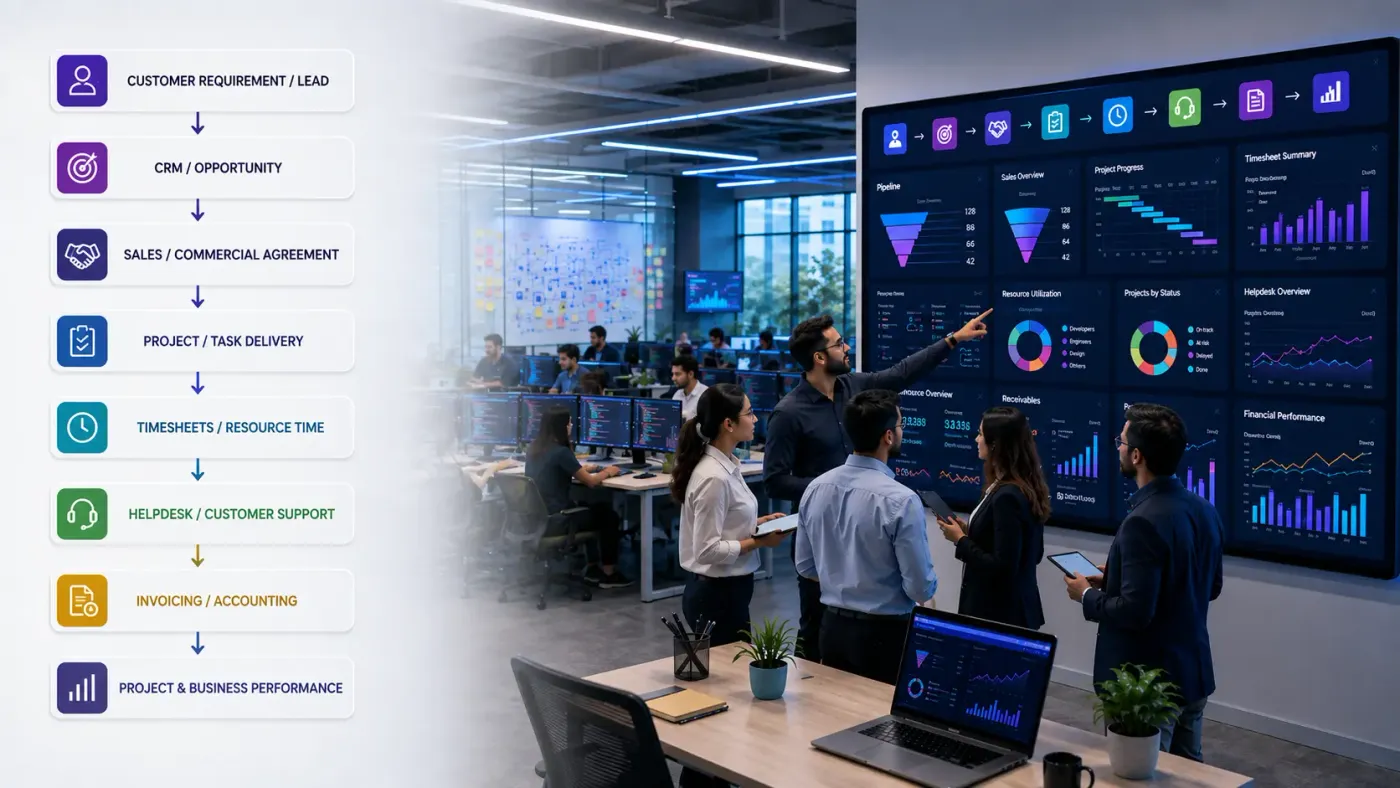
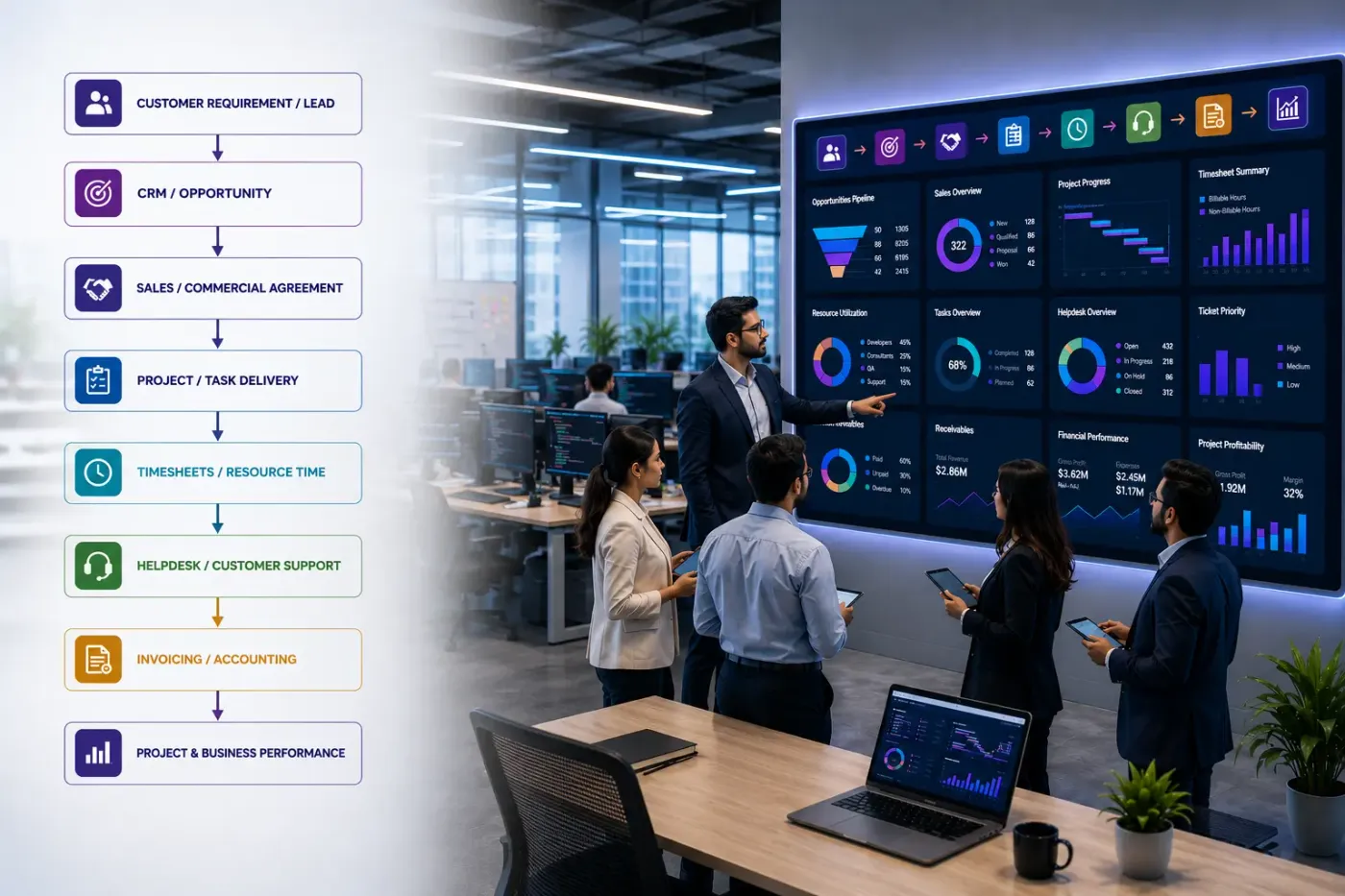
Odoo connects what an IT business runs on: CRM for the pipeline, Sales for contracts and rate cards, Project and Timesheets for delivery, Subscriptions for AMC and SaaS, Helpdesk for support, Employees for the team, and Accounting for margin by project and by client.
Engagements with phases, tasks and budgets, resource allocation across parallel projects, and planned versus actual hours.
Hours against tasks from web or mobile, with approval, and the same entry driving both cost and billable value.
Fixed-price contracts with milestones, time and material rate cards by role and seniority, and change requests as their own order lines.
AMC, managed services and SaaS billed monthly, quarterly or annually, with renewal dates, upgrades and churn visible.
Support tickets with priority, SLA timers, a client portal and escalation, reported by client and by recurring cause.
Project and client margin through analytic accounts, revenue by contract type, GST and export invoicing with foreign currency.
A won deal becomes a project with its budget and its rate card. Hours booked against tasks become both cost and billable value. Milestones or monthly time and material invoices raise themselves from the same records, and support after go-live runs on tickets with an SLA against the same client.
These are the configuration decisions that are cheap to make now and structural to change later. We walk through each one before a single record is migrated.
Client, contract or engagement phase. Margin reporting depends entirely on this and it is awkward to restructure after a few quarters of timesheets.
Per role, per person, per client or per contract. Several structures in parallel is normal and has to be configured deliberately.
Salary-based, a blended rate, or a loaded cost including overhead. Without this decision, project margin is revenue with nothing subtracted.
Daily or weekly, approved by whom, and what happens when a week is missing. This is the one habit the whole system depends on.
Which contracts are fixed price and which are time and material, and how change requests are priced in each.
What AMC covers, what is billable, and how that is recorded on a ticket. Settling it in configuration prevents the monthly argument.
Foreign clients, the currency billed, LUT or GST treatment and how receipts are reconciled.
The right configuration depends on how your business actually operates, not on your sector label. Two companies with the same description on paper often need different warehouse steps, different approval chains and different reports.
We would rather say this before you buy licences than after. These are the areas where we scope real development, recommend a bolt-on, or tell you Odoo is the wrong tool.
Repositories, branching, CI and release management belong in developer tools. Odoo should not try to replace them.
Odoo tasks are not a substitute for a developer issue tracker on a large codebase. Keep both and integrate if the overlap hurts.
Tracking licence keys, entitlements and seat compliance for software you resell usually needs custom modelling.
Deferred and milestone-based recognition to a formal accounting standard needs configuration and custom reporting, with your auditor involved.
Pipeline-weighted resource forecasting across many parallel projects goes beyond standard planning and is usually a custom report.
Metered SaaS billing driven by live product usage is an integration from your application into Odoo, not a setting.
Implementing Odoo for it & software needs more than installing the applications. Your ERP should reflect how your operations actually run.
Understand your contract types, how hours are recorded today, what AMC covers, and whether you bill in foreign currency.
Map deal to delivery to support onto Odoo, and settle the project costing unit, rate cards and cost-per-hour basis before configuration.
Configure the applications above around your requirements rather than installing them at their defaults.
Prepare and migrate masters, open items and opening balances. Data cleaning is scoped explicitly, because it is usually the largest single task. See Odoo migration.
Connect the systems you are keeping and build only what configuration genuinely cannot reach. See integration and customization.
Your own team runs real transactions in a test database before go-live. Role-based training for the people who key them daily. See Odoo training.
Cutover planning, opening balance freeze, hypercare in the first weeks, then ongoing support and AMC.
We do not publish one implementation price, because the same application list costs very differently depending on the factors below. We do publish what moves the number, and the price is fixed in writing before work starts.
We run an Odoo delivery business ourselves, on projects, timesheets, AMC and helpdesk. When we configure utilisation reporting or an SLA tier, it is the setup we use to run our own margin, not a demonstration.
Product capabilities stated on this page are documented by Odoo. The configuration advice and limitations come from our own implementations.
Tell us your mix of fixed-price and time-and-material work, and whether hours are recorded daily today. Those two answers shape the configuration, and the diagnosis call is free.