
Inventory & warehouse
Receipts, putaway, storage locations, internal transfers and despatch, including stock held on behalf of customers in separate locations.
ReceiptsStorageDespatch
Logistics businesses know their revenue precisely and their cost approximately. Vehicle running cost, subcontracted trips, handling and storage all land somewhere other than the job they belong to.
Odoo connects warehouse operations, fleet, subcontractor purchases and billing so cost and revenue meet on the same job.
Businesses running Odoo with OdooBots







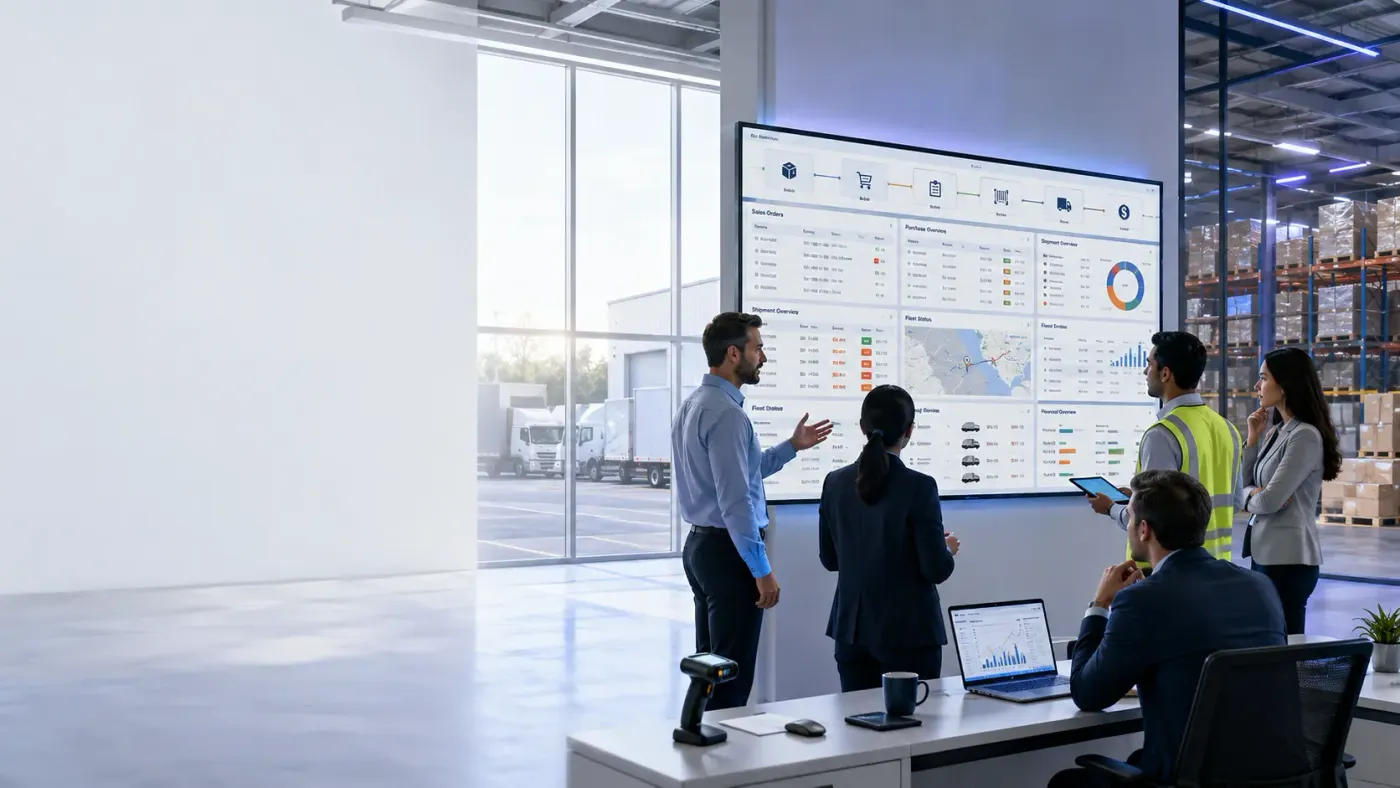
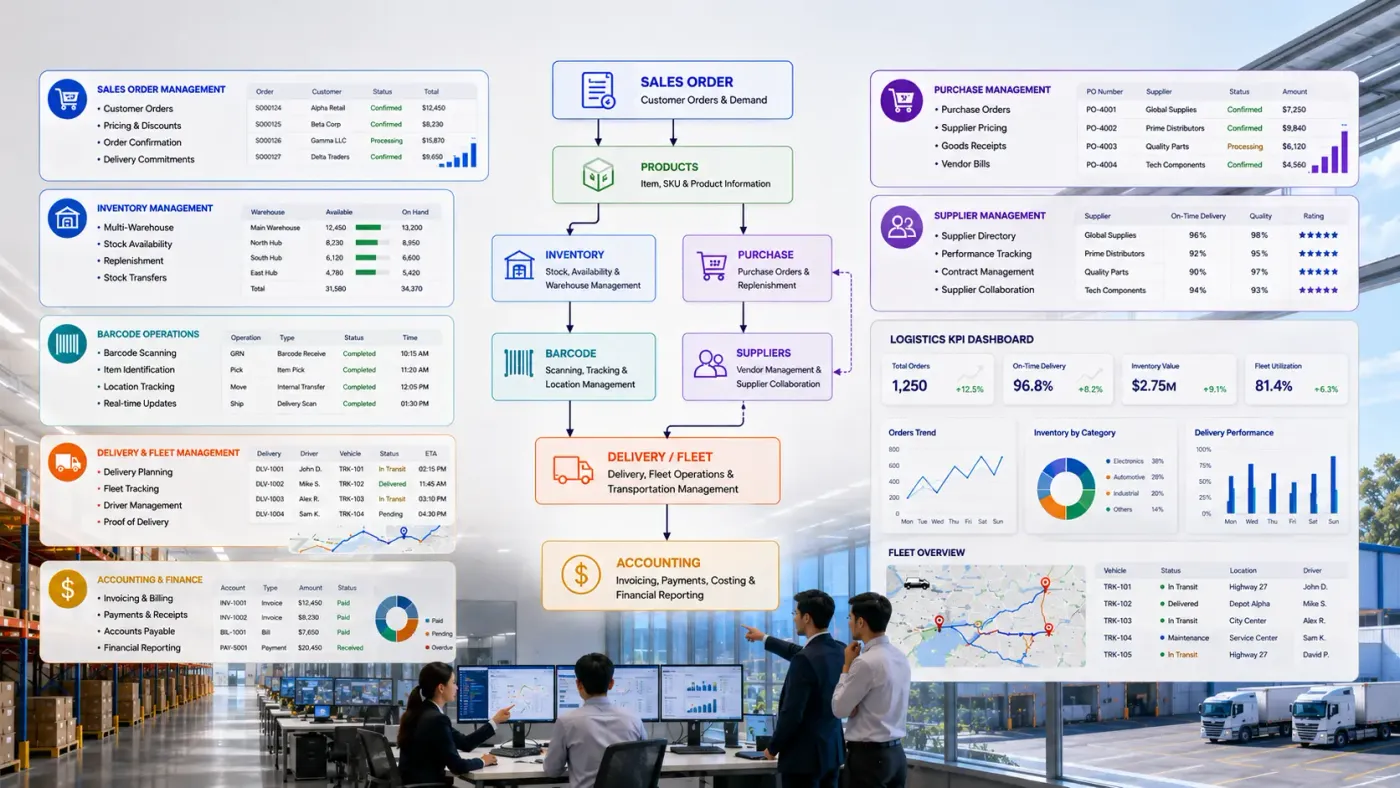
Odoo ERP for logistics connects the warehouse, the vehicles and the billing that pays for both. Inventory and Barcode run receipts, storage and despatch; Fleet holds vehicles with running costs and document expiry; Purchase captures subcontracted trips and handling against the job; and the analytic account brings revenue and cost together per consignment or per contract.
Decide early what a “job” is: a consignment, a trip, a contract or a customer month. Everything — costing, billing and reporting — hangs off that definition, and changing it later means re-posting.
Odoo connects the applications a logistics operation depends on: Inventory and Barcode for the warehouse, Fleet for vehicles, Purchase for subcontractors and fuel, Project or analytic accounting for the job, Sales for contracts and rates, and Accounting underneath.
Receipts, putaway, storage locations, internal transfers and despatch, including stock held on behalf of customers in separate locations.
Scanner-driven receiving, putaway, picking and counting, which is what makes a third-party stock figure defensible to the stock owner.
Vehicles with odometer, fuel and maintenance costs, insurance, permits and document expiry alerts against each one.
Subcontracted trips, handling services and fuel raised against the job so cost lands where the revenue is.
Rate cards per customer and lane, contract terms, and invoicing by consignment, trip or period.
Customer invoicing, vendor bills, GST and e-way bill, and analytic reporting that shows margin per job, lane or customer.
A consignment becomes a job with its own analytic account. Handling, storage, the vehicle and any subcontracted leg all tag to it, so the margin on that movement is a report rather than a feeling.
These are the configuration decisions that are cheap to make now and structural to change later. We walk through each one before a single record is migrated.
Consignment, trip, contract or customer month. Costing, billing and reporting all hang off this definition, and it is expensive to change once transactions exist.
Per job, per lane, per vehicle or per customer. Usually more than one dimension, and worth designing rather than defaulting.
For 3PL, whether held stock sits in separate locations with its own ownership and valuation. This has accounting consequences.
As vendors with purchase orders against the job, or as a service cost. This decides how their bills and any retention are handled.
By weight, volume, distance, lane or slab. Rate complexity is the main driver of whether billing can be automated at all.
Signature, photo or scan, and whether it must attach to the invoice. This decides mobile scope.
Insurance, permits and fitness certificates with alerts, because an expired document stops a vehicle more reliably than a breakdown.
The right configuration depends on how your business actually operates, not on your sector label.
Own fleet, trip-based costing, where vehicle utilisation decides profitability.
Buying and selling capacity, where margin per consignment is the whole business.
Holding other people’s stock, needing separate ownership, accurate counts and activity billing.
High drop counts, proof of delivery and route cost per drop.
Temperature-sensitive movements with expiry and batch control alongside transport.
Warehouse and transport together, where the handover between them is where cost hides.
We would rather say this before you buy licences than after. These are the areas where we scope real development, recommend a bolt-on, or tell you Odoo is the wrong tool.
Vehicle routing, drop sequencing and load planning need a specialist system. Odoo schedules resources; it does not optimise routes.
GPS telematics belongs in a telematics platform that feeds Odoo in summary, not in Odoo itself.
Billing by storage days, handling units and movements against a rate card usually needs custom development.
Carrier rate shopping across multiple providers with surcharges needs an integration or a specialist tool.
Bills of lading, customs filings and trade documents are not modelled natively and are usually attachments plus custom fields.
Trip-based driver pay with allowances and deductions typically needs payroll customisation.
Implementing Odoo for logistics needs more than installing the applications. Your ERP should reflect how your operations actually run.
Understand what you bill for, how your rate cards work, whether you hold customer stock, and how subcontracted movements are recorded today.
Map job creation to invoice onto Odoo, and settle the definition of a job and the analytic structure before anything else.
Configure the applications above around your requirements rather than installing them at their defaults.
Prepare and migrate masters, open items and opening balances. Data cleaning is scoped explicitly, because it is usually the largest single task. See Odoo migration.
Connect the systems you are keeping and build only what configuration genuinely cannot reach. See integration and customization.
Your own team runs real transactions in a test database before go-live. Role-based training for the people who key them daily. See Odoo training.
Cutover planning, opening balance freeze, hypercare in the first weeks, then ongoing support and AMC.
We do not publish one implementation price, because the same application list costs very differently depending on the factors below. We do publish what moves the number, and the price is fixed in writing before work starts.
Logistics costing fails when cost and revenue land on different records. We define the job and the analytic structure in week one, so margin per consignment is a report you can run rather than a spreadsheet somebody rebuilds monthly.
Product capabilities stated on this page are documented by Odoo. The configuration advice and limitations come from our own implementations.
Tell us what you bill against — a trip, a consignment or a contract. That one answer defines the costing structure, and the diagnosis call is free.