
Project
Jobs and campaigns under each client, with stages, deadlines, revision rounds and the analytic account that carries cost.
JobsStagesRevisions
Agency accounts have a particular problem: a large share of what passes through them is not theirs. Media spend, printing, production, influencer payments and third-party vendors flow in and out, and if they are mixed with fee income the revenue figure is meaningless and client margin is invisible.
Odoo separates the two. Fee income on one side, pass-through cost recorded against the job and the client on the other, and a margin figure per client that survives a conversation with your accountant.

Businesses running Odoo with OdooBots







Odoo ERP for marketing and advertising agencies separates fee income from pass-through media and vendor cost, and reports margin per client and per job. Project holds the job or campaign, Timesheets record creative and account team hours, Sales carries retainers and project fees, Purchase records media, production and vendor cost against the job, Expenses handles out-of-pocket items, and analytic accounting keeps the two sides of the account distinct.
Billing media spend as revenue inflates turnover and hides whether the agency fee covers the work. Keeping pass-through separate from fee is the single most useful thing an agency ERP does.
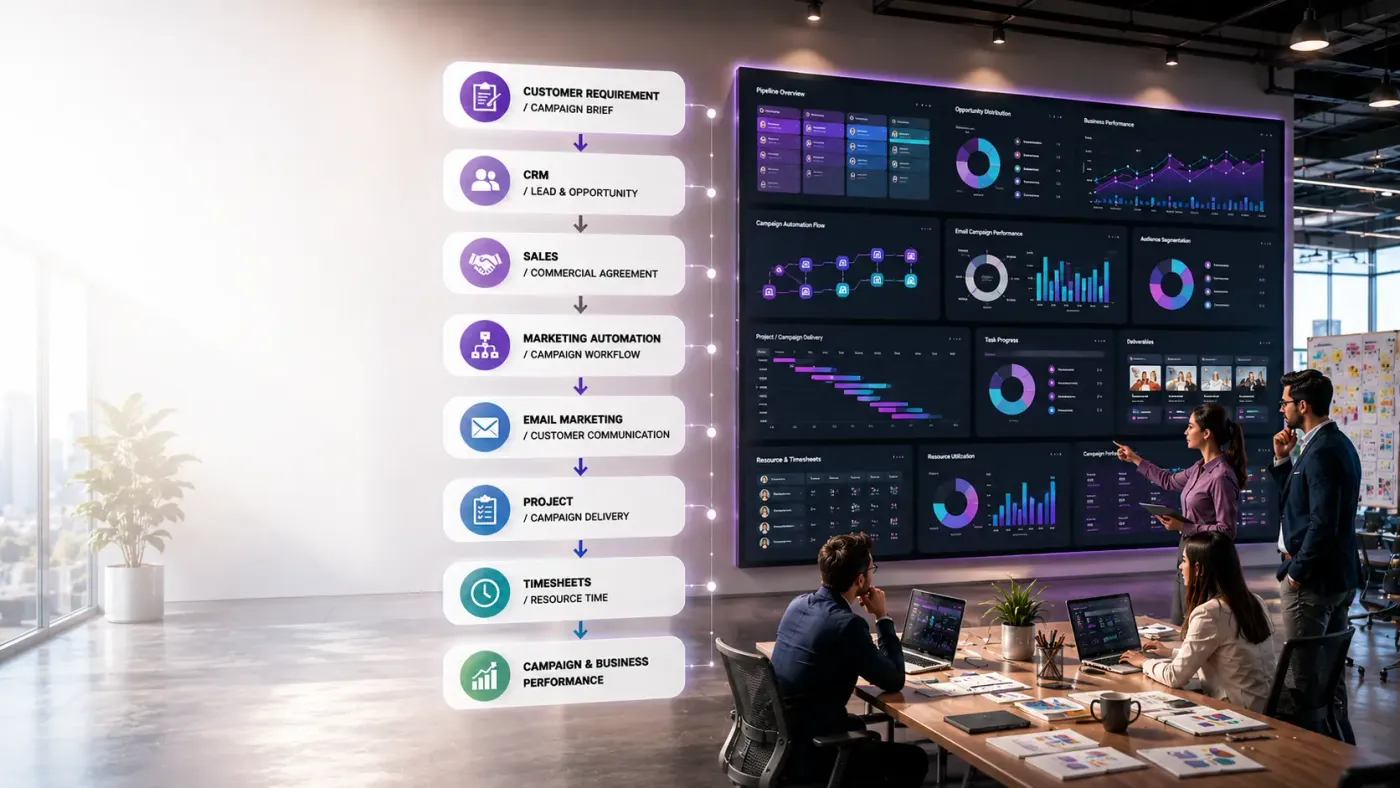
Odoo connects what an agency runs on: CRM for new business, Sales for retainers and project fees, Project and Timesheets for the work, Purchase for media and vendor cost, Expenses for out-of-pocket items, and Accounting for client margin with pass-through kept separate.
Jobs and campaigns under each client, with stages, deadlines, revision rounds and the analytic account that carries cost.
Creative, production and account management hours against the job, so effort per deliverable is measured rather than assumed.
Monthly retainers, project fees with milestones, and rate cards per deliverable type or per role where you bill that way.
Media buying, printing, production houses, influencers and freelancers purchased against the job, with advances where needed.
Shoot costs, travel and out-of-pocket items attached to the job and recovered from the client where agreed.
Fee income separated from pass-through, client and job margin, vendor payables, GST and receivables ageing.
A brief becomes a job under the client. Hours from the creative and account teams land on it, vendor and media costs are purchased against it, and revision rounds are visible as effort. The retainer invoices on schedule, project fees invoice on their milestones, and client margin is fee income less the hours it cost.
These are the configuration decisions that are cheap to make now and structural to change later. We walk through each one before a single record is migrated.
How media and vendor spend is recorded and billed. Get this wrong and both your turnover and your client margin are misleading.
A campaign, a deliverable, or a month of retainer work. Everything about cost reporting depends on it.
How many rounds a fee includes and how extra rounds are recorded. The most common unbilled cost in an agency.
What the monthly fee covers in deliverables or hours, so over-servicing is visible rather than discovered at renewal.
Whether media is paid before client collection, and how that cash exposure is tracked per client.
How external talent is contracted, approved and paid, and how that cost reaches the job.
Where client approvals on creative and estimates are recorded, so a disputed revision has a reference.
The right configuration depends on how your business actually operates, not on your sector label. Two companies with the same description on paper often need different warehouse steps, different approval chains and different reports.

We would rather say this before you buy licences than after. These are the areas where we scope real development, recommend a bolt-on, or tell you Odoo is the wrong tool.
Planning, buying and optimising media sits in specialist platforms. Odoo records the cost; it does not place the buy.
Pulling actual spend from advertising platforms into Odoo is a per-platform integration, not a configuration option.
Large creative asset libraries with versions, rights and previews belong in a DAM, not in an ERP.
Content calendars and scheduled publishing are better handled in the tools built for them.
Frame-accurate annotation and approval on video or artwork needs a proofing tool alongside Odoo.
Campaign performance dashboards drawing live platform metrics are a reporting integration project in their own right.
Implementing Odoo for marketing & advertising needs more than installing the applications. Your ERP should reflect how your operations actually run.
Understand your retainer and project mix, how media and vendor spend is billed today, your revision policy, and what client-level reporting the management team needs.
Map brief to delivery to billing onto Odoo, and settle the fee versus pass-through treatment before anything is configured.
Configure the applications above around your requirements rather than installing them at their defaults.
Prepare and migrate masters, open items and opening balances. Data cleaning is scoped explicitly, because it is usually the largest single task. See Odoo migration.
Connect the systems you are keeping and build only what configuration genuinely cannot reach. See integration and customization.
Your own team runs real transactions in a test database before go-live. Role-based training for the people who key them daily. See Odoo training.
Cutover planning, opening balance freeze, hypercare in the first weeks, then ongoing support and AMC.
We do not publish one implementation price, because the same application list costs very differently depending on the factors below. We do publish what moves the number, and the price is fixed in writing before work starts.
Most agency books mix fee income with media pass-through, which makes turnover look healthy and hides which accounts are actually losing money. We separate the two in the chart of accounts before anything else, because every useful report depends on it.
Product capabilities stated on this page are documented by Odoo. The configuration advice and limitations come from our own implementations.
Tell us roughly what share of your billing is media or vendor pass-through, and whether retainers or projects dominate. Those two answers shape the configuration, and the diagnosis call is free.