
Manufacturing
Batch manufacturing orders against versioned BOMs, with work orders and routing reflecting the real production and packing sequence.
Batch MOsRoutingYield
In pharmaceuticals the question is never whether you can make the product. It is whether you can prove, quickly, exactly which batches went where — and whether near-expiry stock left the warehouse before it became a write-off.
Odoo handles batch manufacturing, expiry-driven removal, quality control and full lot genealogy. What it does not do is pretend to be validated GxP software, and we are explicit about where that line sits.
Businesses running Odoo with OdooBots







Odoo ERP for pharmaceuticals manages batch manufacturing, lot and expiry tracking, quality control and the traceability a recall depends on. Manufacturing orders produce tracked batches, first-expiry-first-out removal pushes near-dated stock out first, quality control points gate release, and lot genealogy links a dispatched batch back to every raw material lot that went into it.
Odoo is not validated GxP software and does not come with 21 CFR Part 11 compliance. It can be configured to support a quality system and it cannot substitute for one. Any partner who tells you otherwise is selling you a problem.
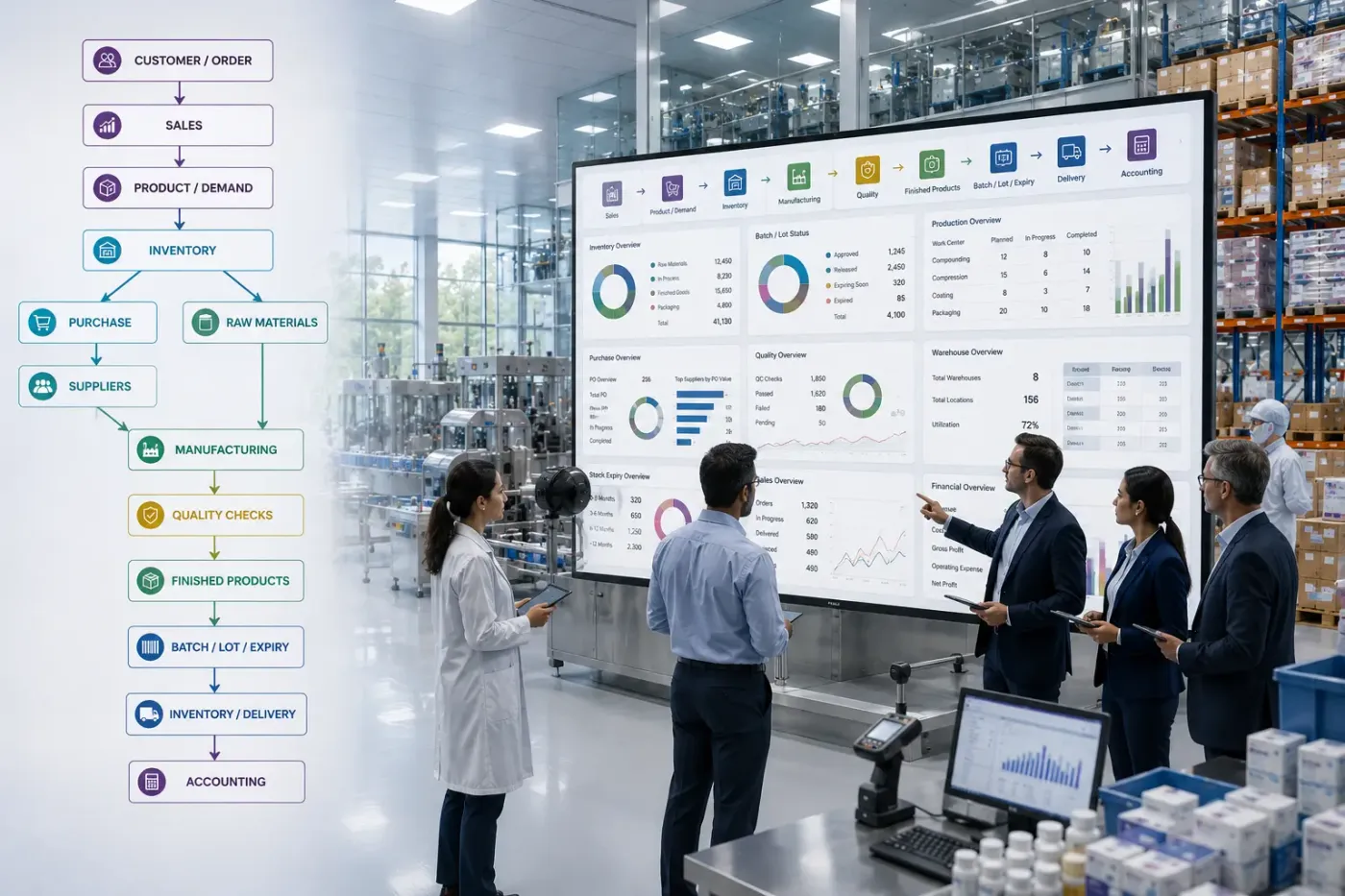
Odoo connects the applications a pharmaceutical operation runs on: Manufacturing for batch production, Inventory for lot and expiry control, Quality for in-process and release checks, Purchase for approved suppliers, Sales for distribution and Accounting underneath.
Batch manufacturing orders against versioned BOMs, with work orders and routing reflecting the real production and packing sequence.
Lot tracking with expiry dates, quarantine and released locations, and first-expiry-first-out removal applied automatically.
Control points on receipt, in process and at release, with measurement capture and quality alerts raised against the specific lot.
Formulation and BOM revision control through change orders with named approvers and full version history.
Approved supplier lists, incoming quality checks and lead times, with replenishment planned against real production demand.
Invoicing, GST and e-invoice, batch-level costing and the write-off visibility that makes expiry losses measurable.
A raw material lot arrives and is quarantined until quality releases it. A manufacturing order consumes released lots and produces a tracked batch. Removal strategy pushes the earliest expiry out first. If a recall comes, the genealogy already exists.
These are the configuration decisions that are cheap to make now and structural to change later. We walk through each one before a single record is migrated.
Which materials are tracked by lot and which are not. In pharma the answer is usually "almost everything", which makes receipt and issue discipline the real project.
Whether incoming material lands in a quarantine location until quality releases it. Without this, unreleased material can be consumed by a manufacturing order.
FEFO configured per product category, not globally. Getting this wrong is how expiry write-offs appear despite having a system that tracks expiry.
Expected versus actual batch output, and whether variance posts to cost or is simply recorded. This decides whether costing is meaningful.
Who approves a formulation change, and whether open manufacturing orders follow it or complete on the previous version.
We run a mock recall during testing: pick a dispatched batch and trace it back to raw material lots, timed. If that takes hours, the configuration is not finished.
Who can release, who can only record, and who can see nothing. In a regulated environment this is a requirement before it is a convenience.
The right configuration depends on how your business actually operates, not on your sector label. Two companies with the same description on paper often need different warehouse steps, different approval chains and different reports.

We would rather say this before you buy licences than after. These are the areas where we scope real development, recommend a bolt-on, or tell you Odoo is the wrong tool.
Odoo is not validated software and has no built-in Part 11 electronic signature compliance. Achieving it means a validation project and customisation, and it is not something configuration delivers.
Recipes where usable quantity depends on measured potency are not native. This needs custom fields and custom consumption logic.
Unit-level serialisation for regulatory track-and-trace schemes requires integration with a serialisation platform.
Stability protocols, timepoints and result trending are a laboratory system’s job, not an ERP’s.
Narcotic and scheduled-substance registers in statutory formats vary by jurisdiction and need custom development.
Laboratory information management and instrument data capture are specialist integrations, not Odoo features.
Implementing Odoo for pharmaceuticals needs more than installing the applications. Your ERP should reflect how your operations actually run.
Understand your formulations, batch sizes, quality checkpoints, regulatory obligations, expiry handling and what a recall currently requires of you.
Map receipt to release to dispatch onto Odoo, and settle quarantine flow and removal strategy before any stock is loaded.
Configure the applications above around your requirements rather than installing them at their defaults.
Prepare and migrate masters, open items and opening balances. Data cleaning is scoped explicitly, because it is usually the largest single task. See Odoo migration.
Connect the systems you are keeping and build only what configuration genuinely cannot reach. See integration and customization.
Your own team runs real transactions in a test database before go-live. Role-based training for the people who key them daily. See Odoo training.
Cutover planning, opening balance freeze, hypercare in the first weeks, then ongoing support and AMC.
We do not publish one implementation price, because the same application list costs very differently depending on the factors below. We do publish what moves the number, and the price is fixed in writing before work starts.
We are explicit about what Odoo is not. It handles batch, expiry, quality and recall traceability well; it is not validated GxP software. We put that boundary in writing before anything is built, and we rehearse a mock recall during testing rather than after go-live.
Product capabilities stated on this page are documented by Odoo. The configuration advice and limitations come from our own implementations.
Tell us what your regulator requires in the system, and how long a recall trace takes you today. Those two answers define the scope, and the diagnosis call is free.