
Project
Engagements with phases, budgets in hours and fees, and planned against actual effort as work progresses.
EngagementsBudgetsPhases
In a professional services firm the product is time, and the two numbers that decide profitability are utilisation and realisation — how much of available time is billable, and how much of billable time is actually collected. Most firms can quote their revenue and neither of those.
Odoo makes both visible: engagements that carry fee and cost, time recorded against them, retainers and milestones invoiced on schedule, and client expenses recovered rather than absorbed.
Businesses running Odoo with OdooBots







Odoo ERP for professional services firms holds each engagement with its fee, its recorded time and its recoverable expenses, so utilisation and realisation are reports. Project carries the engagement, Timesheets record chargeable and non-chargeable time, Sales holds retainer, milestone or hourly fee arrangements, Expenses recovers client-incurred cost, Planning allocates people across concurrent engagements, and analytic accounting brings staff cost and fee onto the same account.
Non-chargeable time matters as much as chargeable time. A firm that only records billable hours knows its revenue and has no idea what its capacity actually is.
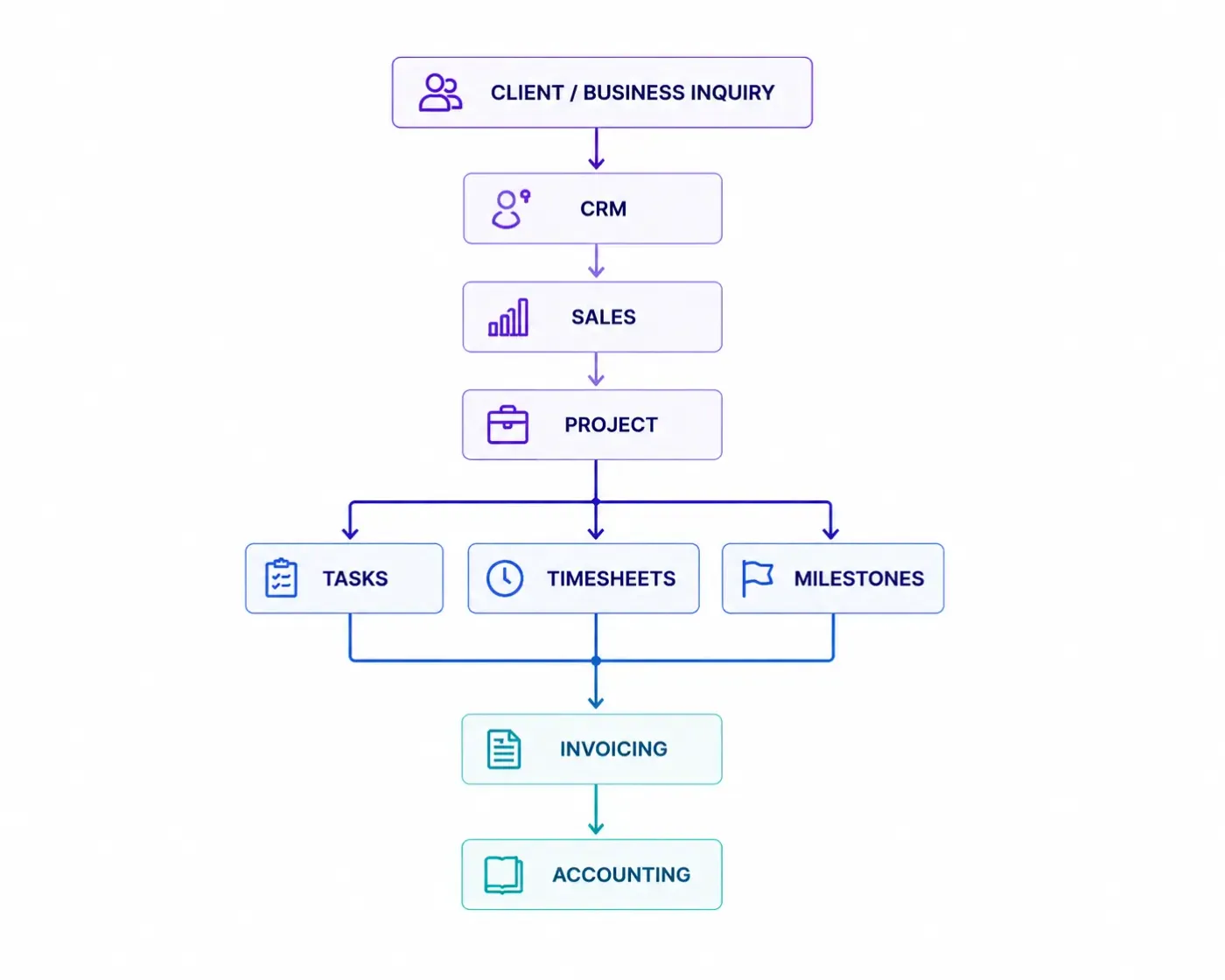
Odoo connects what a professional firm runs on: CRM for the pipeline and proposals, Sales for fee arrangements, Project and Timesheets for delivery, Planning for who is on what, Expenses for recoverable cost, Employees for the team, and Accounting for engagement and client margin.
Engagements with phases, budgets in hours and fees, and planned against actual effort as work progresses.
Chargeable and non-chargeable time against engagement and task, with approval and weekly submission discipline.
Retainers, fixed fees with milestones, hourly rates by grade, and fee caps or estimates agreed in the engagement letter.
Travel, lodging and out-of-pocket cost attached to the engagement, approved, and re-invoiced to the client where recoverable.
Allocation of people across concurrent engagements, with visible over-allocation and leave taken into account.
Engagement and client margin through analytic accounts, write-offs recorded rather than hidden, GST and receivables ageing.
A signed proposal becomes an engagement with its fee and budget. Time booked against it accumulates cost and chargeable value; travel and out-of-pocket cost attach to the same engagement and appear on the invoice. The fee note goes out on the retainer schedule or against the milestone, and realisation is visible per engagement.
These are the configuration decisions that are cheap to make now and structural to change later. We walk through each one before a single record is migrated.
A client, a matter, a project or a phase. Utilisation and realisation reporting both depend on this and it should not be revisited later.
What counts as chargeable, who decides, and how non-chargeable categories are structured. Without the second half, capacity is invisible.
Partner, manager and associate rates, standard versus client-specific, and how a blended rate is handled if you quote one.
Salary-derived or loaded with overhead. This single decision is the difference between margin and revenue.
Which categories are recoverable, at cost or with a margin, and what needs client pre-approval.
How unbilled or discounted time is recorded, so realisation can be measured instead of inferred from a gap.
Daily or weekly, with whose approval, and what happens to a missing week. The whole system rests on this habit.
The right configuration depends on how your business actually operates, not on your sector label.
Project-based advisory where scope creep and senior time decide margin.
Seasonal workload with heavy compliance deadlines and strong utilisation peaks.
Deliverable-driven milestones with drawing revisions and client approvals.
Matter-based work with retainers, where time capture is the hardest habit.
Scheduled delivery with trainer allocation and per-participant billing.
Placement fees and contract staffing, a different revenue model within the same firm.
We would rather say this before you buy licences than after. These are the areas where we scope real development, recommend a bolt-on, or tell you Odoo is the wrong tool.
Audit working papers, statutory file formats and regulator-specific documentation belong in practice software, not in an ERP.
Document-heavy legal matter management with version control and privilege handling usually needs a dedicated system.
Holding client money under professional regulations needs specific controls and is outside standard Odoo.
Formal independence and conflict screening workflows need custom development if they must live in Odoo.
Engineering drawing versions and approvals are better held in design document tools, with Odoo carrying the commercial data.
Pipeline-weighted resourcing across a large partner group goes beyond standard planning and becomes a custom report.
Implementing Odoo for professional services needs more than installing the applications. Your ERP should reflect how your operations actually run.
Understand your fee arrangements, how time is captured today, which expenses are recoverable, and what utilisation reporting the partners expect.
Map proposal to fee note to collection onto Odoo, and settle the engagement unit, chargeable definition and cost-per-hour basis before configuration.
Configure the applications above around your requirements rather than installing them at their defaults.
Prepare and migrate masters, open items and opening balances. Data cleaning is scoped explicitly, because it is usually the largest single task. See Odoo migration.
Connect the systems you are keeping and build only what configuration genuinely cannot reach. See integration and customization.
Your own team runs real transactions in a test database before go-live. Role-based training for the people who key them daily. See Odoo training.
Cutover planning, opening balance freeze, hypercare in the first weeks, then ongoing support and AMC.
We do not publish one implementation price, because the same application list costs very differently depending on the factors below. We do publish what moves the number, and the price is fixed in writing before work starts.
We insist on recording non-chargeable time, which firms resist and then rely on. Without it you can report revenue but not capacity, and capacity is the decision partners actually need the system for.
Product capabilities stated on this page are documented by Odoo. The configuration advice and limitations come from our own implementations.
Tell us how many fee arrangements you run and whether non-chargeable time is recorded today. Those two answers shape the configuration, and the diagnosis call is free.