
CRM
Enquiries from portals, the website and walk-ins, with site visit scheduling, follow-up history and channel partner attribution.
Site visitsChannelsFollow-up
A real estate business runs three different operations that rarely share a system: selling units, building them, and looking after them afterwards. Sales lives in a CRM, construction cost lives in a spreadsheet, and rent or maintenance billing lives wherever the accountant put it.
Odoo holds all three in one database: unit-level inventory and bookings, project cost against the same analytic account as the revenue, and recurring invoicing for leases and maintenance.

Businesses running Odoo with OdooBots







Odoo ERP for real estate tracks each unit from enquiry to final payment, costs construction against the same project the revenue sits on, and invoices leases and maintenance on a schedule. CRM carries site visits and the pipeline, units are modelled as inventory or project records so two salespeople cannot sell the same flat, Project and analytic accounting hold construction cost, Subscriptions handle rent and maintenance, and Helpdesk or Field Service covers handover snags and facility work.
Odoo is not a RERA compliance tool. It will hold the data those filings need, and the filing itself stays a reporting exercise — usually a custom report, sometimes a spreadsheet.
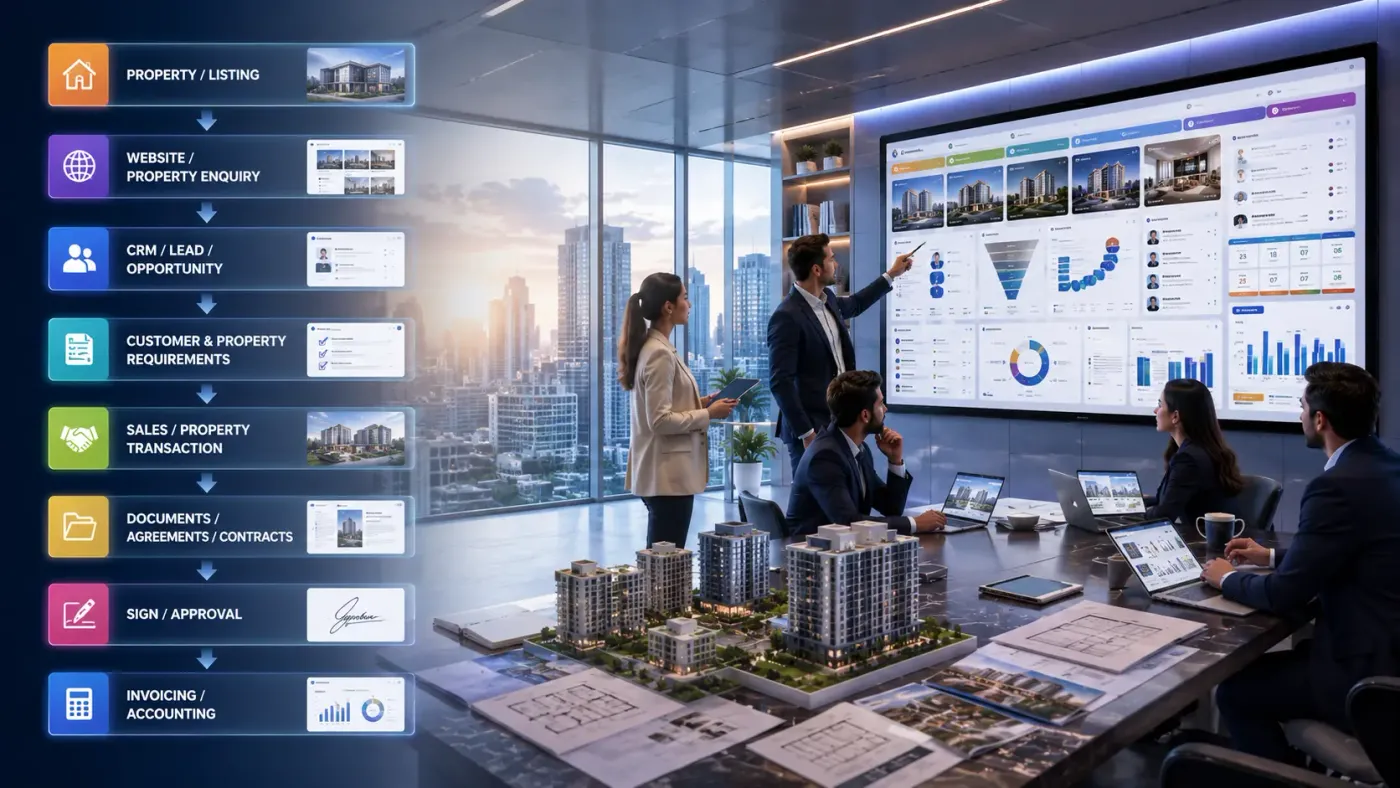
Odoo connects what a real estate business runs on: CRM for enquiries and site visits, unit records for availability and blocking, Sales for bookings and agreements, Project and Purchase for construction cost, Subscriptions for lease and maintenance billing, and Accounting for collections and GST.
Enquiries from portals, the website and walk-ins, with site visit scheduling, follow-up history and channel partner attribution.
Bookings against a specific unit, agreement values, payment plans and the instalment schedule the demands are raised from.
Construction progress with tasks, milestones and contractor work, tagged to the analytic account that carries the cost.
Material procurement, contractor bills and work-order certification against the project rather than against the company.
Lease rent, CAM and maintenance charges invoiced on a schedule, with escalation dates and renewal reminders.
Collections against demands, receivables ageing by unit, brokerage payable, GST and TDS, and project-wise margin.
An enquiry becomes a site visit, a visit becomes a booking against a specific unit, and that unit is no longer available to anyone else. Construction cost accumulates on the same project the booking revenue sits against, and the margin on a tower is a report instead of a reconciliation exercise.
These are the configuration decisions that are cheap to make now and structural to change later. We walk through each one before a single record is migrated.
As a product with inventory, a project record, or a dedicated model. This decides how availability, blocking and reporting work, and it is structural.
Milestone-linked, time-linked or construction-linked instalments. The demand generation and the receivables ageing both follow from this.
Per project, per tower, per phase or per unit. Every purchase, contractor bill and booking tags to it, so it has to be decided first.
When booking value becomes revenue in your books. An accounting decision your auditor should confirm before configuration follows it.
When commission is earned, when it is paid, and how it is held against collection milestones.
How a rent increase in year three is configured, so the schedule does not need rebuilding by hand each time.
Who owns a snag, how closure is recorded, and whether that sits in Helpdesk or Field Service.
The right configuration depends on how your business actually operates, not on your sector label.
Unit sales with milestone demands, where collections against construction stage decide cash flow.
Layout and plot sales, simpler construction cost but heavy documentation and registration tracking.
Recurring rent, CAM and escalation clauses, where the billing schedule matters more than the sale.
Project cost and certified billing against clients, closer to a project business than to a sales one.
Maintenance contracts, tickets and scheduled visits across buildings you do not own.
Selling some assets and holding others, which needs the sales and the lease models configured side by side.
We would rather say this before you buy licences than after. These are the areas where we scope real development, recommend a bolt-on, or tell you Odoo is the wrong tool.
Odoo holds the underlying data; the statutory formats and portal submissions are a reporting exercise and usually need custom reports.
Pushing inventory to property portals and pulling leads back is an integration per portal, not a standard feature.
Revenue recognised on construction progress needs configuration and often custom reporting to satisfy an auditor.
Apartment association accounting with member ledgers and sinking funds is close enough to need custom work.
Drawing versions, approvals and BIM data belong in document and design tools, not in an ERP.
Document registration, encumbrance and title tracking varies by state and is usually a custom module if it must live in Odoo.
Implementing Odoo for real estate needs more than installing the applications. Your ERP should reflect how your operations actually run.
Understand what you sell or lease, how payment plans are structured, how construction cost is captured today, and what reporting your auditor and RERA filings need.
Map enquiry to final payment and construction cost to project margin, and settle unit modelling and analytic structure before anything is configured.
Configure the applications above around your requirements rather than installing them at their defaults.
Prepare and migrate masters, open items and opening balances. Data cleaning is scoped explicitly, because it is usually the largest single task. See Odoo migration.
Connect the systems you are keeping and build only what configuration genuinely cannot reach. See integration and customization.
Your own team runs real transactions in a test database before go-live. Role-based training for the people who key them daily. See Odoo training.
Cutover planning, opening balance freeze, hypercare in the first weeks, then ongoing support and AMC.
We do not publish one implementation price, because the same application list costs very differently depending on the factors below. We do publish what moves the number, and the price is fixed in writing before work starts.
Real estate projects go wrong on unit modelling and the analytic structure, because both look like details and both are structural. We settle them with your payment plans and your auditor in the room, before a single booking is migrated.
Product capabilities stated on this page are documented by Odoo. The configuration advice and limitations come from our own implementations.
Tell us whether you are mainly selling or mainly leasing, and how many payment plan structures you run. Those two answers shape the configuration, and the diagnosis call is free.