OdooBots
Loading
Industry · Telecommunications

Odoo ERP for Telecommunications

Telecom businesses at a regional scale — internet service providers, cable operators, network integrators and equipment suppliers — have a particular shape: recurring subscriber revenue, a device at every customer location, and a field team that installs and repairs.

Odoo handles that shape well. Where it does not belong is the carrier layer: provisioning, rating and mediation. Knowing which side of that line your problem sits on is most of the decision.

Suresh BabuOdoo Solution Architect, 7+ years| Reviewed by Arun Kumar| Updated 18 October 2026| Covers Odoo 16–19, Community & Enterprise
0Odoo projects delivered
0Consultants & developers
Per subscriberBilling, device and service history
ChennaiAmbattur, Tamil Nadu
Odoo ERP for telecommunications — a telecom and network services operation managing subscribers and field work in Odoo ERP
630
630+ projectsdelivered on Odoo

Businesses running Odoo with OdooBots

Dhanalakshmi Industries logo Sanjeev Autoparts logo Electro Flux Equipments logo Anchor Marine Equipment Company logo NEXG logo PV Constructions logo SESS logo
Definition

What is Odoo ERP for telecommunications?

Odoo ERP for telecom and network services bills subscribers on recurring plans, tracks the device at each location by serial number, and runs installation and repair as field service. Subscriptions handle plans, renewals and suspensions, Inventory issues serial-tracked routers, set-top boxes and ONTs to the subscriber, Field Service schedules installs and faults, Helpdesk carries support with SLA, and Project and Purchase cover network build and equipment supply projects.

Odoo is not an OSS or BSS. It will not provision a connection, rate a usage record or mediate traffic. If your billing depends on live usage, that comes from your network systems into Odoo rather than being calculated in it.

CPE
Customer premises equipment — the router, box or ONT installed at the subscriber location.
Provisioning
Activating a service on the network. A network function, not an ERP one.
Rating
Turning usage records into chargeable amounts. Needs a rating engine, not a subscription module.
Churn
Subscribers lost over a period. The number a recurring business lives or dies by.
Modules

Odoo telecommunications modules for your business

Odoo connects what a regional telecom business runs on: CRM for new connections, Subscriptions for plans and billing, Inventory for serial-tracked customer equipment, Field Service for installation and faults, Helpdesk for support, Purchase and Project for network build, and Accounting for subscriber revenue and GST.

Subscriptions

Monthly, quarterly and annual plans with upgrades, downgrades, suspension for non-payment, reconnection and churn reporting.

PlansSuspensionChurn

Inventory

Routers, set-top boxes, ONTs and cable issued by serial number to the subscriber, with returns and faulty-unit handling.

CPE serialsReturnsFaulty

Field Service

New installations, shifting, fault attendance and recovery visits scheduled by area, with checklists and material used on site.

InstallsFaultsAreas

Helpdesk

Subscriber complaints with priority and SLA, recurring fault patterns by area or device model, and a self-service portal.

SLAPatternsPortal

Project

Network build, enterprise connectivity and integration projects with material, labour and subcontract cost per site.

BuildEnterpriseSites

Accounting

Subscriber receivables and ageing, collection by area or collector, GST on services, and margin by plan and by area.

AgeingCollectionGST
Workflow

How Odoo connects telecommunications operations

A new connection becomes a subscriber on a plan, with a device issued by serial number to that address. Installation runs as a field service visit. Billing recurs automatically with suspension and reconnection handled, and a fault months later shows which device is installed and what has already been done to it.
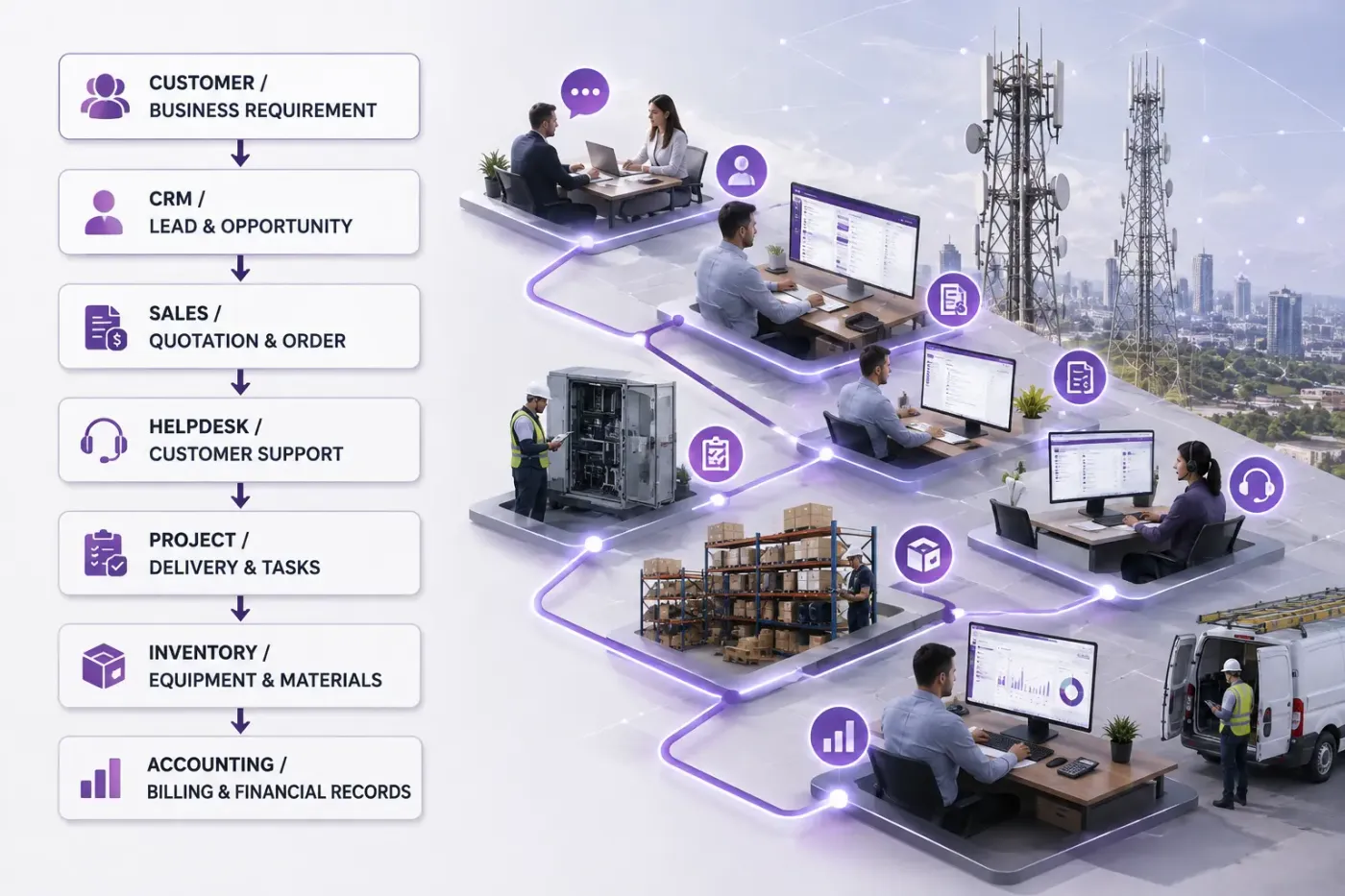
  • Recurring subscriber billing with plan changes, suspension and reconnection
  • Customer equipment tracked by serial number against the subscriber address
  • Installation and fault visits scheduled, with on-site completion recorded
  • Network build and enterprise supply projects costed against their own account
Diagram of connected telecommunications operations in Odoo ERP
Connected operations — how the telecommunications applications above share one database.
Expertise · how we work

What we settle in week one of a telecommunications implementation

These are the configuration decisions that are cheap to make now and structural to change later. We walk through each one before a single record is migrated.

  1. What the subscriber record is

    A customer, a connection or an address. Many premises have more than one connection and the model has to allow for it.

  2. CPE tracking policy

    Whether customer equipment is serial-tracked, owned or sold. This decides how recovery, faults and warranty are handled.

  3. Suspension and reconnection rules

    After how many days of non-payment, with what charge, and who authorises it. Better as configuration than as a daily decision.

  4. Field collection handling

    If collection happens in the field, how receipts are recorded and reconciled by collector and by area.

  5. Plan change treatment

    Mid-cycle upgrades and downgrades: pro-rata, next cycle, or with an adjustment. Decided before the first plan change, not during it.

  6. Fault versus chargeable visit

    What a visit records so the billable ones are billed, which is where small telecom businesses quietly lose margin.

  7. Network systems boundary

    What stays in provisioning and network management, and what the interface to Odoo carries.

Business models

Odoo for different telecommunications business models

The right configuration depends on how your business actually operates, not on your sector label. Two companies with the same description on paper often need different warehouse steps, different approval chains and different reports.
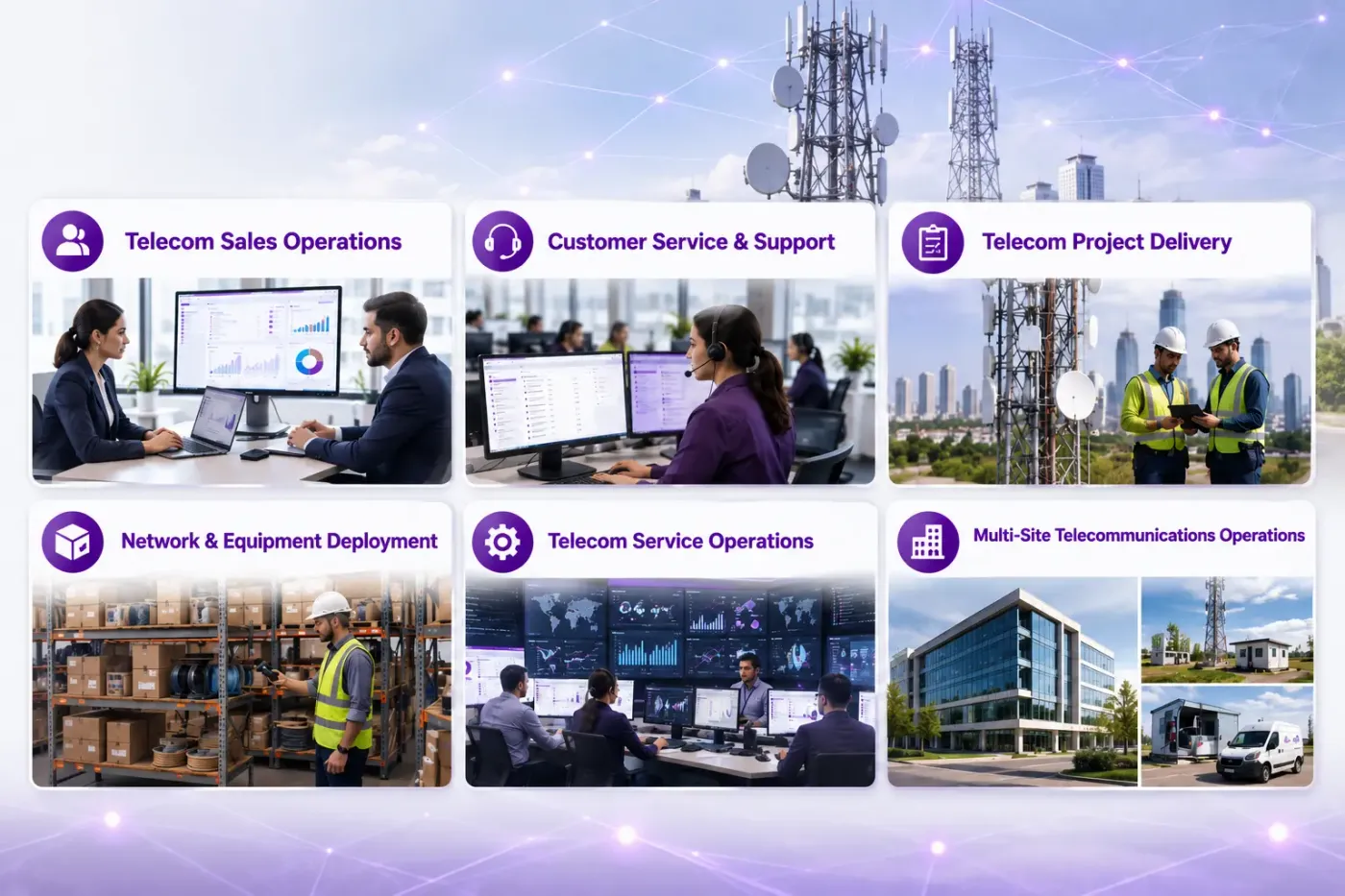
  • Internet service providers — Recurring broadband plans where churn and collection discipline decide profitability.
  • Cable and local operators — Area-based subscriber bases with collection in the field and high device counts.
  • Network integrators — Enterprise projects supplying and installing equipment, closer to a project business.
  • Equipment distributors — Selling networking hardware from stock, with warranty and RMA as the service layer.
  • Managed network services — AMC and managed contracts for enterprise networks, billed recurring with SLA.
  • Infrastructure and tower services — Maintenance of passive infrastructure on scheduled visit contracts.
Odoo ERP configured for different telecommunications business models
Business models — the same applications, configured differently for each operating model.
Trust · honest advice

Where Odoo needs work for telecommunications businesses

We would rather say this before you buy licences than after. These are the areas where we scope real development, recommend a bolt-on, or tell you Odoo is the wrong tool.

OSS and BSS functions

Provisioning, activation, service orchestration and network inventory at carrier scale are specialist systems, not ERP features.

Rating and mediation

Turning usage records into charges needs a rating engine. Odoo bills plans, not metered traffic.

Number and resource management

Number ranges, IP pools and SIM lifecycle management need custom modelling or dedicated tools.

Interconnect settlement

Carrier-to-carrier settlement and reconciliation is outside standard Odoo.

Network monitoring

Uptime, bandwidth and element monitoring comes from network management platforms, with Odoo consuming alerts at most.

Regulatory reporting

Licence-specific regulatory returns vary by authority and almost always need custom reports.

Our services

Odoo telecommunications ERP implementation services

Implementing Odoo for telecommunications needs more than installing the applications. Your ERP should reflect how your operations actually run.

  1. Requirement analysis

    Understand your subscriber base and plans, whether customer equipment is tracked, how collection happens, and which network systems stay in place.

  2. Workflow design

    Map new connection to billing to fault resolution onto Odoo, and settle the subscriber record model and CPE policy before configuration.

  3. Odoo configuration

    Configure the applications above around your requirements rather than installing them at their defaults.

  4. Data migration

    Prepare and migrate masters, open items and opening balances. Data cleaning is scoped explicitly, because it is usually the largest single task. See Odoo migration.

  5. Integration & customisation

    Connect the systems you are keeping and build only what configuration genuinely cannot reach. See integration and customization.

  6. Testing & user training

    Your own team runs real transactions in a test database before go-live. Role-based training for the people who key them daily. See Odoo training.

  7. Go-live & support

    Cutover planning, opening balance freeze, hypercare in the first weeks, then ongoing support and AMC.

Trust · what it costs

What an Odoo implementation costs for telecommunications businesses

We do not publish one implementation price, because the same application list costs very differently depending on the factors below. We do publish what moves the number, and the price is fixed in writing before work starts.

  • Subscriber countLarge bases need migration care and self-service to keep administration manageable.
  • CPE tracking depthSerial-tracking every device is discipline at install and recovery, and it pays back on faults.
  • Field operation sizeMore technicians and areas means more scheduling and mobile configuration.
  • Collection modelField collection needs tighter cash controls than online payment.
  • Network system interfacesAny feed from provisioning or usage systems is scoped separately.
  • Enterprise project workRunning projects alongside subscriptions is effectively a second module set.
Why us

Why choose OdooBots for Telecommunications ERP implementation

We will tell you plainly which parts of a telecom problem Odoo should not touch. For a regional ISP or operator, what it does solve is real: recurring billing with suspension rules, a device record per address, and field visits that end in a closed ticket rather than a phone call.

Based inAmbattur, ChennaiTamil Nadu 600053, India
Phone+91 98414 81435Mon–Sat, business hours IST
Delivered630+ Odoo projects30+ consultants and developers
Versions supportedOdoo 16 – 19Community and Enterprise
FAQ

Odoo ERP for telecommunications: frequently asked questions

What is Odoo ERP for telecom and network services?
Odoo ERP for telecom bills subscribers on recurring plans with suspension and reconnection rules, tracks the router, set-top box or ONT at each address by serial number, schedules installation and fault visits through field service, runs support with an SLA, and costs network build or enterprise supply projects separately.
Can Odoo bill broadband or cable subscribers?
Yes, on recurring plans with upgrades, downgrades, suspension for non-payment, reconnection charges and churn reporting. What it cannot do is rate metered usage, so if your billing depends on live traffic, that comes from your network systems into Odoo rather than being calculated in it.
Can Odoo track customer premises equipment?
Yes, by serial number against the subscriber address, including returns and faulty-unit handling. This is worth insisting on, because a fault call a year later is answerable from the record instead of from a technician memory.
Is Odoo an OSS or BSS?
No, and we say so before any licence is bought. Provisioning, activation, service orchestration, rating and mediation are carrier-scale specialist systems. Odoo suits regional ISPs, cable operators, integrators and equipment businesses for the commercial and field layer.
Can Odoo handle field collection from subscribers?
Yes, with receipts recorded by collector and by area and reconciled against subscriber ledgers. Cash collection in the field needs tighter controls than online payment, so that part of the configuration is deliberately stricter.
How does Odoo handle suspension for non-payment?
As a configured rule: after an agreed number of days, with an optional reconnection charge and a defined authoriser. Making it configuration rather than a daily judgement call is what keeps it applied consistently.
Can Odoo run enterprise network projects alongside subscriptions?
Yes, with projects carrying material, labour and subcontract cost per site while the subscription side bills recurring plans. Running both is effectively a second module set and is scoped as such rather than assumed.
Can OdooBots implement Odoo for an ISP or network company?
Yes, for internet service providers, cable and local operators, network integrators, equipment distributors, managed network service providers and infrastructure maintenance businesses.
References

Sources and official documentation

Product capabilities stated on this page are documented by Odoo. The configuration advice and limitations come from our own implementations.

Ready to connect your telecommunications operations with Odoo?

Tell us roughly how many active subscribers you bill and whether customer equipment is tracked today. Those two answers shape the configuration, and the diagnosis call is free.