
Customer and vehicle records
The owner and the vehicle as linked records with registration, model, odometer and the full service history, so the counter knows the vehicle before the mechanic sees it.
RegistrationOdometerHistory
A workshop loses money in two places: parts fitted and never charged, and a vehicle’s history that only exists in the mechanic’s memory. Both are record-keeping problems wearing the costume of a margin problem.
A garage system in Odoo ties the vehicle, the job card, the parts issued and the invoice into one record, so what was done and what it cost are the same piece of information.
Businesses running Odoo with OdooBots







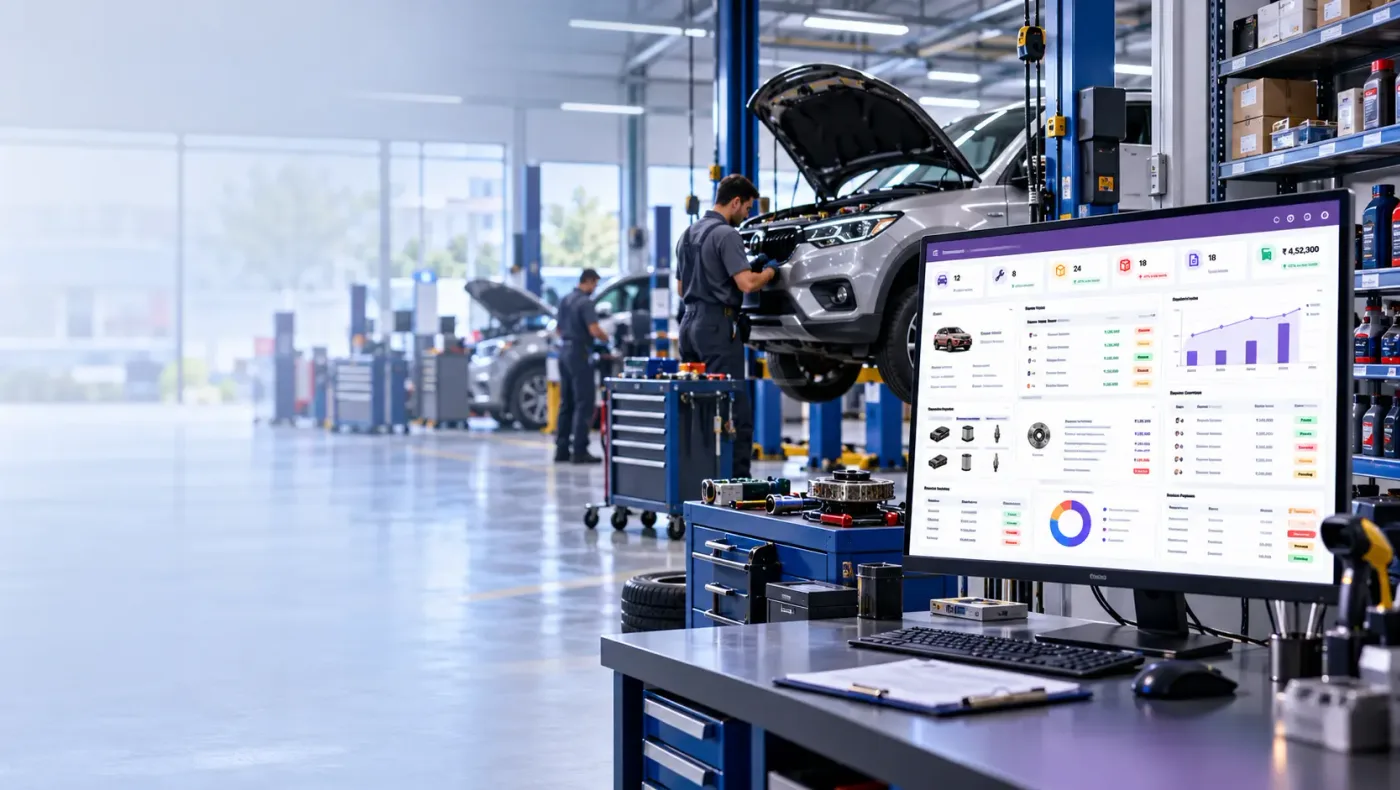
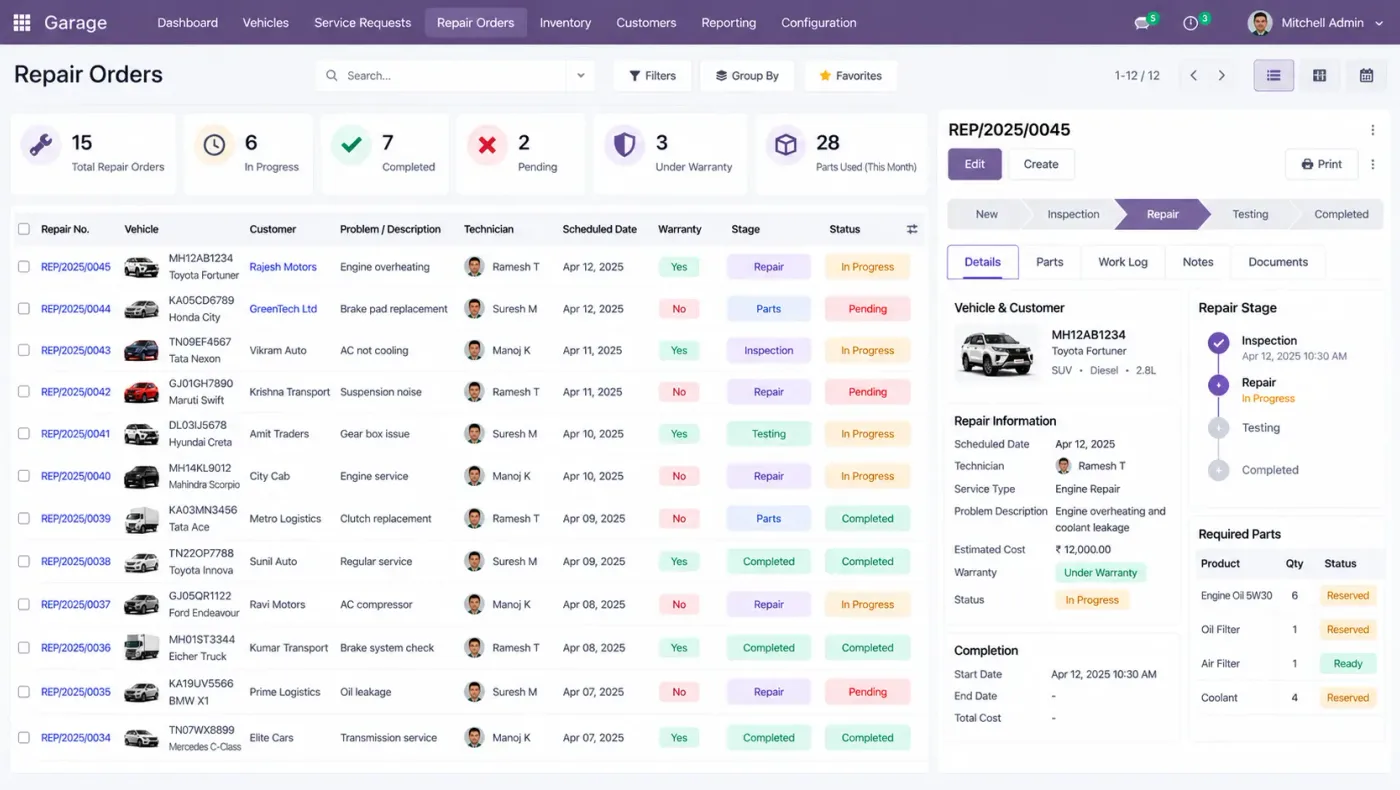
An Odoo garage management system keeps the customer, the vehicle, the job card, the parts and the bill on one record. A vehicle arrives against its own history, the job card records the work agreed and the technician doing it, spare parts are issued from stock against that card, labour is charged by time or by a standard rate, and the invoice is raised from the same card — so nothing fitted is unbilled and the vehicle’s service history is a record rather than a recollection.
Odoo has no standard vehicle job card. Repairs covers product repairs and Fleet covers vehicles you own, so a customer-vehicle workshop model is built on top of the standard applications. That build is quoted separately from the configuration, and a partner who does not say so is leaving it until week three.
Six parts make up a workshop system, and the value is that they are one chain rather than six books.
The owner and the vehicle as linked records with registration, model, odometer and the full service history, so the counter knows the vehicle before the mechanic sees it.
The complaint recorded, an inspection noted, and an estimate approved by the customer before work begins — which is what a disputed bill is settled against.
Work assigned to a technician with the tasks, the time taken and the status visible, so a vehicle in the bay has a state other than "being worked on".
Parts issued from stock against the job card, so consumption is real, the counter stock figure is true and nothing fitted leaves the workshop unbilled.
Labour billed by recorded time or by a standard rate per operation, alongside consumables and outside work bought in for the job.
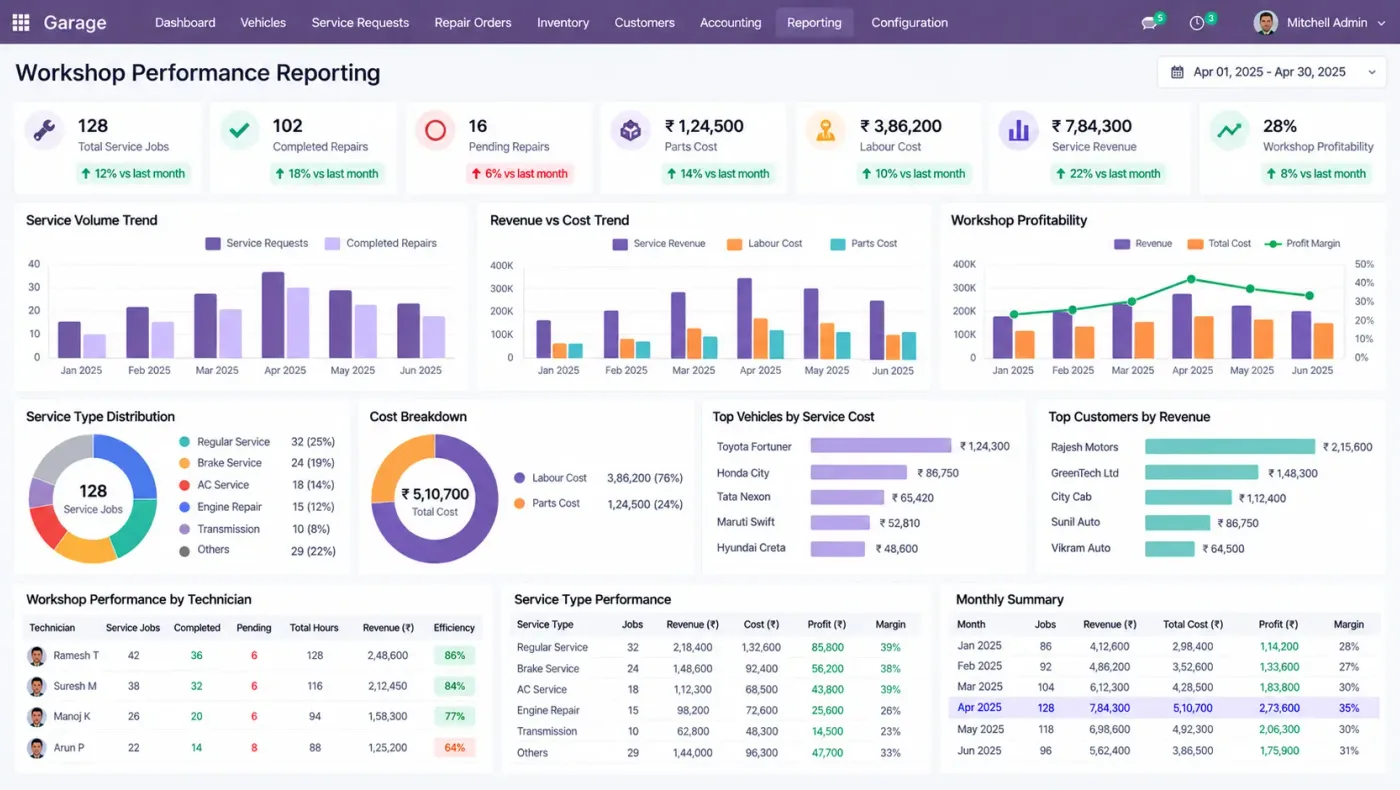
The invoice raised from the job card with GST and part payments, the job added to the vehicle’s history, and workshop performance reported by technician, job type and turnaround time.
A vehicle arrives and is matched to its record and its history. The complaint and inspection produce an estimate the customer approves. The job card goes to a technician; parts are issued from stock against it and labour is recorded. The invoice is raised from that card, so every part fitted is on the bill, and the whole job is added to the vehicle’s history for next time.
Because parts leave the same inventory the counter sells from, the stock figure stays true and the margin on a job is the difference between two real numbers.
These are the configuration decisions that are cheap to make now and structural to change once transactions exist. We walk through each one before a single record is migrated.
Repairs, a project task or a custom model. This decides how parts, labour and billing attach, and it is the first thing to settle.
Recorded time or a standard rate per operation. Standard rates are faster at the counter and need the operation list built first.
How customer approval is captured before work starts, and what happens when the job grows beyond it.
Whether parts leave stock at issue or at billing. Issue is accurate; billing is easier and makes counter stock wrong all day.
Whether you also sell parts over the counter, because that is point of sale sharing the same stock.
How manufacturer warranty jobs and free services are recorded so they are not billed and are still costed.
Painting, machining or electrical bought in for a job, recorded against it rather than as a general expense.
Odoo moves features between Community and Enterprise from one version to the next, so the list below is what holds today and is confirmed against your own version during the diagnosis rather than taken as permanent.
Most of a workshop runs on Community applications — inventory, purchasing, sales, invoicing and accounting all come as standard.
What is not standard is the vehicle job card itself, and that is a build decision rather than a licence one.
We would rather say this before you buy licences than after. These are the areas where we scope real development, recommend a bolt-on, or tell you another tool is the better answer.
Manufacturer catalogues with vehicle fitment data are a licensed data problem. Odoo holds your stock; it does not know which part fits which model.
Reading fault codes from workshop equipment into a job card needs an integration per tool.
Surveyor approval, claim documentation and settlement tracking usually need a custom module.
Scheduling physical bays and lifts with capacity is beyond standard task assignment.
Claiming back from a manufacturer needs its own tracking, and the format varies by brand.
Online service booking with slot availability is a website build on top rather than a standard feature.
Implementing An Odoo garage management system needs more than installing the application. It should reflect how your business already works, and change only what is worth changing.
Understand your job volume, whether you sell parts over the counter, how labour is priced today, and whether warranty or insurance work is a large share.
Settle what the job card is built on, the labour pricing basis, parts issue discipline and estimate approval before anything is configured.
Set An Odoo garage management system up around how you work rather than installing it at its defaults, and build only what configuration genuinely cannot reach. See Odoo customization.
Masters, open items and opening balances prepared and loaded. Data cleaning is scoped explicitly, because it is usually the largest single task. See Odoo migration.
Your team runs real transactions in a test database before go-live, including the awkward cases that never appear in a demonstration.
Role-based training for the people who key transactions daily, then cutover, hypercare and ongoing support and AMC.
We do not publish one price, because the same application costs very differently depending on the factors below. We do publish what moves the number, and the price is fixed in writing before work starts.
We insist parts leave stock when they are issued to the job, not when the invoice is raised. It is harder for the storekeeper and it is the only way the counter stock figure is true at four in the afternoon.
Product capabilities stated on this page are documented by Odoo. The configuration advice, edition notes and limitations come from our own implementations.
Tell us roughly how many jobs a day you handle and whether you also sell parts over the counter. Those two answers shape the build, and the diagnosis call is free.