
Requests and tickets
Customer requests arriving by phone, email, portal or website form, categorised, prioritised and tracked against an SLA rather than a memory.
PortalPrioritySLA
Service businesses lose money in the gap between the job being done and the job being billed. The technician finishes, the paperwork goes in a bag, the parts used are remembered approximately, and the invoice goes out three weeks later for less than it should.
A service management system closes that gap by making the completion of the job and the record of the job the same event.
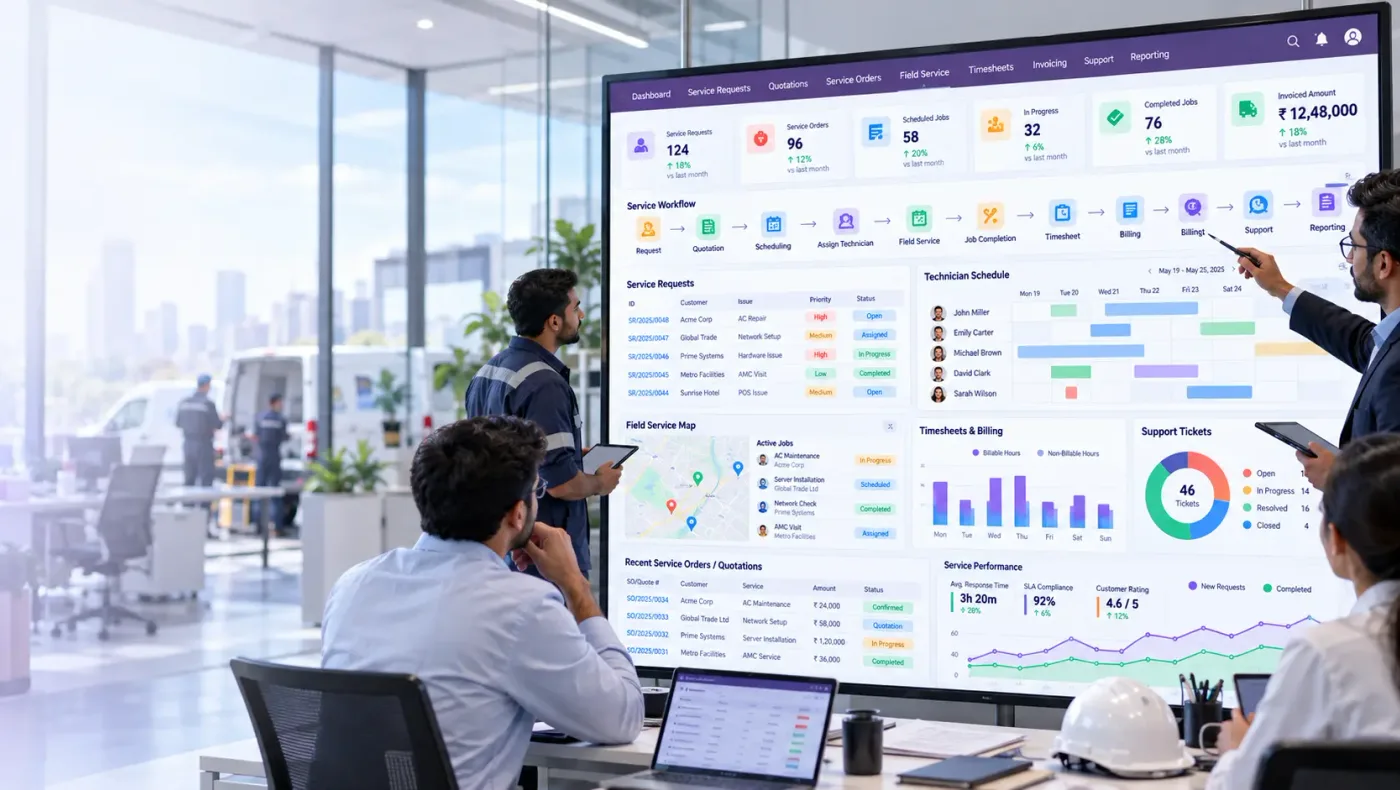
Businesses running Odoo with OdooBots







An Odoo service management system takes a request through scheduling, on-site completion and billing without the job being written down twice. Requests arrive as tickets or orders, work is scheduled to a technician by skill and area, the on-site worksheet records what was done and which parts were consumed, those parts leave stock, and the invoice is raised from the same record — either against the job or against the AMC contract that covers it.
Field Service and Helpdesk are both Enterprise applications. A service business running on Community is doing this with projects and tasks, which works and is noticeably more manual, and the licence maths usually favours Enterprise once you have more than a handful of technicians.
Six parts make up a service operation in Odoo, and the chain only works if the last two are connected to the first four.
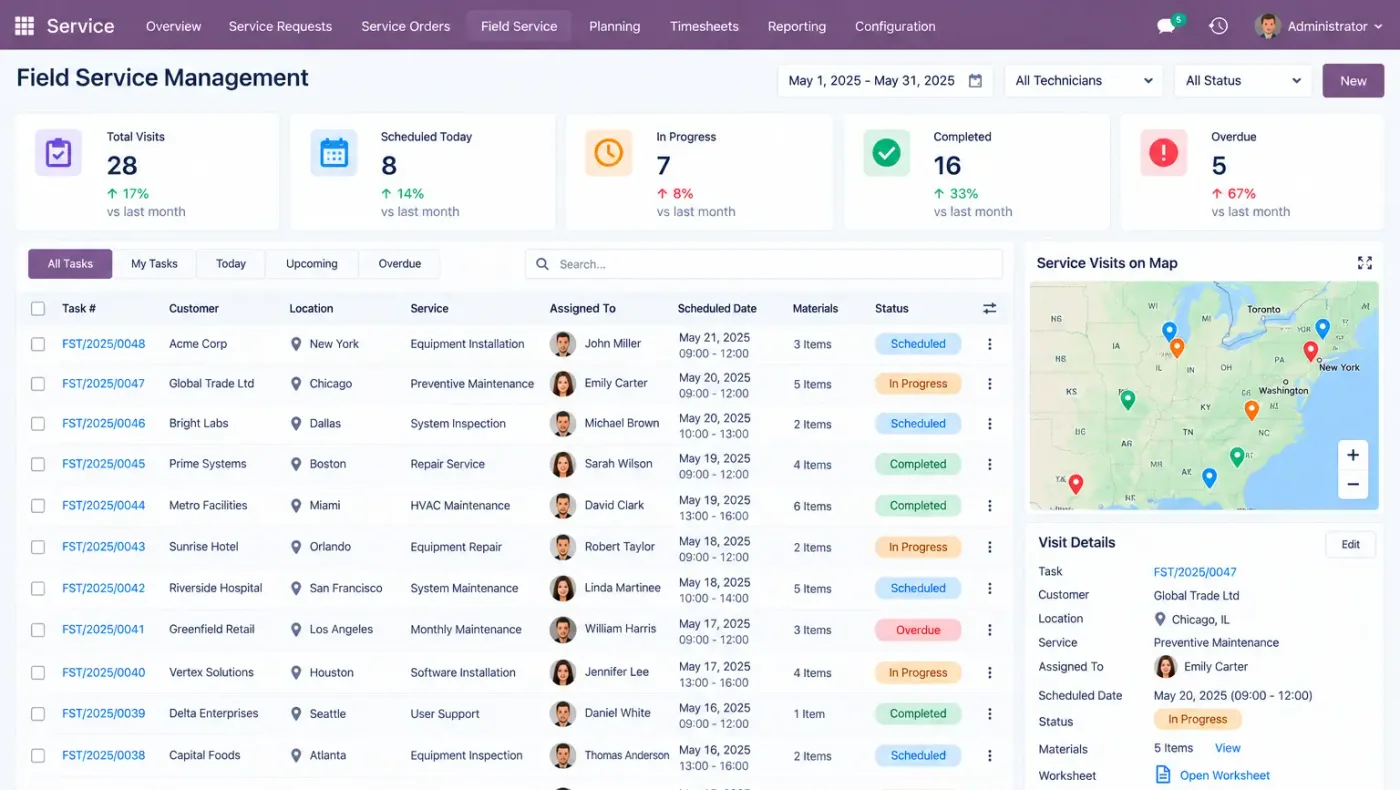
Customer requests arriving by phone, email, portal or website form, categorised, prioritised and tracked against an SLA rather than a memory.
Work assigned to technicians by skill, territory and availability, with travel considered and leave accounted for, so the plan is one somebody can actually complete.
A worksheet completed on a phone or tablet with the work done, readings taken, photographs attached and a customer signature before the technician leaves.
Spares consumed on the job leaving stock from the van or the store, so the job cost is real and the van stock figure is not fiction.
Invoices raised from the completed job — time and material, a fixed service charge, or nothing because the AMC covers it, which is a decision the system should make.
AMC and maintenance contracts billed on schedule with their scope recorded, preventive visits planned from them, and renewals chased before they lapse.
A request becomes a scheduled job. The technician completes a worksheet on site, consuming parts from van stock, and the customer signs. That worksheet drives the invoice the same day, or marks the visit as covered by the AMC. The contract keeps billing monthly regardless, and preventive visits are planned from it rather than remembered.
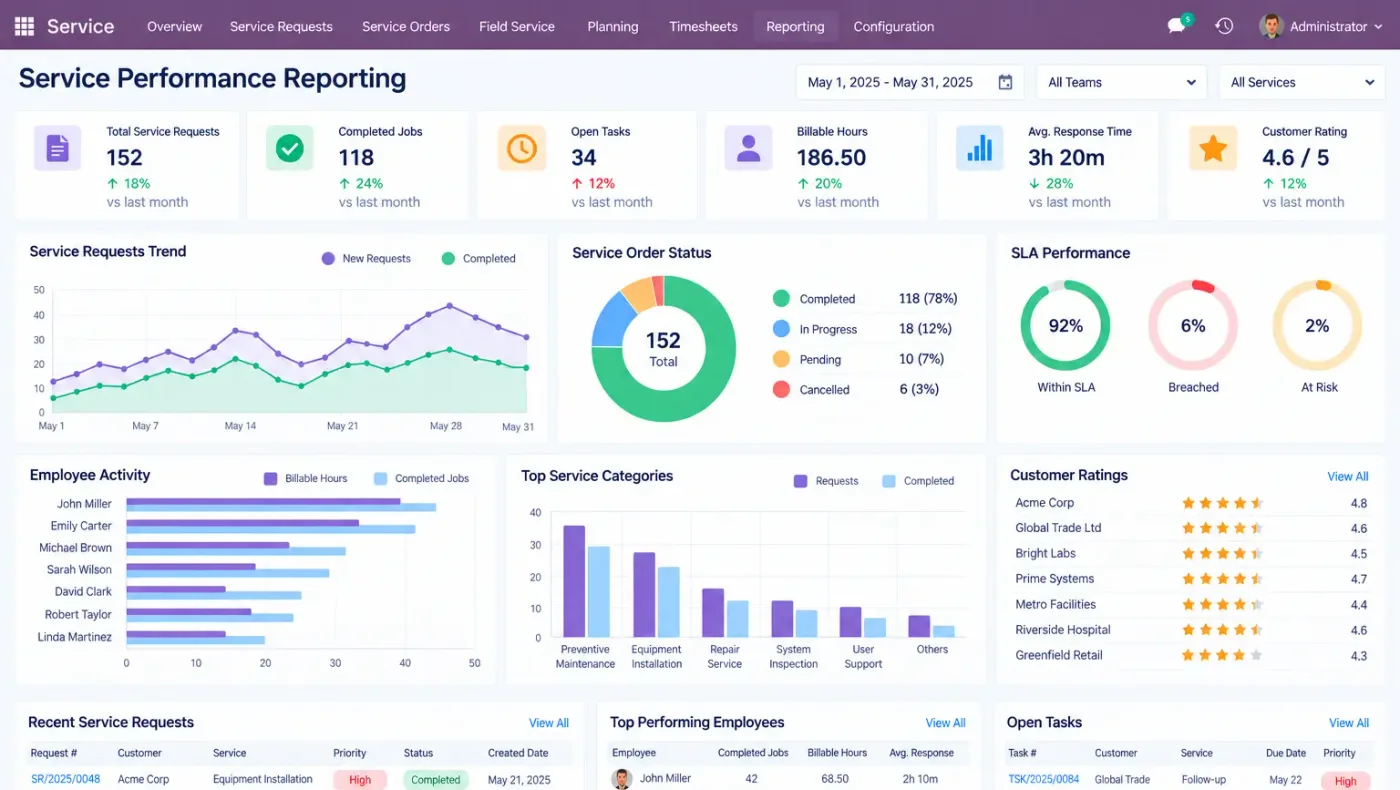
What changes commercially is the gap between work done and cash: the paperwork is the job record, so there is nothing to type up later and nothing to forget to bill.
These are the configuration decisions that are cheap to make now and structural to change once transactions exist. We walk through each one before a single record is migrated.
A ticket, a task or a sales order line. Everything about cost and billing follows from this, and it is awkward to restructure later.
How the system knows whether a visit is covered by AMC. Without this rule, it is argued about once a month, per customer.
Whether each technician’s vehicle is a stock location. It is more discipline and it is the only way job cost is real.
What the technician must record before closing a job, designed with technicians rather than for them, or it gets filled with nothing.
Response versus resolution, by priority and contract, so the commitment is measured rather than claimed in a sales meeting.
Skills, territory, travel time and leave, and who may override the schedule when a customer escalates.
What a technician can do with no signal at a site, because basements and factories exist.
Odoo moves features between Community and Enterprise from one version to the next, so the list below is what holds today and is confirmed against your own version during the diagnosis rather than taken as permanent.
The applications that make service work properly sit in Enterprise, which makes this one of the simpler licence conversations.
Community can run a service business through projects, tasks and timesheets, with more manual steps and no mobile worksheet, which suits a small team and stops scaling around ten technicians.
We would rather say this before you buy licences than after. These are the areas where we scope real development, recommend a bolt-on, or tell you another tool is the better answer.
Odoo schedules; it does not solve a travelling-salesman route across thirty jobs. That is specialist software, integrated if you need it.
Live drag-and-drop dispatch with automatic reallocation on delay goes beyond standard planning.
Equipment raising its own service request from telemetry is an integration project, not a setting.
Mobile working assumes intermittent connectivity rather than none. Sites with no signal at all need the process designed around that.
Claiming back from a manufacturer under warranty usually needs custom modelling to track properly.
Dispatching to third-party engineers with their own rates and settlement is scoped as development.
Implementing An Odoo service management system needs more than installing the application. It should reflect how your business already works, and change only what is worth changing.
Understand how requests arrive, how many technicians you schedule, whether vans carry stock, and what your AMC contracts actually cover.
Settle what a job is, the billable-versus-AMC rule, van stock treatment and worksheet content before anything is configured.
Set An Odoo service management system up around how you work rather than installing it at its defaults, and build only what configuration genuinely cannot reach. See Odoo customization.
Masters, open items and opening balances prepared and loaded. Data cleaning is scoped explicitly, because it is usually the largest single task. See Odoo migration.
Your team runs real transactions in a test database before go-live, including the awkward cases that never appear in a demonstration.
Role-based training for the people who key transactions daily, then cutover, hypercare and ongoing support and AMC.
We do not publish one price, because the same application costs very differently depending on the factors below. We do publish what moves the number, and the price is fixed in writing before work starts.
We configure the AMC rule first — what is covered and what is chargeable — because that is the argument service businesses have with their customers every month, and it is a configuration problem being treated as a relationship problem.
Product capabilities stated on this page are documented by Odoo. The configuration advice, edition notes and limitations come from our own implementations.
Tell us how many technicians you schedule and whether your vans carry stock. Those two answers shape the configuration.