OdooBots
Loading
Odoo ERP · the plain answer

What is Odoo ERP?

Most people meet Odoo as a CRM, a website builder or an invoicing tool, and come away unsure whether it is really an ERP at all.

It is. This page says what that means in practice, what you get, and where it genuinely does not fit.
Karthik RajOdoo Technical Consultant, 10+ years| Reviewed by Suresh Babu| Updated 25 November 2026| No sales pitch on this page
0Odoo projects delivered
0Consultants & developers
Open sourceCommunity edition
ChennaiAmbattur, Tamil Nadu
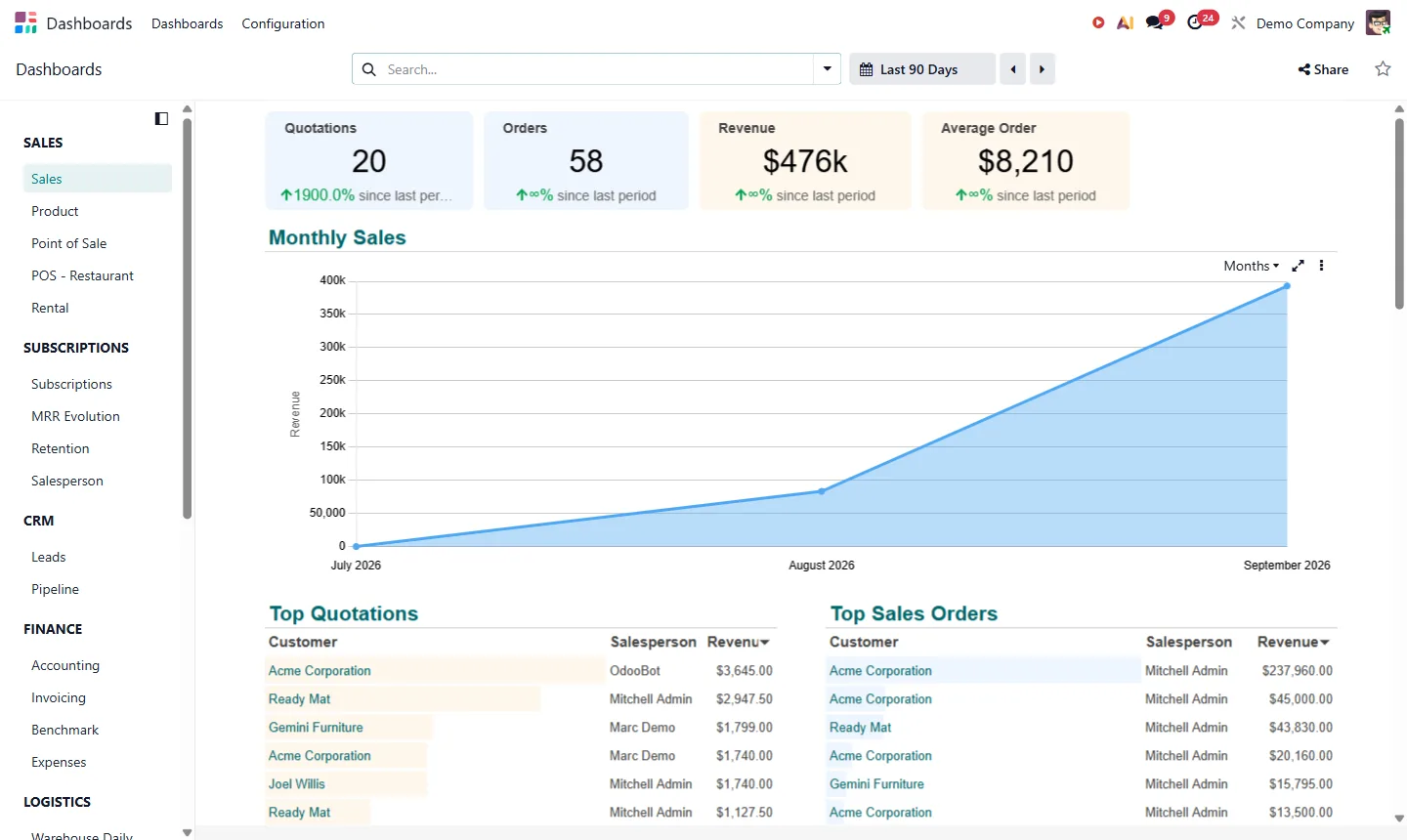
The Odoo apps dashboard, where every Odoo application is switched on or off
1
One databasebehind every app

Businesses running Odoo with us

Dhanalakshmi Industries logo Sanjeev Autoparts logo Electro Flux Equipments logo Anchor Marine Equipment Company logo NEXG logo PV Constructions logo SESS logo
Definition

What is Odoo ERP?

Odoo is an open-source ERP: a suite of business applications — accounting, sales, CRM, purchase, inventory, manufacturing, HR, point of sale, projects and a website builder among them — that all read and write the same database. That single database is the whole point. When a salesperson confirms an order, the warehouse sees a delivery to pick, accounting sees an invoice to raise and the margin report changes, because all three are reading the same record rather than three copies of it.

Odoo is sold in two editions. Community is free and open source. Enterprise is a paid licence that adds applications and Odoo’s own support. Both run the same core.

ERP
Enterprise Resource Planning: one system of record for the whole business rather than one tool per department.
App
An Odoo module you switch on. You install what you need and leave the rest off.
Community
The free, open-source edition. Self-hosted, no licence fee.
Enterprise
The paid edition: more apps, Odoo’s support, per-user licensing.
What is in it

The applications most businesses actually switch on

Odoo publishes dozens of apps. A first go-live almost never uses dozens. These are the ones that carry the work.

Accounting

Invoices, bills, bank reconciliation, taxes and the reports your auditor asks for. In India this is where GST and e-invoicing live.

GSTBankReports

Sales and CRM

Leads and pipeline on one side, quotations and confirmed orders on the other, with the same customer record behind both.

PipelineQuotations

Inventory

Stock by location, receipts, deliveries, lots and serial numbers, and the valuation that follows every move.

LocationsLotsValuation

Purchase

Requests, purchase orders, vendor bills matched against what actually arrived.

POThree-way match

Manufacturing

Bills of material, work orders, work centres and the cost that lands on the finished product.

BOMWork orders

Point of Sale, Projects, HR, Website

A shop counter, billable project work, employees and leave, and a storefront — each reading the same products, customers and accounts.

POSProjectsHR
The honest line

Where Odoo fits, and where it does not

Both columns are worth reading before you commit. The second one is the reason some enquiries we receive should not become projects.

Odoo fits well

Businesses this usually suits

  • You run three or more disconnected tools and re-key between them.
  • You need accounting, stock and sales to agree without somebody reconciling them weekly.
  • You want to start with a few apps and add more as you go.
  • You have processes that are a little unusual and need the system bent to them rather than the other way round.
  • You want to own the code of anything custom, in your own repository.
  • Indian compliance matters: GST, e-invoicing and e-way bill are handled by the localisation.
Look elsewhere

Where we would tell you not to

  • You need one narrow thing done extremely well and nothing else — a dedicated tool will beat an ERP module.
  • Nobody internally can own the project. Odoo does not fail on software; it fails on nobody deciding.
  • You want zero process change. An ERP is a change of working method before it is a purchase.
  • Your industry needs a certified vertical system that Odoo has no equivalent for.
  • You expect it to be running next week. A real implementation is measured in weeks of your people’s time, not ours.
Why OdooBots

Who is answering this

Based inAmbattur, ChennaiTamil Nadu 600053, India
Phone+91 98414 81435Mon–Sat, business hours IST
VersionsOdoo 13 – 19Community and Enterprise
Your codeYour repositoryYou keep what we write
FAQ

What is Odoo: common questions

Is Odoo a CRM or an ERP?
Both, and that is the source of the confusion. Odoo CRM is one application inside an ERP suite. You can run CRM alone, which is how many people first meet Odoo, but the same database also carries accounting, stock and manufacturing when you switch them on.
Is Odoo free?
Odoo Community is genuinely free and open source, and you can self-host it with no licence fee. Odoo Enterprise is a paid per-user licence. Neither covers implementation, which is the work of configuring it to your business — that is what an implementation partner is paid for.
What does ERP stand for?
Enterprise Resource Planning. In practice it means one system of record for the whole business instead of a separate tool for each department, so that stock, sales and the accounts cannot disagree with one another.
How long does Odoo take to implement?
A focused first go-live on a few applications is usually measured in weeks; a multi-company, multi-warehouse rollout with custom modules runs into months. The variable is rarely the software. It is how quickly your own team can make decisions about process.
Can Odoo replace Tally?
For most Indian businesses, yes, and it is one of the commonest moves we are asked for. Whether it should is a separate question, which the Odoo vs Tally comparison goes through properly.
Sources

Odoo’s own documentation

Want to see it with your own data?

A demo on your numbers rather than a showroom database, so you can judge the fit instead of the slide deck.