
Vehicle and driver records
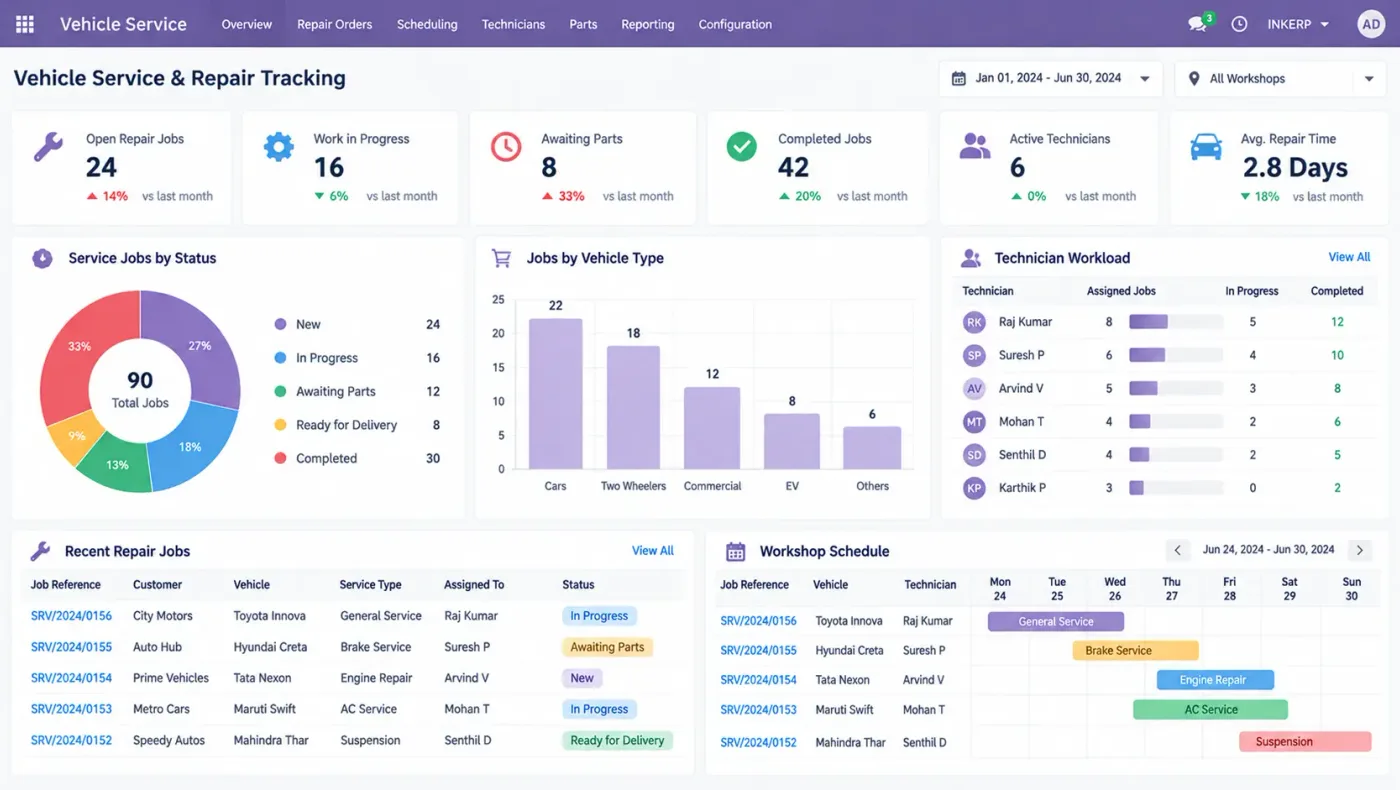
Each vehicle as a record with registration, model, chassis, acquisition date and the driver currently assigned, plus the history of who drove it and when.
RegistrationDriverHistory
Most companies know what their vehicles cost in total and almost nothing about what any one of them costs. Fuel is a fuel bill, repairs are a repair bill, insurance is an insurance bill, and none of the three is attached to a registration number.
A fleet system is mostly a filing decision: every cost lands on the vehicle that caused it. Once that is true, the vehicle to sell, the driver to talk to and the contract to renegotiate are all visible without an argument.
Businesses running Odoo with OdooBots







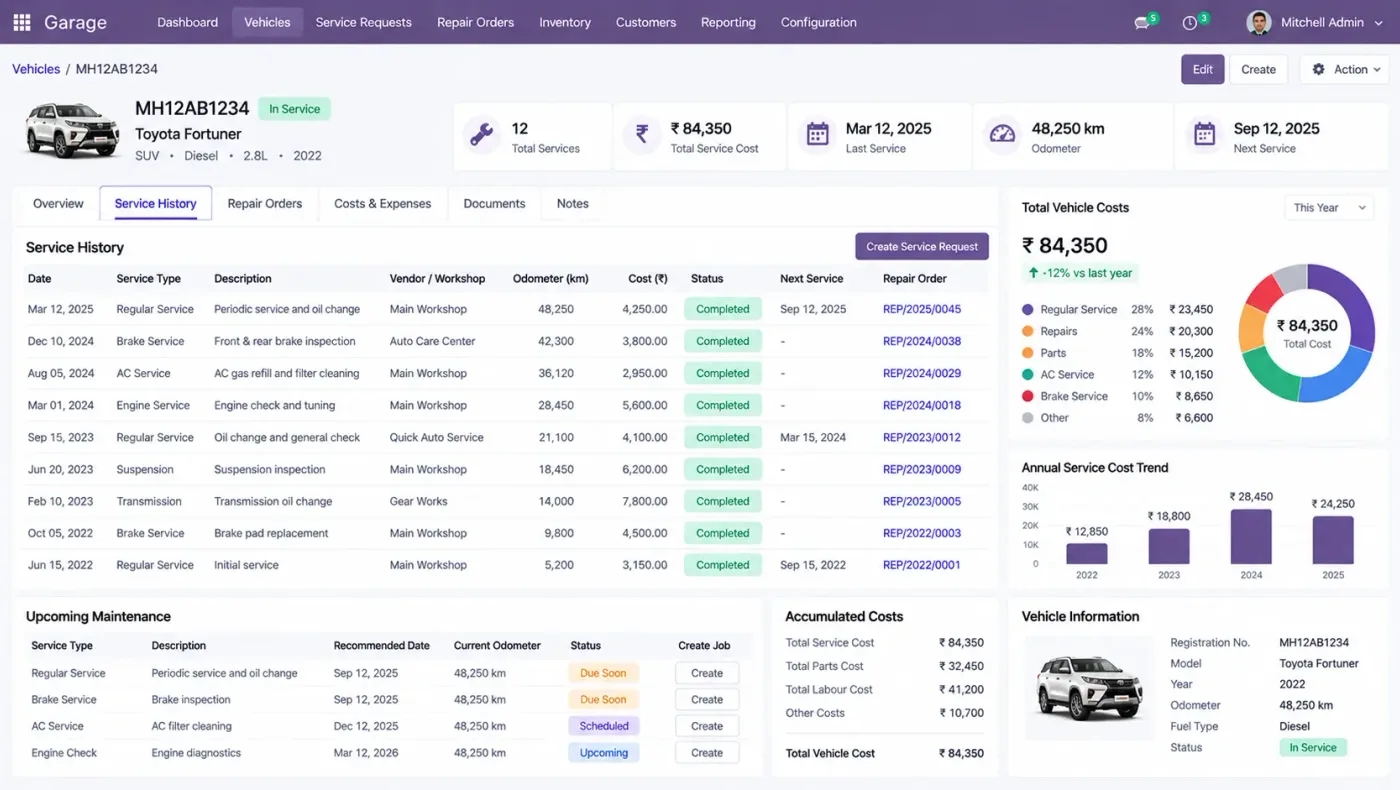
An Odoo fleet management system keeps every vehicle you own as a record that carries its driver, its contracts, its costs and its history. The vehicle holds registration, model, acquisition and odometer; a driver is assigned with the dates that assignment held; insurance, leasing and service contracts sit on the vehicle with their renewal dates; fuel and service costs are logged against it; and because the costs are on the record rather than in the ledger alone, cost per vehicle and cost per kilometre are figures you can read rather than reconstruct.
Odoo Fleet manages vehicles you own or lease. It is not a telematics product: there is no GPS tracking, no live location and no route optimisation in Odoo, and anyone who tells you otherwise is describing an integration with a tracking provider rather than a feature. For customer vehicles coming into a workshop, the record you want is a job card, which is the Odoo garage management system, not Fleet.
Six parts make up a fleet system, and each one is only worth having because it lands on the same vehicle record.
Each vehicle as a record with registration, model, chassis, acquisition date and the driver currently assigned, plus the history of who drove it and when.
Insurance, leasing, permits and service contracts held against the vehicle with their cost and expiry, so a lapsed policy is a warning rather than a discovery at a checkpoint.
Fuel entries and odometer readings recorded against the vehicle, which is what turns a pile of fuel bills into consumption per kilometre per vehicle.
Work done on the vehicle recorded against it over time, whether done in-house or bought in, so a vehicle with a pattern of failures is visible before it strands a delivery.
Recurring and one-off costs attached to the registration rather than only to a general expense account, which is the single thing that makes per-vehicle reporting possible.
Cost by vehicle, by cost type and over time, with analytic accounting available where a vehicle serves one department, project or branch that should carry its cost.
A vehicle is created once with its registration and model. A driver is assigned, and that assignment carries dates so history survives a change. Insurance, leasing and service contracts sit on the vehicle with their renewal dates. Fuel entries and odometer readings arrive over the life of the vehicle, and service work is recorded against it. Every one of those costs is attached to the registration, so the reporting is a read rather than a reconstruction.
Where the vehicle is bought rather than leased, the purchase goes through Purchase and the capitalised value belongs in the asset register, which is a different record with a different purpose — see Odoo asset management.
These are the configuration decisions that are cheap to make now and structural to change once transactions exist. We walk through each one before a single record is migrated.
Owned, leased, and whether staff vehicles on allowance are tracked at all. The last one is a policy decision that looks like a configuration one.
The driver, an administrator, or a card statement loaded in bulk. This decides whether the fuel data is complete, which decides whether any per-kilometre figure is worth quoting.
How often readings are captured and by whom. A fleet with no readings has costs and no denominator.
The list of cost types you will report on, agreed before entries start, because recategorising a year of costs later is manual.
Who is warned about a renewal and how far ahead, so the reminder reaches somebody who can act on it.
Whether a vehicle carries its cost to a department, project or branch through analytic accounting, which has to be set up before the entries exist.
If you run your own workshop the equipment side belongs in maintenance; if you send vehicles out, it is a cost record on the vehicle.
Odoo moves features between Community and Enterprise from one version to the next, so the list below is what holds today and is confirmed against your own version during the diagnosis rather than taken as permanent.
Fleet is a Community application, which surprises people: vehicle records, drivers, contracts, fuel and odometer logs and the cost reporting over them do not need an Enterprise licence.
What is worth checking is the accounting side, because the asset register and depreciation sit in full Accounting rather than in Fleet.
We would rather say this before you buy licences than after. These are the areas where we scope real development, recommend a bolt-on, or tell you another tool is the better answer.
Odoo holds no vehicle location. Live tracking means integrating a telematics provider and bringing its data in, which is an integration project with a recurring subscription behind it.
Optimising a day of drops across vehicles is a routing problem that specialist software solves properly. We will say so rather than quote a customisation that will not match it.
Loading a fuel card statement automatically needs a per-provider import. Manual entry works and is only as complete as the discipline behind it.
Licence expiry, permits and fitness certificates can be held as contracts or custom fields, but a full compliance workflow with document renewals is usually a small build.
Tracking a tyre or battery by serial across vehicles needs the inventory side involved and is not standard Fleet behaviour.
Fleet records costs; it does not depreciate. The capitalised value and its schedule belong in the asset register, which is an Accounting feature.
Implementing An Odoo fleet management system needs more than installing the application. It should reflect how your business already works, and change only what is worth changing.
Understand how many vehicles you run, whether they are owned or leased, who records fuel today, and whether anybody is currently accountable for a renewal date.
Settle the cost categories, the odometer and fuel entry routine, who owns renewals, and whether vehicles carry their cost to departments through analytic accounting.
Set An Odoo fleet management system up around how you work rather than installing it at its defaults, and build only what configuration genuinely cannot reach. See Odoo customization.
Masters, open items and opening balances prepared and loaded. Data cleaning is scoped explicitly, because it is usually the largest single task. See Odoo migration.
Your team runs real transactions in a test database before go-live, including the awkward cases that never appear in a demonstration.
Role-based training for the people who key transactions daily, then cutover, hypercare and ongoing support and AMC.
We do not publish one price, because the same application costs very differently depending on the factors below. We do publish what moves the number, and the price is fixed in writing before work starts.
We will not sell you Odoo as a vehicle tracking system. It is a very good record of what each vehicle costs you and a poor substitute for a GPS product, and knowing which of those you actually need is usually the whole conversation.
Product capabilities stated on this page are documented by Odoo. The configuration advice, edition notes and limitations come from our own implementations.
Tell us how many vehicles you run and who records fuel today. Those two answers decide whether this is a configuration or a data-discipline project.