
Equipment register
Every machine as a record with category, serial, location, assigned employee or work centre, warranty and purchase details, so a machine is a thing with a history rather than a name on a wall.
SerialLocationWarranty
Maintenance is usually run on a wall planner and a phone call. The planner says what should have happened, the phone call is what actually happens, and nobody can say which machine stops most often or what that costs.
Putting maintenance in the ERP changes one thing worth the effort: the breakdown, the schedule and the machine become the same record, so the history exists without anybody keeping it.
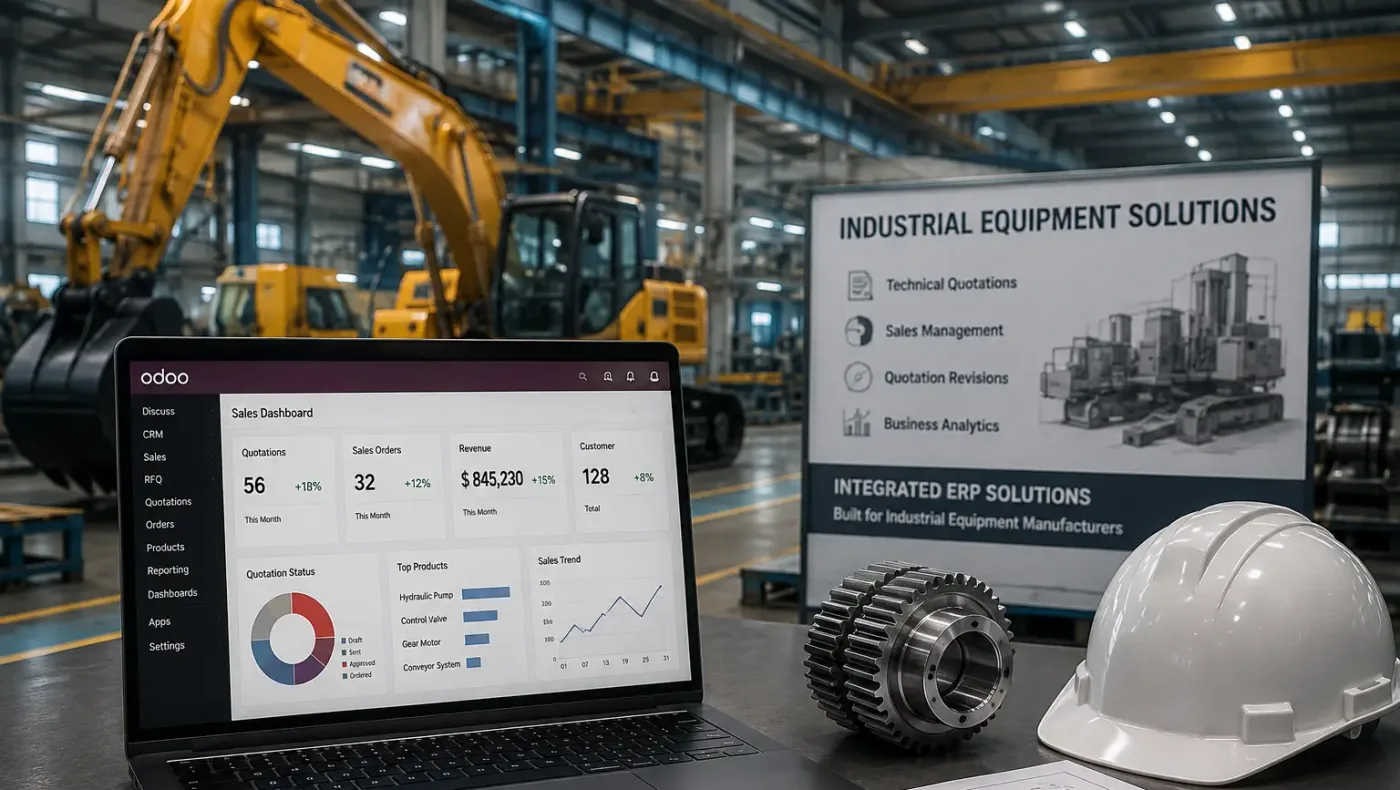
Businesses running Odoo with OdooBots







An Odoo maintenance management system keeps each piece of equipment as a record that carries its preventive schedule, its breakdown history and the team responsible for it. Equipment is registered with its category, location and the person or work centre using it; preventive requests are generated on a schedule; corrective requests are raised when something fails and move through stages to completion; and because every request sits on the equipment, mean time between failures, mean time to repair and the machines that cost you the most are reports rather than opinions.
This is Odoo Maintenance, which looks after your equipment. It is not the same thing as our Odoo support and AMC, which looks after your Odoo. The two phrases are close enough that people arrive on the wrong one, so: this page is about machines.
Six parts make up a maintenance system, and the value is that they all attach to one equipment record.
Every machine as a record with category, serial, location, assigned employee or work centre, warranty and purchase details, so a machine is a thing with a history rather than a name on a wall.
Requests generated ahead of failure on a frequency per equipment, which is what moves a maintenance team from reacting to planning.
A failure raised as a request by whoever found it, assigned to a team, moved through stages and closed with what was done, so the history is a by-product of the work.
Work split across teams with their own kanban and calendar, so each team sees its own queue instead of everybody seeing everything.
Parts consumed on a repair issued from inventory so the cost of a breakdown is real and the store figure is not fiction — which needs the link between the request and the stock move set up deliberately.
Time between failures and time to repair per equipment and per category, which is how you argue for replacing a machine with a number rather than a feeling.
A machine is registered once. Preventive requests arrive on its schedule and corrective requests arrive when it fails, both against the same record. The team works the request through its stages, consuming spare parts from the store. The equipment accumulates a history nobody had to keep, and that history is what the downtime reporting reads.
Where the equipment is a work centre on the shop floor, a machine under maintenance affects what manufacturing can plan — which is the main reason to have maintenance in the same database as production rather than beside it.
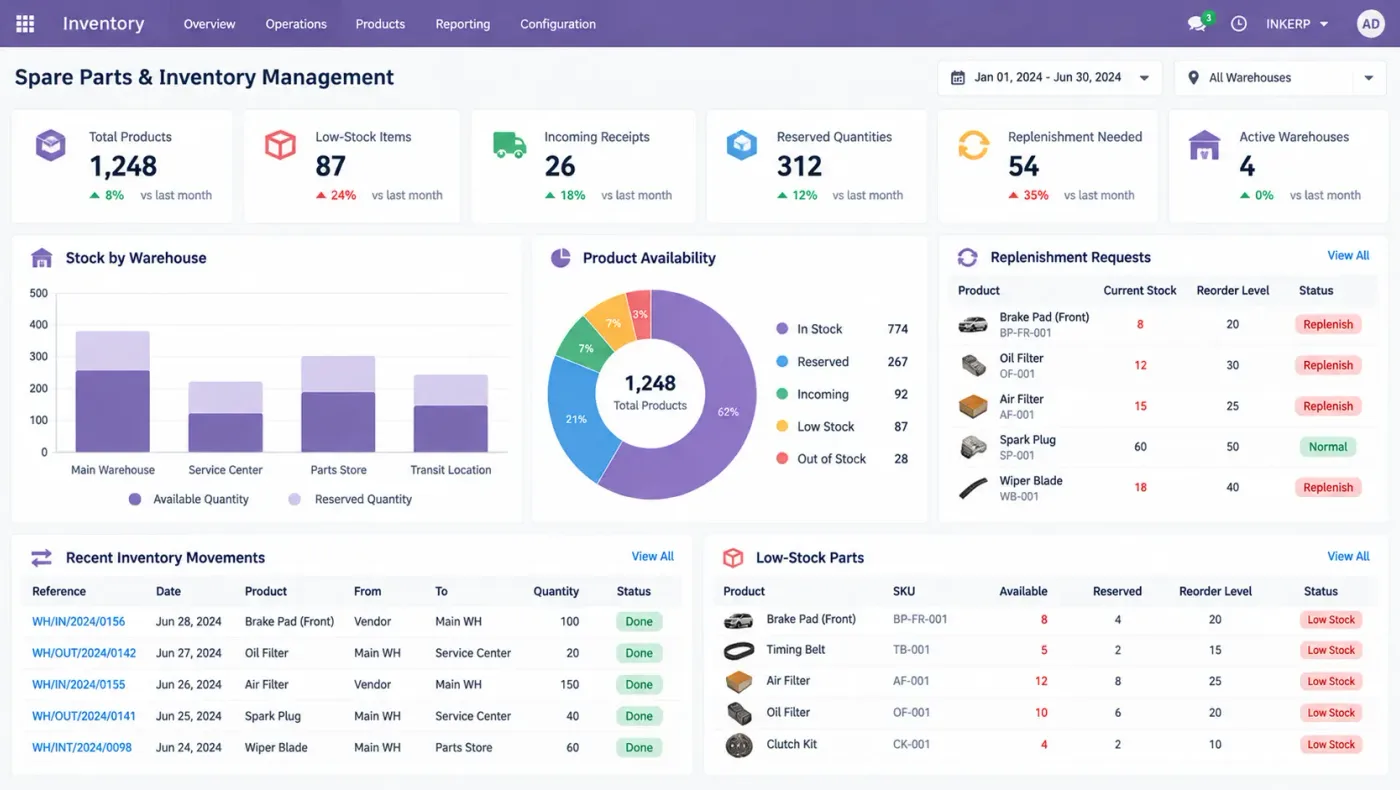
These are the configuration decisions that are cheap to make now and structural to change once transactions exist. We walk through each one before a single record is migrated.
Every machine, or only those above a value or criticality. Registering everything sounds thorough and produces a register nobody maintains.
The operator, the supervisor or the maintenance team. This decides whether your downtime figure is real or whether small stoppages never appear.
Calendar frequency is standard. Triggering on running hours or output count is a meter reading Odoo does not take by itself, and that is a build.
Whether parts are issued from stock against the request or bought ad hoc. Only the first makes repair cost and store stock both true.
Whether a machine is linked to a manufacturing work centre, so maintenance and production planning see the same unavailability.
How many teams, and what the stages mean. Stages that do not match how work really moves get skipped and the data goes with them.
When a machine is counted as down and when it is counted as back. Agreeing this once prevents a year of unusable numbers.
Odoo moves features between Community and Enterprise from one version to the next, so the list below is what holds today and is confirmed against your own version during the diagnosis rather than taken as permanent.
Maintenance is a Community application. Equipment records, preventive and corrective requests, teams, stages and the basic reporting over them do not need Enterprise.
What tends to need more thought is the parts and costing side, because that reaches into inventory and accounting rather than staying inside Maintenance.
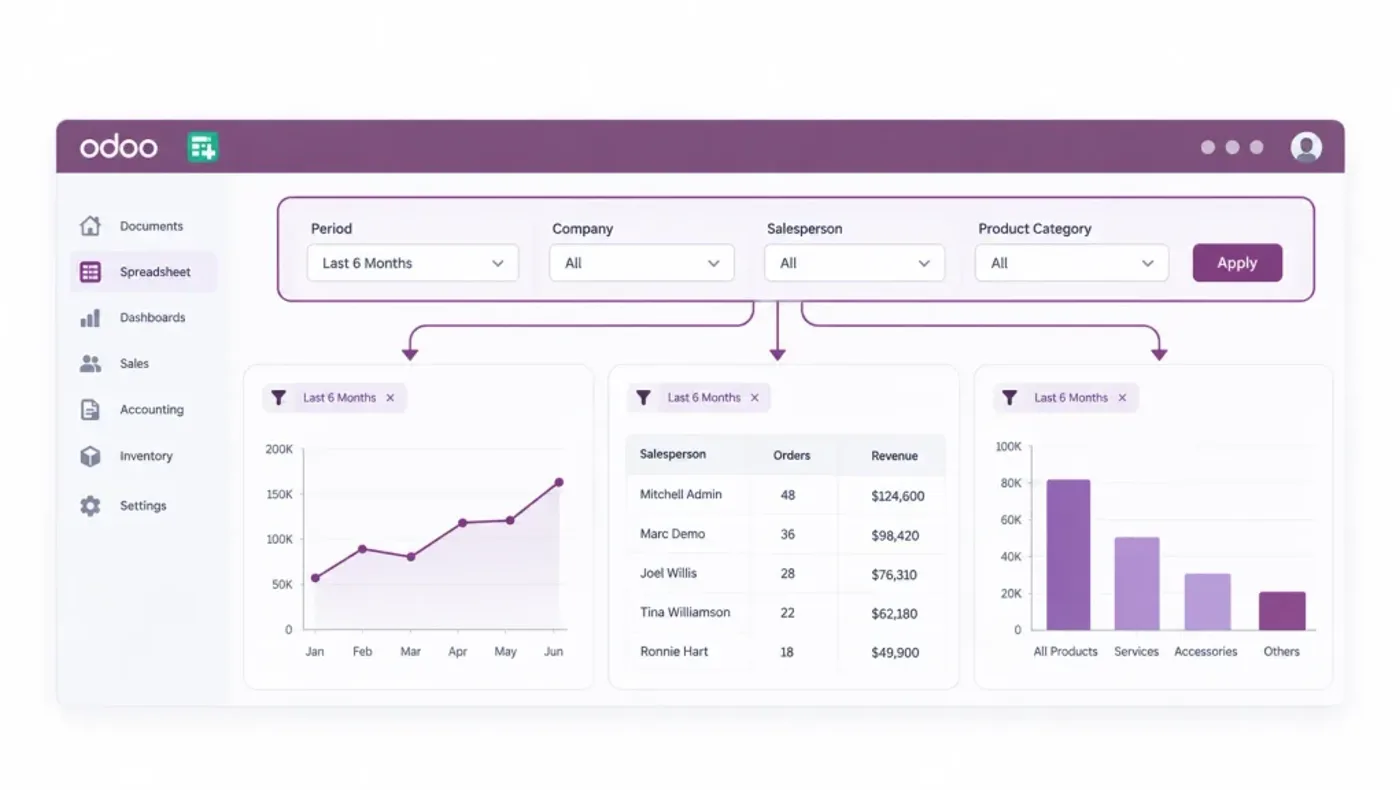
We would rather say this before you buy licences than after. These are the areas where we scope real development, recommend a bolt-on, or tell you another tool is the better answer.
Triggering maintenance on running hours, cycles or output is normal in a CMMS and is not standard in Odoo, which schedules on a calendar frequency. Meters are a build.
Consuming spare parts from stock against a maintenance request is not as direct as it should be, and getting repair cost and store stock both right usually needs this wired deliberately rather than assumed.
Reading vibration, temperature or current from sensors into Odoo is an integration per device, not a feature. Odoo is where the record lives, not where the sensor is read.
A plant technician working in a basement with no signal is not served by a browser form. Where this matters, it is a specific build or a different tool.
Permit-to-work, lock-out tag-out, spare parts kits per machine and criticality-driven planning are CMMS features Odoo does not ship. Some are small builds; some mean a specialist product is the honest answer.
Claiming a repair back under a manufacturer warranty needs its own tracking, and the format differs by supplier.
Implementing An Odoo maintenance management system needs more than installing the application. It should reflect how your business already works, and change only what is worth changing.
Understand how many machines you run, who notices a breakdown first, whether any preventive plan exists today, and whether maintenance cost is currently visible at all.
Settle what counts as equipment, who raises a breakdown, the preventive trigger basis, and how spare parts reach the request before anything is configured.
Set An Odoo maintenance management system up around how you work rather than installing it at its defaults, and build only what configuration genuinely cannot reach. See Odoo customization.
Masters, open items and opening balances prepared and loaded. Data cleaning is scoped explicitly, because it is usually the largest single task. See Odoo migration.
Your team runs real transactions in a test database before go-live, including the awkward cases that never appear in a demonstration.
Role-based training for the people who key transactions daily, then cutover, hypercare and ongoing support and AMC.
We do not publish one price, because the same application costs very differently depending on the factors below. We do publish what moves the number, and the price is fixed in writing before work starts.
We will tell you when Odoo Maintenance is not enough. If you need permit-to-work, meter-based planning and spare kits per machine, that is a CMMS, and saying so at the quotation stage is cheaper for you than finding out in month four.
Product capabilities stated on this page are documented by Odoo. The configuration advice, edition notes and limitations come from our own implementations.
Tell us how many machines you run and whether any preventive plan exists today. Those two answers decide whether this is configuration or culture.